
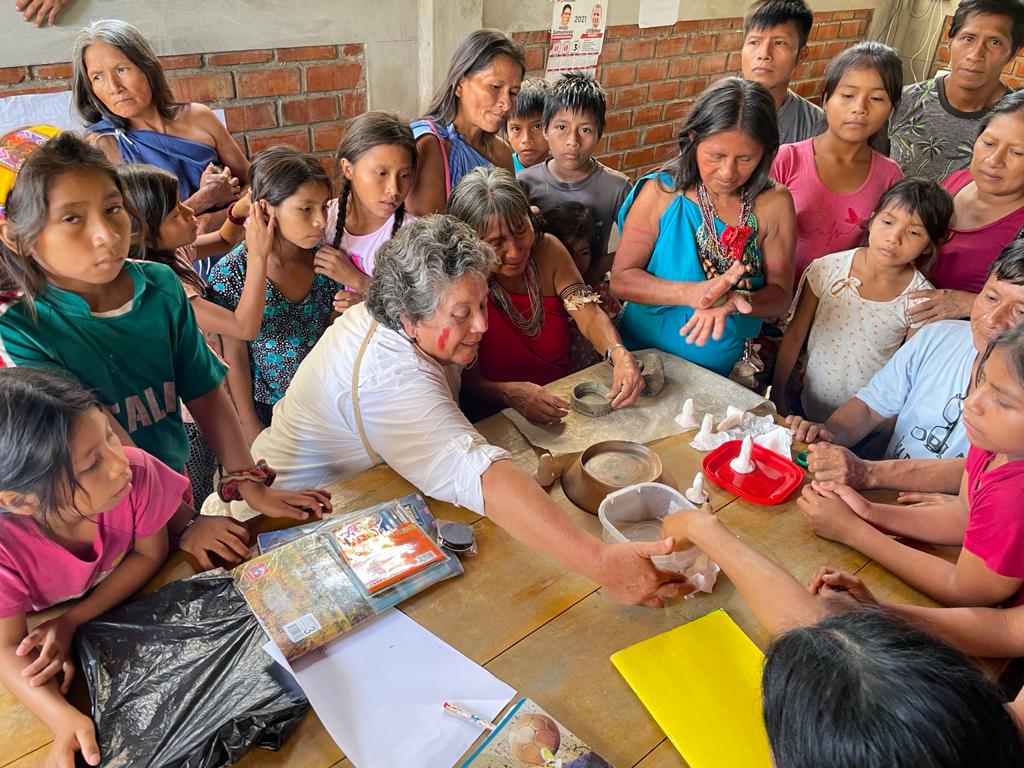
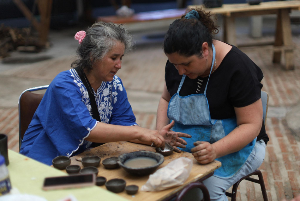
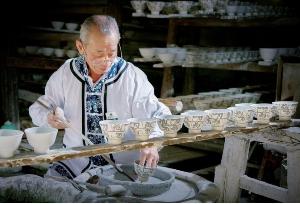
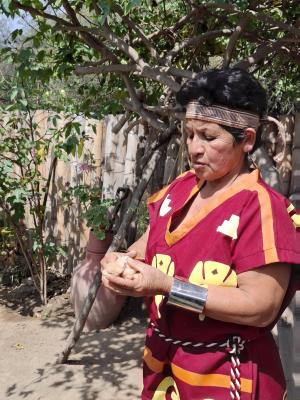
Josefa Nolte's work has brought together actors at different levels, always with the conviction that the community must be the center and the ultimate goal of any cooperative effort. At the local level, she has supported the consolidation of the Cenepa Association of Mothers and Potters as a legitimate and autonomous representative of public institutions, successfully persuading the Municipality of El Cenepa to build a dedicated space for the exhibition and sale of their products. At the national level, she has facilitated the inclusion of Awajún pottery in the country's main museums and cultural spaces, contributing decisively to its recognition as a National Cultural Heritage in 2017 and Intangible Cultural Heritage of Humanity by UNESCO (2021) are the accumulated result of decades of sustained work, and have had the collateral effect of awakening in other Awajún communities the interest in recovering this practice, generating a revitalization movement that transcends Cocoashi.
Josefa Nolte's approach has promoted cultural diversity from a perspective that recognizes Awajún knowledge as a complex, sophisticated, and autonomous form of understanding—not a passive object of study, but a living system in constant evolution. She has supported the Association's formalization processes, produced publications that document and return to the community its own graphic and technical heritage, offered organizational guidance on its internal dynamics, supported literacy training for the ceramic artists of Cocoashi, and advised on the development of new products that innovate from within, without imposing logics foreign to Awajún aesthetics and values.
06-01-2026
| Institutional and human capacities | The efforts to safeguard Awajún pottery have relied primarily on the partnership between Josefa Nolte and the Association of Mother Potters of Cenepa, in a context where state safeguarding plans have historically been insufficient. The declaration as a National Cultural Heritage (2017) and its inscription on UNESCO's Representative List of the Intangible Cultural Heritage of Humanity (2021) are significant institutional achievements that validate decades of work, but the real responsibility for preserving and transmitting this heritage has fallen to the Awajún potters themselves and to those—like Josefa Nolte—who have chosen to accompany them with perseverance, respect, and a vocation of service over time | |
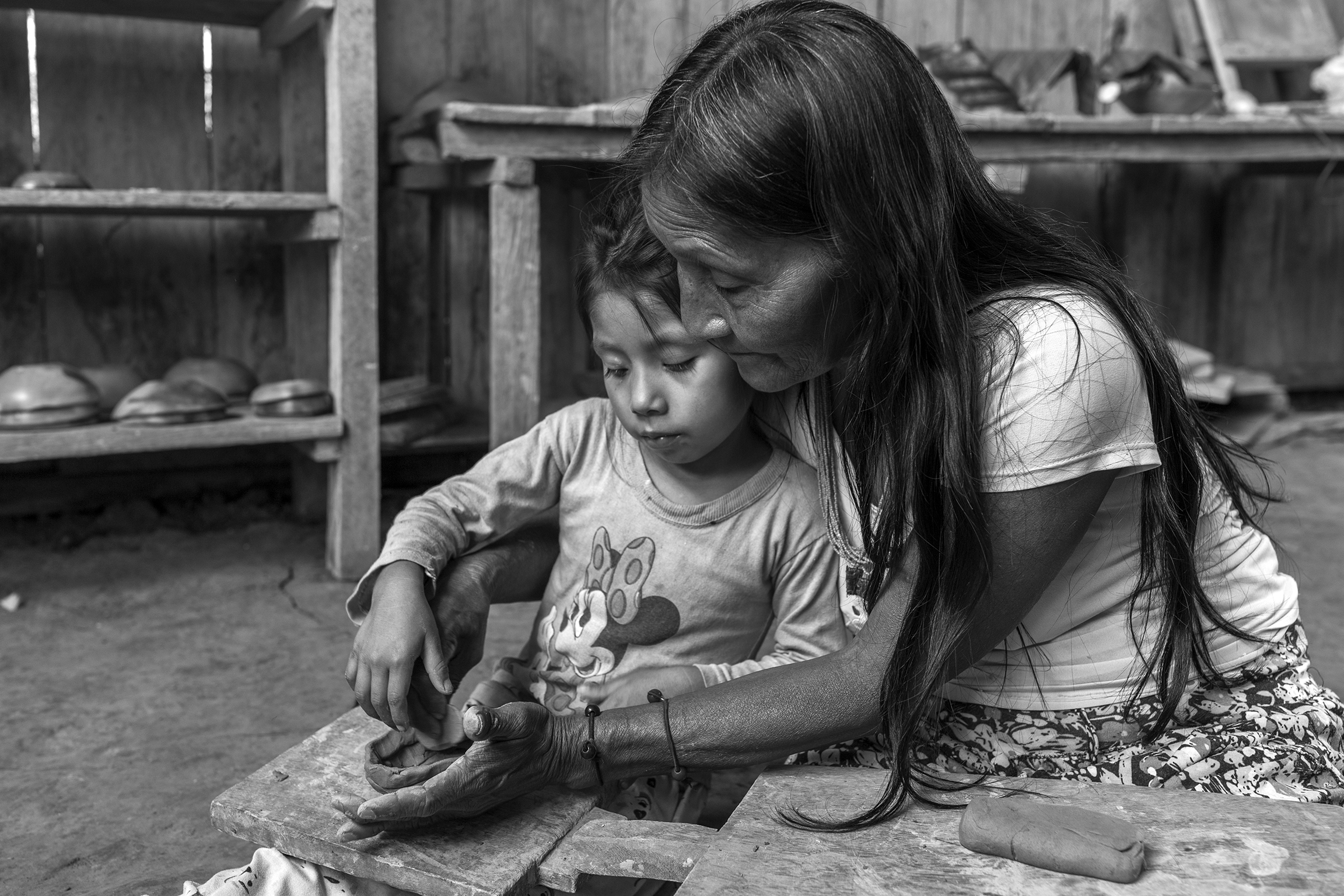
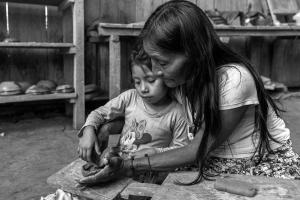
| Transmission and education | The two editions of the Awajún Pottery Manual for Girls (2016 and 2026) are the clearest expression of the philosophy that guides Josefa Nolte's work: building bridges between ancestral knowledge and formal learning spaces, without either one subordinating the other. By linking the pottery production process to the primary education curriculum, the Manual legitimizes, before the formal school system, the knowledge that girls already receive from their mothers in the workshop, simultaneously reinforcing both learning environments. This approach stems from the recognition that the viability of Intangible Cultural Heritage depends on its capacity to integrate naturally into the daily lives of new generations, on their own terms and according to their own logic. Thus, the manual, published in both Awajún and Spanish, is designed for use in Awajún schools themselves, as well as outside the community. | |
| Inventorying and research | Josefa Nolte research about Awajún graphic art—conducted with the permission and active collaboration of the women potters—resulted in publications that are now instruments of memory and transmission for the community itself. Under her guidance, the potters of Cocoashi have innovated in design and product development without abandoning their ancestral visual language, and their sustained participation in fairs and exhibitions has extended its impact to other Awajún communities. In 2026, the second edition of the Awajún Ceramics Manual was published, and a second, expanded edition of Awajún Graphic Art: Geometry of the Universe is in preparation, confirming that this work has no end date. | |
| Policies as well as legal and administrative measures | The efforts to safeguard Awajún pottery have relied primarily on the partnership between Josefa Nolte and the Association of Mother Potters of Cenepa, in a context where state safeguarding plans have historically been insufficient. The declaration as a National Cultural Heritage (2017) and its inscription on UNESCO's Representative List of the Intangible Cultural Heritage of Humanity (2021) are significant institutional achievements that validate decades of work, but the real responsibility for preserving and transmitting this heritage has fallen to the Awajún potters themselves and to those—like Josefa Nolte—who have chosen to accompany them with perseverance, respect, and a vocation of service over time. | |
| Role of intangible cultural heritage and its safeguarding in society | The Association of Ceramic Mothers has taken concrete steps toward increasing economic autonomy. The women have grasped the value of collective capitalization and have decided to allocate 10% of their income to shared expenses, including internet service. Recently, they have taken an even more significant step: directing part of their production toward building a permanent fund to address unforeseen events—such as the wear and tear of solar panels and communication equipment—a particularly relevant provision in Cocoashi, a community without electricity or conventional telephone service. This process of autonomous decision-making regarding the allocation of collective resources is one of the most eloquent expressions of their organizational maturity. The acquisition of goods for collective use—sound equipment, internet access, communal lunches financed by the association itself—reflects an understanding of sustainability that extends beyond the economic sphere to encompass quality of life and the social fabric of the community. | |
| Awareness raising | At the regional and national levels, sustainability means that the general public recognizes Awajún ceramic products and identifies the Awajún people as an Indigenous people who possess profound knowledge about nature and their environment. That a remote Amazonian community is now recognized as a guardian of an Intangible Cultural Heritage of Humanity is the result of a long and patient process in which the respectful visibility of their knowledge has transformed external perceptions, creating conditions for that recognition to translate into demand, dignity, and continuity. | |
| Engagement of communities, groups and individuals as well as other stakeholders | Josefa Nolte's understanding that safeguarding cultural heritage cannot be separated from the holistic well-being of those who sustain it has led her to accompany the community beyond the formal spheres of research and promotion. She has supported the literacy process for the women potters of Cocoashi, offered accounting advice to ensure the sustainability of their formalization, and collaborated in the operation of the community's primary school by providing materials and books. These actions, seemingly far removed from ICH in the strict sense, are an essential part of this accompaniment who understands the Awajún ceramicists as whole subjects whose autonomy and well-being are a condition for the continuity of their practice. | |
| International engagement | The first edition of the book Grafica awajun: geometria del universo is already sold. This book has been sold in different countries of America and Europe. Some of the books were sold with an awajun ceramic. | |
| References |
|
|












.jpeg)


.png)



.jpeg)
.jpg)

.png)
.jpg)


_(31711258567).jpg)