
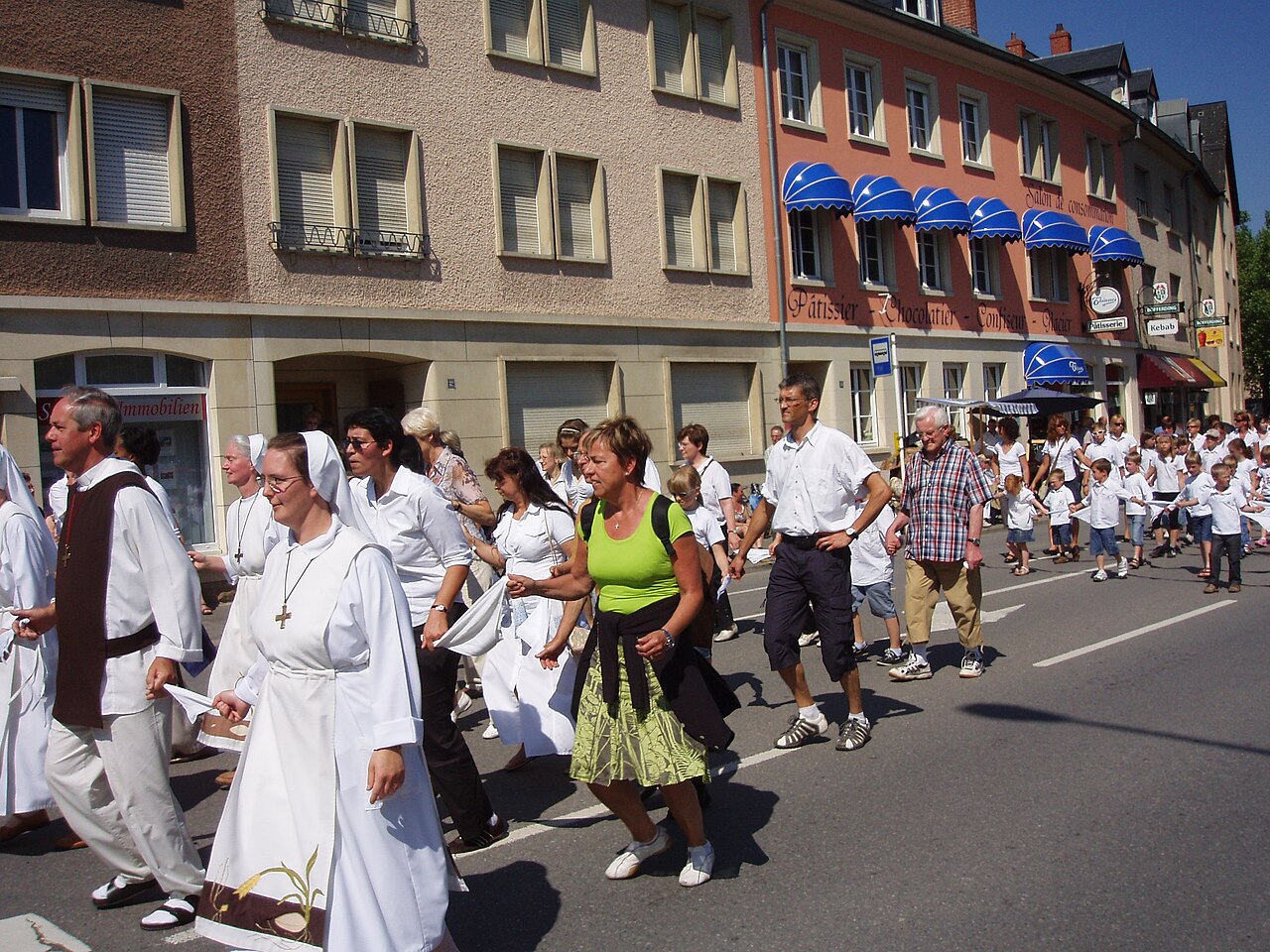
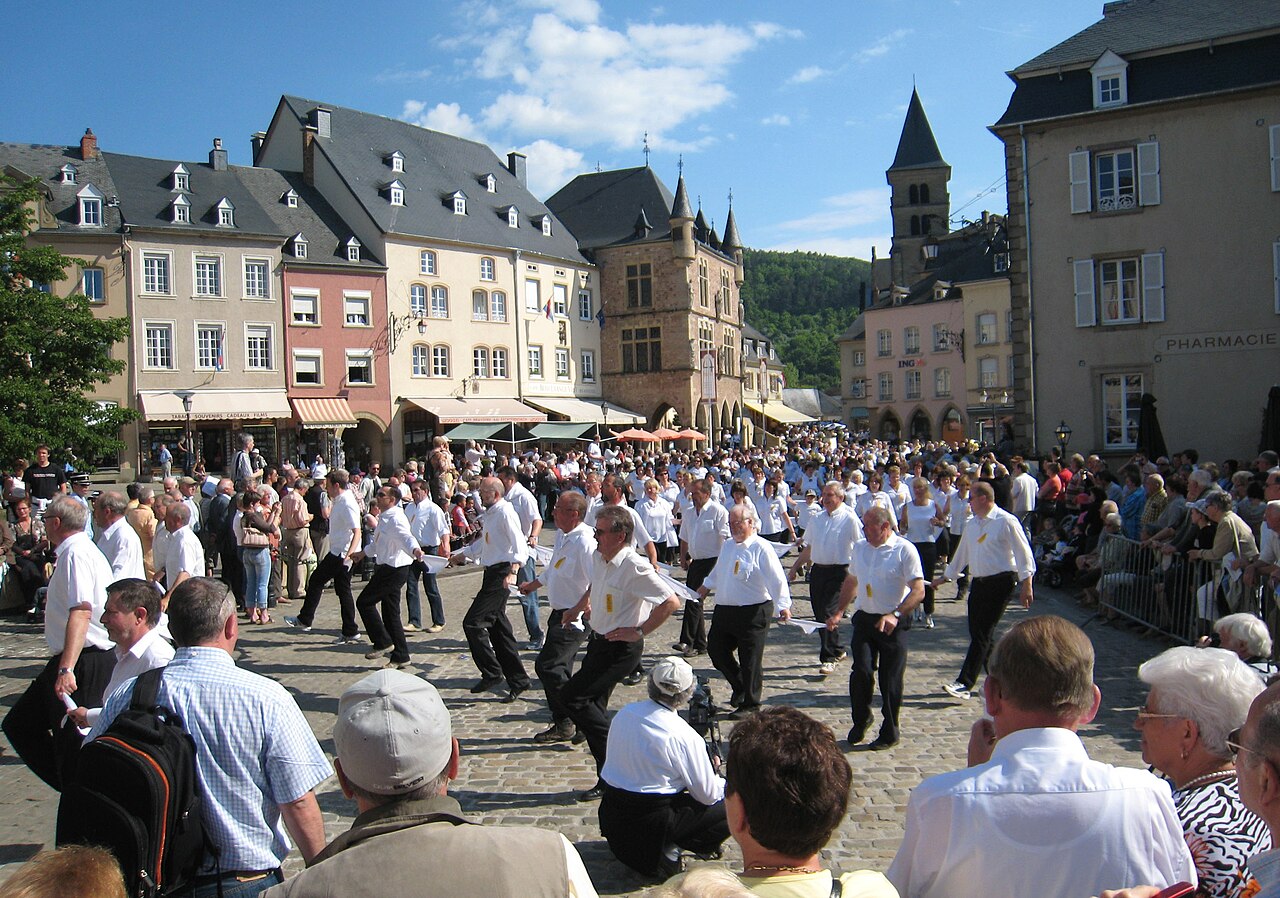
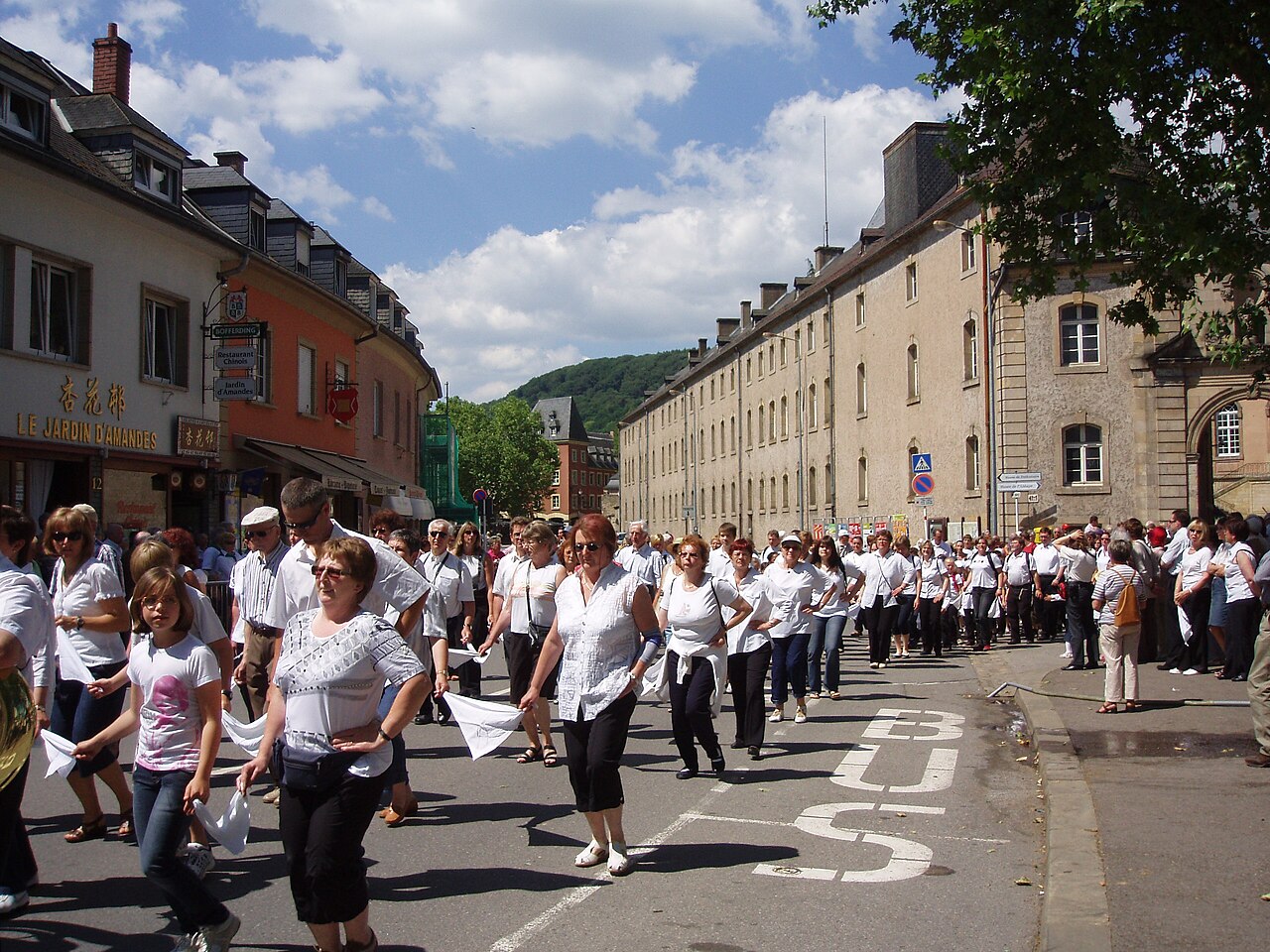
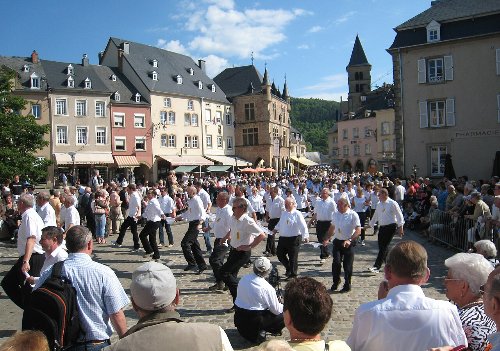
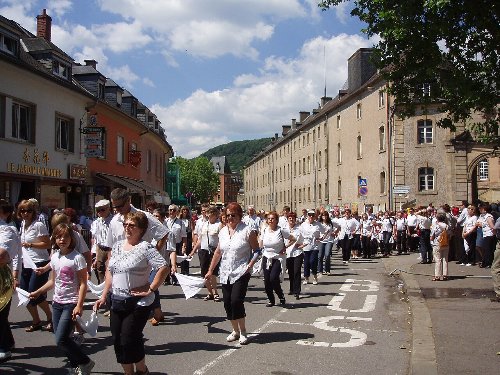
The Hopping Procession of Echternach (Iechternacher Sprangprëssioun) takes place each year on the Tuesday of Pentecost in the medieval town centre of Echternach, Luxembourg. The procession is a religious practice centred on Saint Willibrord, founder of the Abbey of Echternach, and combines prayer, liturgical songs, music and a distinctive form of group dancing. The procession begins at the former abbey with the singing of litanies dedicated to Saint Willibrord and proceeds through the town before ending at the basilica. The tradition has been documented since at least the early medieval period.
Dancers move forward in rows while holding handkerchiefs, following a traditional melody performed by accompanying musical groups. The procession brings together dancers, singers, musicians, worshippers and individual pilgrims. In its contemporary form, the practice remains a religious event while also functioning as a major annual gathering for the local community and pilgrims from Luxembourg and neighbouring regions.
11-27-2026
| Institutional and human capacities | The procession is organized by the Oeuvre Saint-Willibrord, the association responsible for maintaining and organizing the practice. Its work includes coordinating participating groups, musicians, pilgrims and the practical organization of the procession. Civil and religious authorities also support the event, reflecting the close relationship between the procession, the town of Echternach and the religious institutions associated with Saint Willibrord. The tradition depends on a broad network of participants rather than on a small group of specialized practitioners. Dancers learn the movement through participation in organized groups, while singers, musicians, worshippers and pilgrims contribute different roles to the event. Groups from Luxembourg and neighbouring regions regularly participate, allowing the procession to function as a shared religious and cultural practice extending beyond Echternach itself. | |
| Transmission and education | The procession is transmitted from generation to generation through participation in the event and through the continued involvement of local families, associations, religious communities and participating groups. UNESCO identifies this intergenerational transmission as one of the defining characteristics of the tradition and links it directly to the sense of identity and continuity experienced by participants and observers. Transmission also takes place through educational and religious contexts. Luxembourg's safeguarding framework has included the procession in school programmes, while primary-school children in Echternach receive specific instruction related to the procession. Religious education also contributes to transmitting knowledge of traditions such as the Echternach procession. | |
| Inventorying and research | The Hopping Procession of Echternach was included in Luxembourg's national inventory of intangible cultural heritage in 2008, when the country's first group of ICH elements was established. The inventory was developed by the Luxembourg National Commission for Cooperation with UNESCO and is maintained and updated through research and information provided by the local societies that sustain the traditions. The procession was subsequently documented extensively in UNESCO's 2010 nomination file, which records its history, organization, ritual sequence, community involvement and safeguarding measures. The nomination also incorporated the national inventory documentation and evidence of community consent. | |
| Policies as well as legal and administrative measures | The procession has been formally recognized within Luxembourg's national intangible cultural heritage framework since 2008 and was inscribed on UNESCO's Representative List in 2010. The UNESCO nomination was prepared with the participation of the civic authorities and the Oeuvre Saint-Willibrord, whose free, prior and informed consent was documented. Safeguarding measures identified during the nomination included the establishment of an abbey museum and a documentation center, together with continued support from the community and the State. Luxembourg's national approach also places the procession within a broader system of inventorying, education and public awareness concerning intangible cultural heritage. | |
| Role of intangible cultural heritage and its safeguarding in society | The procession provides a collective expression of religious devotion centered on Saint Willibrord while reinforcing connections between participants, the town and the wider region. Its continuation across generations gives participants and observers a sense of identity and continuity, a role specifically recognized by the UNESCO Committee when it assessed the element for inscription. The practice also creates a space in which religious, social and cultural participation intersect. People can take part as dancers, singers, musicians, worshippers or individual pilgrims, while the annual gathering brings together local residents and participants from neighboring areas. Its continued popularity demonstrates that the procession remains a living practice despite broader processes of secularization. | |
| Awareness raising | The procession's annual presence in the streets of Echternach makes it highly visible to both participants and spectators. Its public character allows the practice to be experienced directly rather than only through religious or archival documentation. The Luxembourg government and cultural institutions have also used the procession in public-awareness activities concerning intangible cultural heritage. UNESCO inscription has provided an additional international platform for presenting the procession as living heritage. During the COVID-19 pandemic, when the traditional event could not take place normally, Luxembourg's Ministry of Culture and the Luxembourg Commission for UNESCO organized a digital presentation involving photographs, videos, online tours and contributions from the public, demonstrating an effort to maintain awareness of the tradition even when physical participation was impossible. | |
| Engagement of communities, groups and individuals as well as other stakeholders | Community participation is integral to the procession. The UNESCO nomination involved the civic authorities and Oeuvre Saint-Willibrord, while the practice itself depends on the continuing participation of dancers, singers, musicians, worshippers and pilgrims. The organizers allow individuals to participate without registration and provide opportunities for larger established groups and musical societies to join the procession through advance registration. The openness of participation helps maintain the procession as a community practice rather than a staged performance. New groups and musical societies continue to be welcomed, while established groups return annually. This combination of organized continuity and broad participation allows the tradition to remain rooted in Echternach while incorporating pilgrims from Luxembourg and neighbouring regions. | |
| International engagement | The Hopping Procession of Echternach was inscribed on the UNESCO Representative List of the Intangible Cultural Heritage of Humanity in 2010, under nomination file No. 00392 and Decision 5.COM 6.27. The inscription recognized the procession's strong connection to the Echternach community, its intergenerational transmission, its community participation and Luxembourg's safeguarding commitments. The procession also has an international dimension through the participation of pilgrims and groups from neighboring regions and countries. Its annual gathering brings together people who arrive in Echternach specifically to participate in the religious and cultural practice, while its UNESCO recognition has placed a locally rooted tradition within the wider international framework of intangible cultural heritage safeguarding. | |
| References | Documentary Sources
Photographic Credits
|
|