
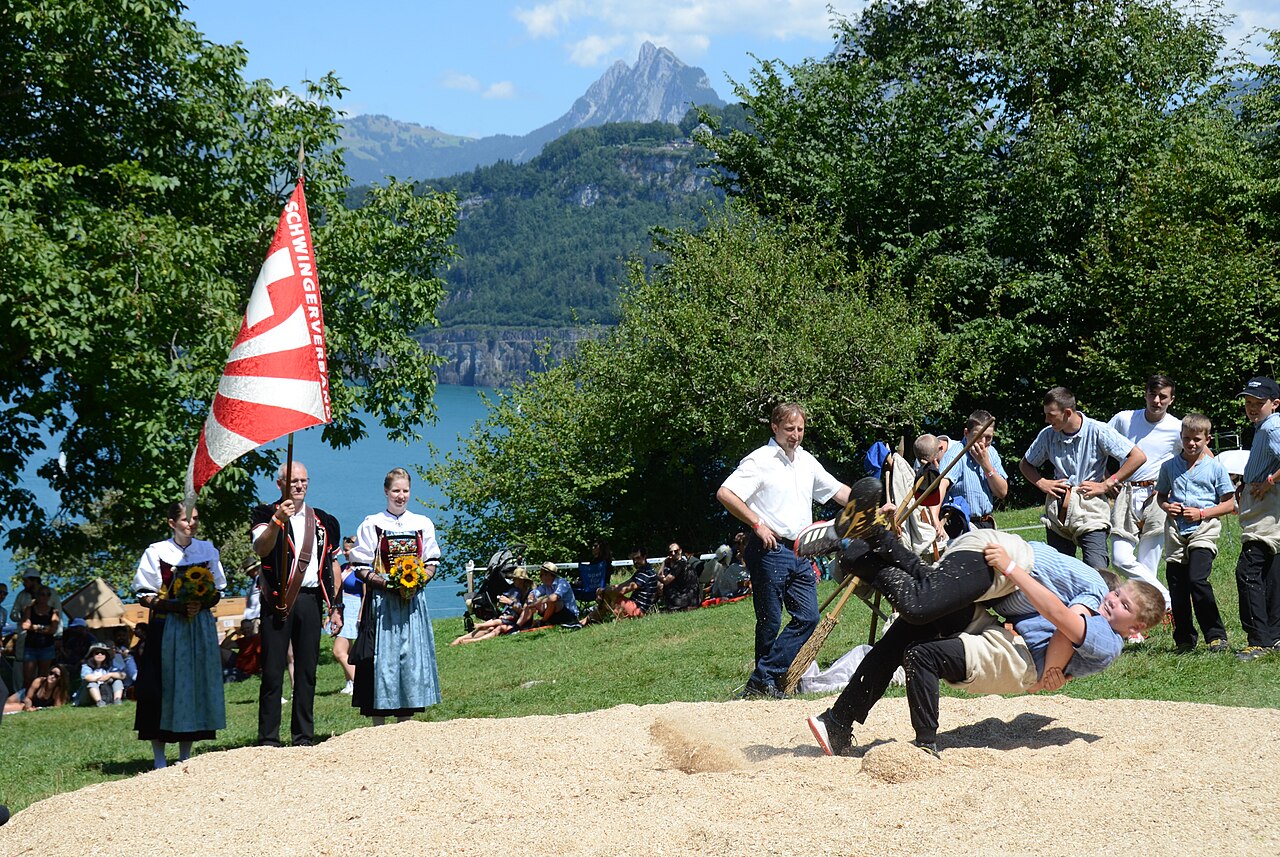
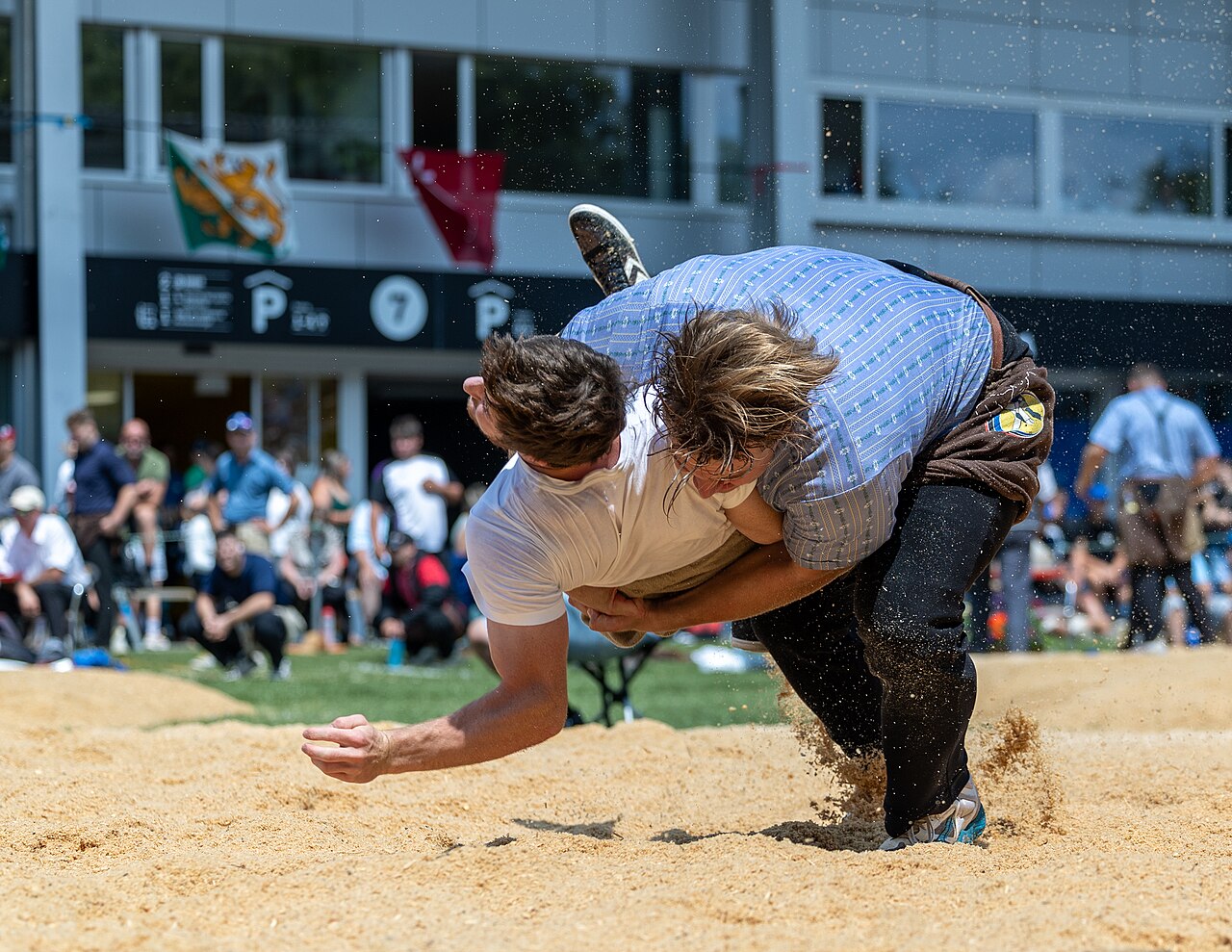
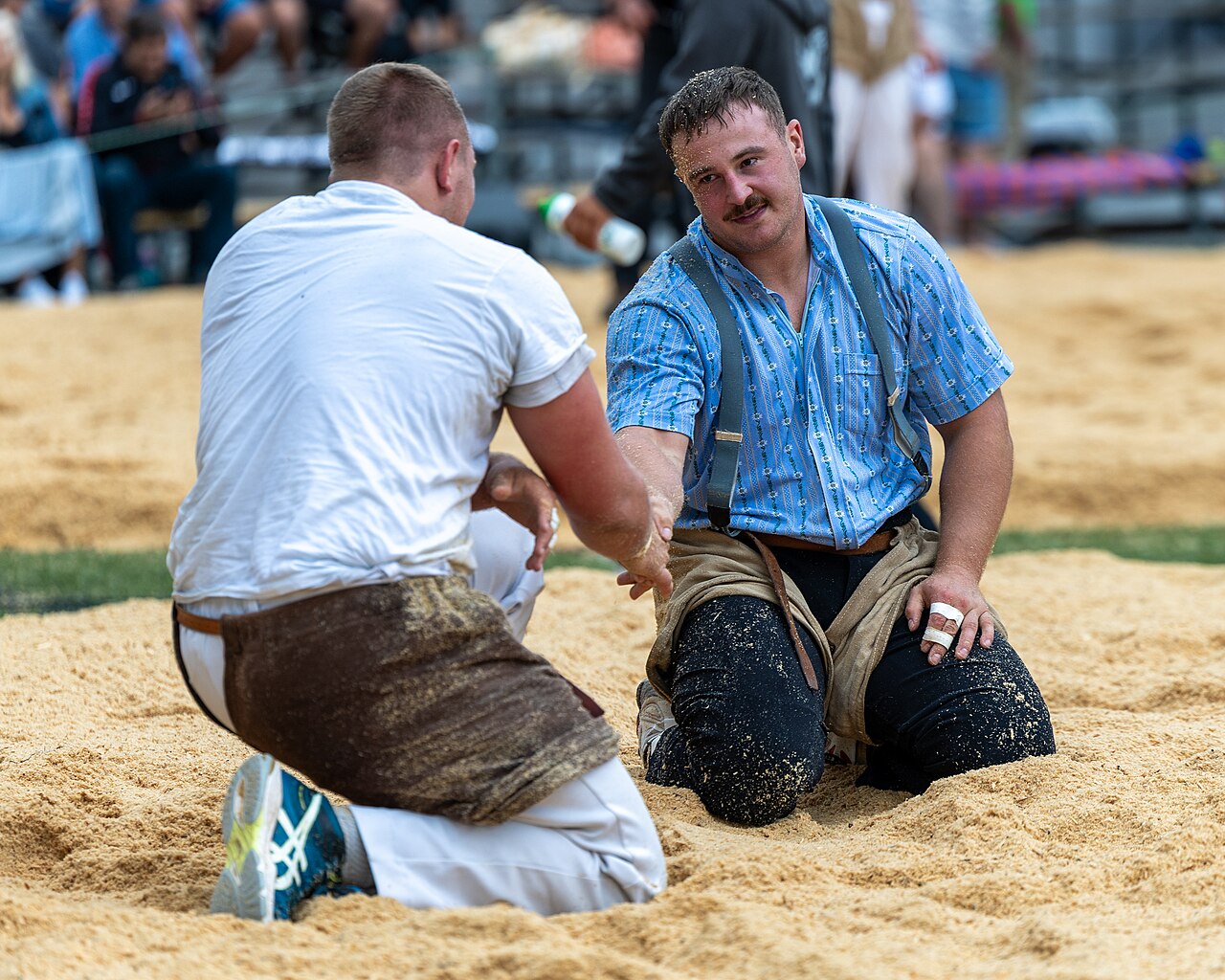
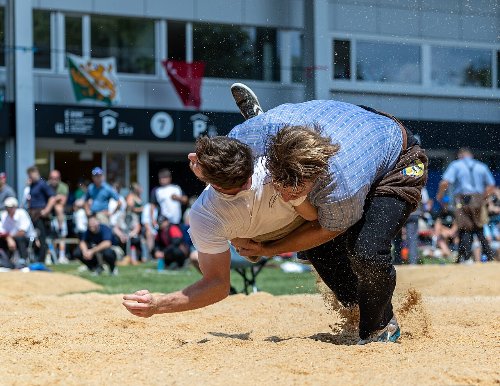
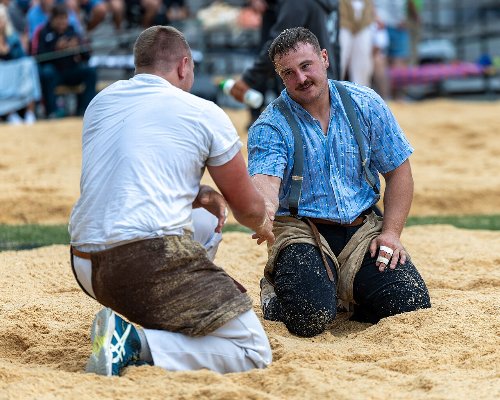
Schwingen is a traditional Swiss form of wrestling practiced in a circular ring covered with sawdust. Two opponents grasp the back of one another's special wrestling shorts and attempt to bring their opponent to the ground using established holds and footwork. A bout begins and ends with a handshake, and the winner traditionally brushes the sawdust from the loser's back, expressing the mutual respect that accompanies the contest. Although historically associated mainly with men, women and girls increasingly participate in the practice.
The practice is closely connected to Schwingfeste, or wrestling festivals, which have developed from local rural gatherings into major public events. Competitions remain the central setting in which the techniques, rules, clothing and etiquette of Schwingen are collectively practiced and displayed.
11-25-2026
| Institutional and human capacities | The principal bearers are the Schwinger, who acquire the techniques, rules and etiquette of the practice through participation in clubs and competitions. Wrestling associations provide an important organizational framework, including the Swiss Wrestling Association and the Swiss Women's Wrestling Association. The national inventory records more than 60,000 members of the Swiss Alpine Wrestling Association in 2017. The tradition is also sustained by the wider network surrounding wrestling festivals: clubs, associations, organizers, spectators and families. Together they maintain the social environment in which Schwingen is practiced not only as physical competition but as a recognized form of Swiss community life. | |
| Transmission and education | Knowledge of Schwingen is transmitted primarily through practical participation in wrestling clubs and competitions. Young practitioners learn established grips, movements, rules and forms of conduct through training and interaction with more experienced wrestlers. The increasing participation of women and girls demonstrates that transmission is also adapting to a changing community of practitioners. The transmission of the tradition therefore involves more than technical wrestling ability. Handshaking, respect for opponents and the ritual of brushing sawdust from a defeated wrestler form part of the learned social code of the practice. | |
| Inventorying and research | Schwingen is included in Switzerland's List of Living Traditions, the country's national inventory of intangible cultural heritage. The inventory was first established in 2012 and updated in 2023; it currently documents 228 significant living traditions through written, visual and audiovisual materials. The dedicated Schwingen inventory entry documents the practice's characteristics, historical development, geographical presence, associated traditions and institutional contacts. Its documentation also includes photographs of competitions and women's and girls' wrestling festivals, demonstrating the practice through contemporary examples. | |
| Policies as well as legal and administrative measures | Switzerland's national inventory provides an official framework for recognizing and documenting Schwingen as living intangible cultural heritage. The Federal Office of Culture coordinates the inventory together with the cantons, while proposals can also originate from the population and final selections are approved by the cantons. This recognition does not turn Schwingen into a fixed historical practice. The inventory itself emphasizes that living traditions evolve, and the development of women's participation and the transformation of local contests into major public festivals illustrate this continuing adaptation. | |
| Role of intangible cultural heritage and its safeguarding in society | Schwingen combines physical competition with a distinctive code of respect. The handshake before and after a bout and the obligation of the winner to remove sawdust from the loser's back turn victory into a socially regulated encounter rather than simply a contest of strength. The tradition also contributes to a sense of Swiss cultural identity. Its historical development from contests among farmers and herders into a widely practiced national sport demonstrates how a local practice can acquire broader social significance while retaining recognizable techniques, clothing and customs. | |
| Awareness raising | Wrestling festivals have become important public occasions through which Schwingen reaches audiences beyond individual clubs. Events that were once local gatherings have developed into large-scale sporting and cultural festivals, attracting substantial numbers of spectators. Contemporary events such as the Fête Romande de Lutte Suisse provide further settings in which the practice is made visible through live competition. Such events allow the techniques, clothing, rules and social etiquette of Schwingen to be encountered directly by new generations and wider audiences. | |
| Engagement of communities, groups and individuals as well as other stakeholders | Community engagement is fundamental to Schwingen. Wrestlers participate through clubs and competitions, while families, spectators and local organizers contribute to the festivals in which the practice takes place. The growing participation of women and girls has further broadened the community of practitioners. The tradition's continued vitality is therefore visible not simply in the existence of competitions but in the networks of people who train, organize, attend and participate in them. Its social character is reinforced through repeated gatherings where sporting practice and community interaction take place together. | |
| International engagement | Unlike several Swiss traditions currently inscribed on UNESCO's Intangible Cultural Heritage lists, Schwingen is not currently inscribed on a UNESCO list. It is instead recognized within Switzerland's national inventory of living traditions. Its principal international dimension lies in the visibility of Swiss cultural heritage through major wrestling festivals and the documentation of the tradition within Switzerland's national ICH framework. At the same time, its continued development as a contemporary practice demonstrates how national traditions can remain locally rooted while participating in wider cultural and sporting exchanges. | |
| References | Documentary Sources
Photographic Credits
|
|