
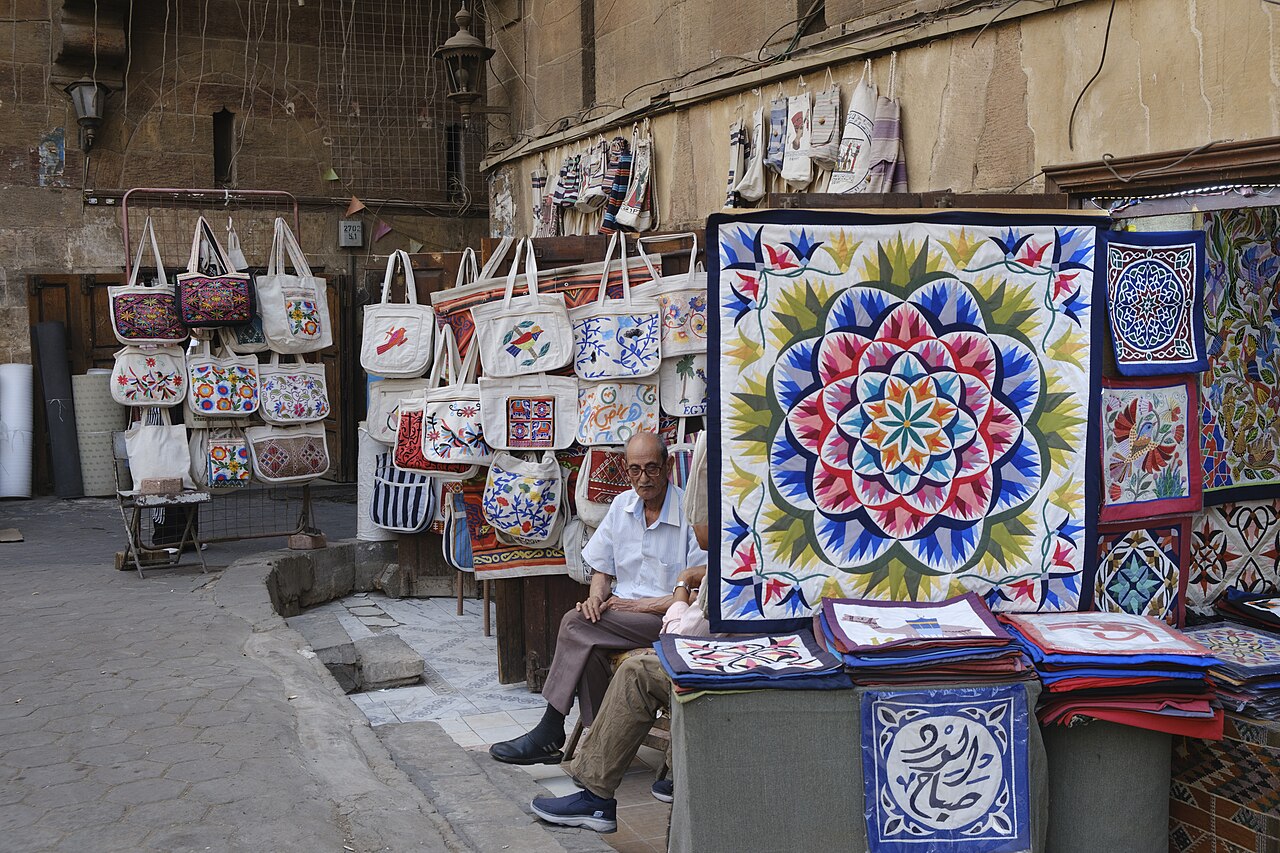
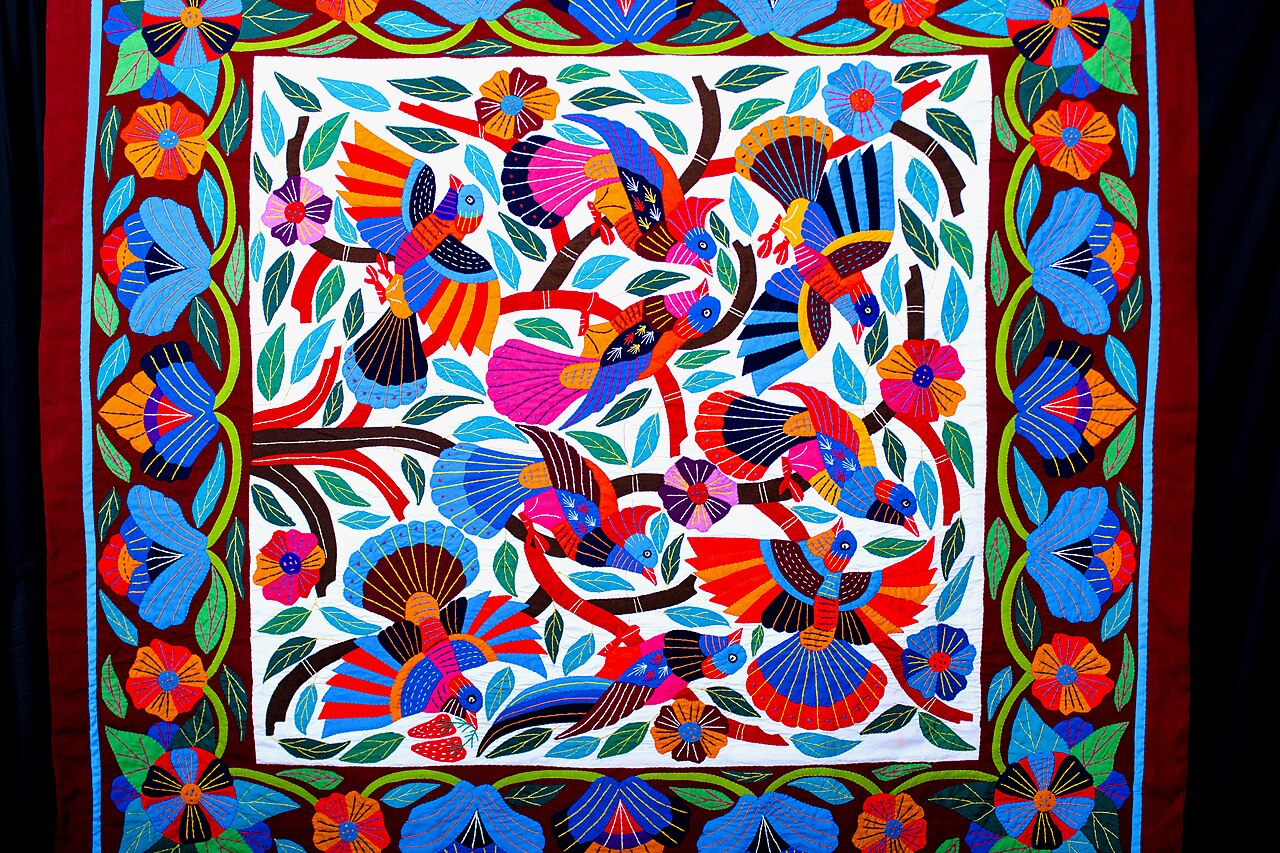
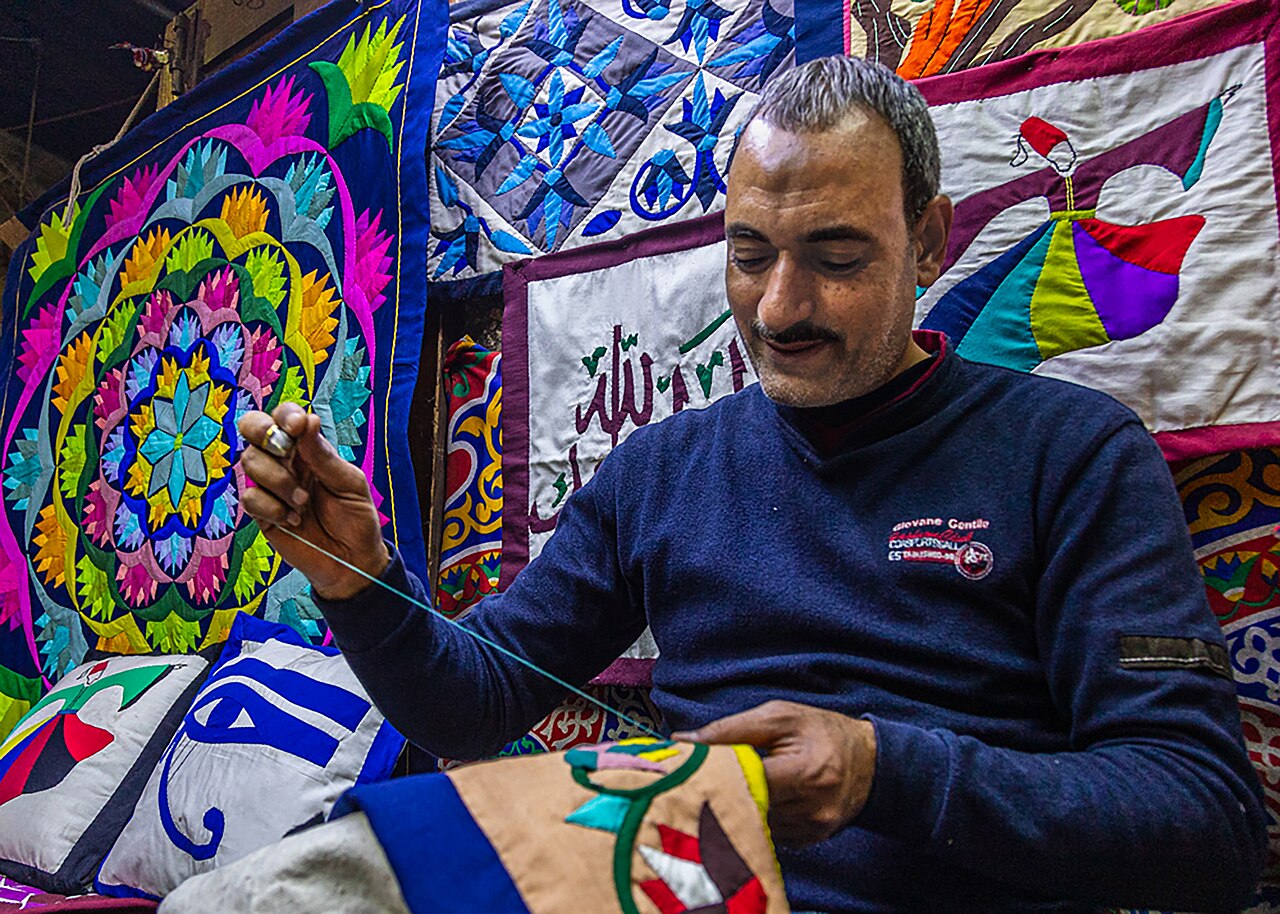
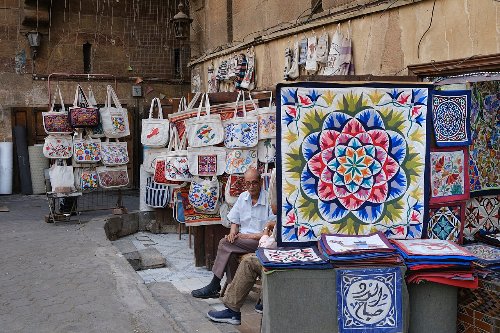
Khayamiya is a traditional Egyptian appliqué craft in which pieces of coloured fabric are cut and hand-stitched onto a textile base to create geometric, floral, figurative and other decorative compositions. Historically associated with the production and decoration of tents and ceremonial canopies, the craft continues in Historic Cairo, particularly around Khayamiya Street in the Al-Darb al-Ahmar area. The craft's Egyptian name is recorded in the Egyptian Archive of Folk Life and Folk Traditions, where it is classified among skills related to traditional arts and crafts.
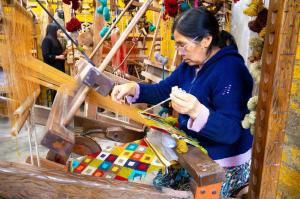
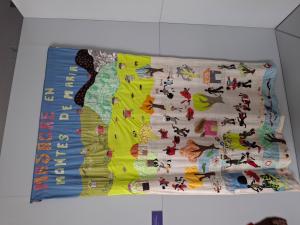
The practice encompasses more than the finished textile. It involves selecting and preparing fabrics, cutting appliqué pieces, arranging patterns and securing them through precise hand stitching. Contemporary Khayamiya includes wall hangings and other decorative and functional textiles alongside the larger tent textiles for which the craft historically became known. The craft remains closely associated with the workshops and marketplace of Khayamiya Street, where production, display and sale continue to take place.
11-11-2026
| Institutional and human capacities | The principal bearers of Khayamiya are specialist craftspeople who maintain the practical knowledge required to cut, position and stitch appliqué textiles. The Egyptian Archive's 2013 inventory identifies the concerned community as professional practitioners and records field collection in several Egyptian locations, including Al-Ghuriya and Souq al-Silah in Cairo. Institutional support has expanded through documentation and safeguarding initiatives. The Egyptian Society for Folk Traditions (ESFT), Cairo Governorate and other cultural actors have worked with craftspeople to document traditional crafts in Historic Cairo. A UNESCO-supported project trained practitioners in inventorying and documented traditional craftsmanship, while a subsequent safeguarding programme involved 46 craftspeople and 15 young volunteers across 30 crafts, including Khayamiya. | |
| Transmission and education | Khayamiya knowledge has traditionally been transmitted through practical work in workshops, where skills are learned through observation and participation. The continuity of the craft therefore depends strongly on access to experienced practitioners and opportunities for younger people to work alongside them. Research on Historic Cairo's traditional crafts has noted that many of these techniques are transmitted from one generation to another rather than primarily through written manuals. Recent safeguarding activities have introduced more structured opportunities for transmission. In the UNESCO-supported Historic Cairo project, 15 young participants took part in apprenticeship workshops with experienced craftspeople. These included storytelling, practical sessions and artistic activities intended to connect younger participants with traditional craft knowledge. | |
| Inventorying and research | Khayamiya has been documented through Egypt's national folk-life inventory as الخيامية (Khayamiya), inventory code ESFT 70/2013. The record identifies professional practitioners as the concerned community and documents field collection undertaken in Cairo and other Egyptian locations between 2009 and 2012. This provides an established Egyptian inventory record predating the later UNESCO-supported Historic Cairo project. A separate community-based inventorying initiative was implemented by the Egyptian Society for Folk Traditions between 2021 and 2023 with support from the UNESCO 2003 Convention. The project initially focused on 20 traditional crafts in the core of Historic Cairo and examined workshops, tools, materials, traditional skills and knowledge. The later documentation reported 30 crafts, including Khayamiya tentmaking. Practitioners were trained in inventory methods and multimedia documentation, while young participants were involved in field activities and apprenticeships. | |
| Policies as well as legal and administrative measures | Khayamiya is safeguarded within Egypt's wider framework for intangible cultural heritage and through cultural initiatives directed toward traditional crafts in Historic Cairo. The craft is not a separate UNESCO Representative List element; rather, it has been included in Egyptian inventorying and in UNESCO-supported safeguarding work concerning the living crafts of Historic Cairo. Current local measures also connect the safeguarding of Khayamiya with the preservation of its historic production environment. In 2026, Cairo Governorate began restoration and rehabilitation work at the historic Khayamiya Market in Qasabat Radwan Bey, with the stated aim of preserving traditional craft activity, supporting artisans' livelihoods and ensuring transmission to future generations. The project is being implemented with support from the Aga Khan Foundation for Culture–Egypt and the ALIPH Foundation. | |
| Role of intangible cultural heritage and its safeguarding in society | Khayamiya links craftsmanship with the social and cultural life of Cairo. Historically, tent textiles and ceremonial canopies were associated with gatherings and occasions requiring decorated temporary spaces. Contemporary Khayamiya has expanded into decorative and functional textiles while retaining its connection with Egyptian visual culture and the historic craft districts of Cairo. The craft also contributes to the continuity of Historic Cairo as a living urban environment. Khayamiya Street is not only a location where finished products are sold; workshops continue to combine production, craft knowledge and economic activity. The continued presence of artisans therefore connects cultural safeguarding with livelihoods and the maintenance of a distinctive craft-based urban identity. | |
| Awareness raising | Public exhibitions have been an important means of presenting Khayamiya to wider audiences. The UNESCO-supported safeguarding programme organised six exhibitions during 2022 and 2023 at Cairo Governorate premises, allowing participating artisans to display their products while raising awareness among civil society, young people and public officials. Contemporary exhibitions have also provided opportunities to demonstrate how Khayamiya can remain relevant while retaining its hand-appliqué techniques. Exhibitions in Cairo have brought traditional craftspeople together with contemporary designers and have presented new applications of Khayamiya alongside established forms of the craft. | |
| Engagement of communities, groups and individuals as well as other stakeholders | Community participation is central to recent documentation of Khayamiya. The Historic Cairo inventory project was explicitly designed as a community-based inventory, involving practitioners, local authorities, governmental and non-governmental organisations and other actors concerned with traditional craftsmanship. Craftspeople were trained to participate directly in inventorying their own practices and knowledge. The project also sought to connect documentation with the continued practice of the craft. Experienced artisans participated in training younger people, while exhibitions provided opportunities for craftspeople to present their work and maintain links with the wider public. The approach therefore treated practitioners as active participants in safeguarding rather than simply as subjects of documentation. | |
| International engagement | Khayamiya has participated in international heritage engagement primarily through community-based inventorying and safeguarding under the framework of the UNESCO 2003 Convention. The Historic Cairo inventory project received US$86,950 in International Assistance and was implemented from August 2021 to September 2023 by the Egyptian Society for Folk Traditions. The project connected Egyptian craftspeople and local institutions with the international safeguarding framework while keeping the documentation and transmission activities rooted in Historic Cairo. Khayamiya therefore represents an example of international heritage cooperation supporting a living craft without requiring the practice itself to be separately inscribed on a UNESCO list. | |
| References | Documentary Sources
Photographic Credits
|
|









.jpeg)



.png)






.jpeg)
.jpg)



.png)
.jpg)