
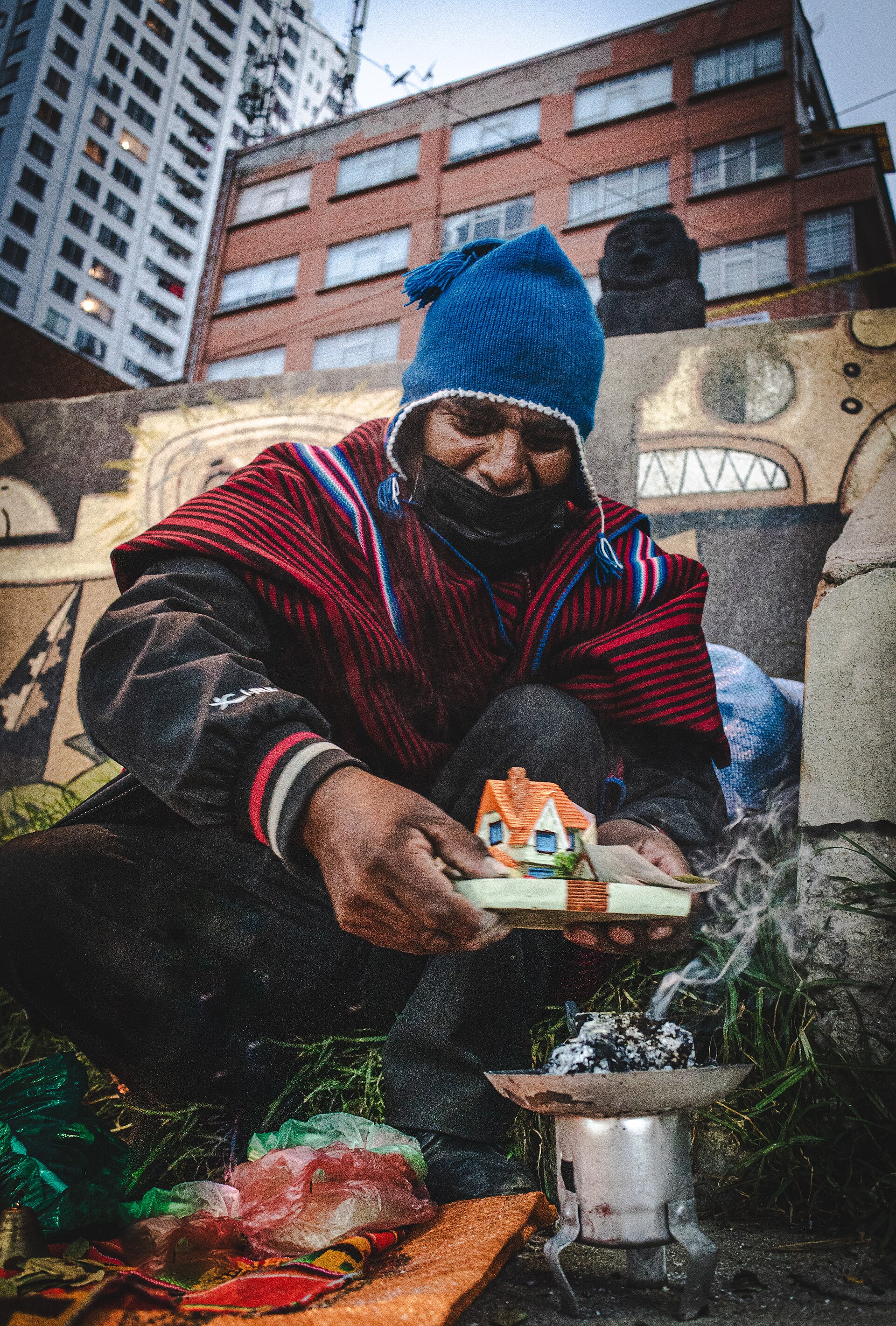

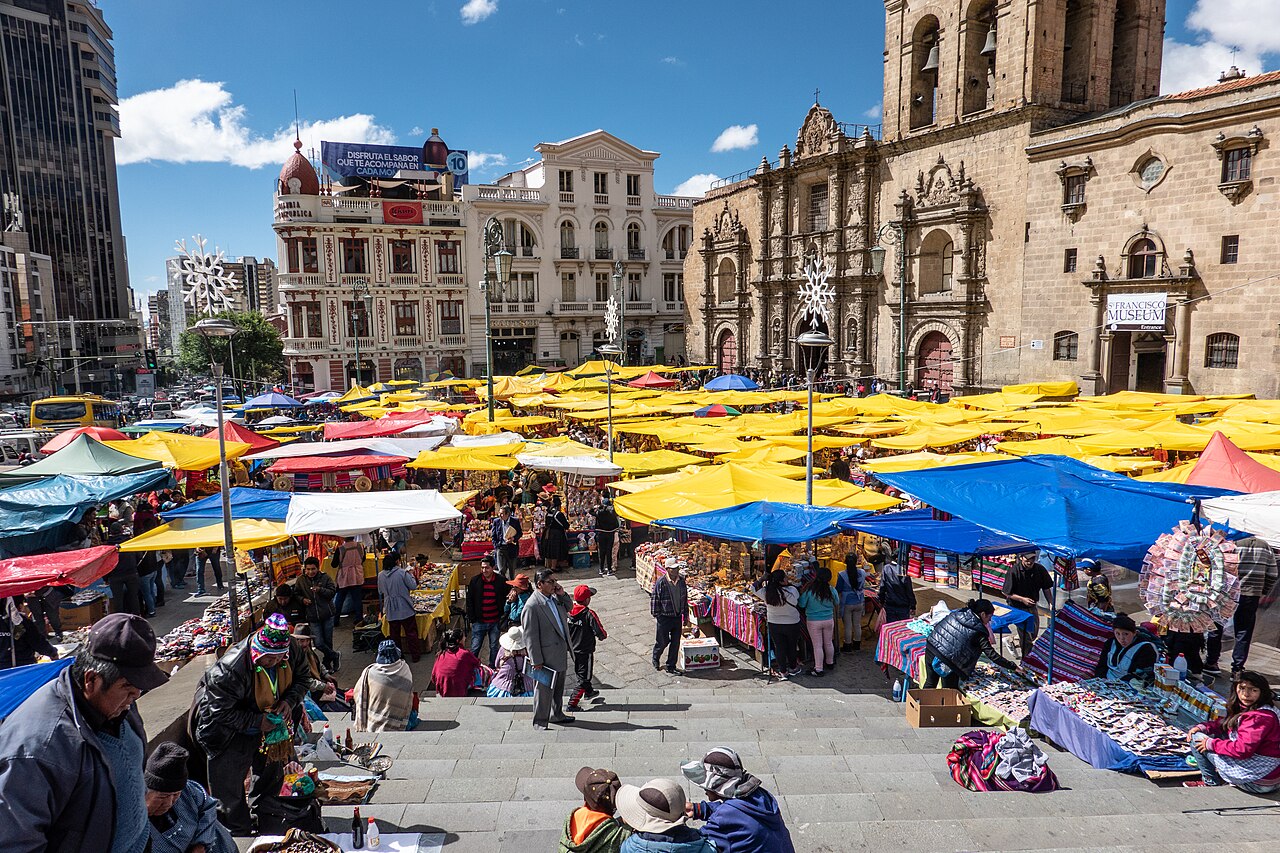
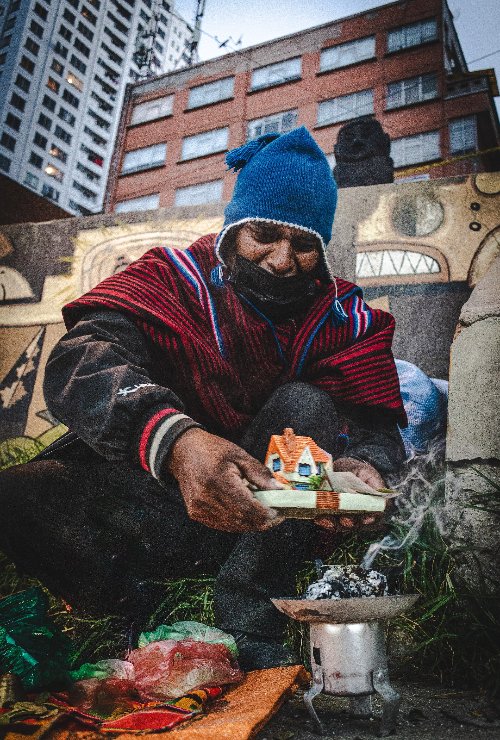
Alasita is a living urban Andean tradition in La Paz centred on the acquisition, preparation and ritual activation of miniature objects representing people's wishes and aspirations. The principal ritual cycle begins on 24 January and continues for several weeks. Participants acquire miniature houses, vehicles, money, food, university degrees, businesses, travel documents and other objects corresponding to desired forms of prosperity. The miniatures are associated with the Ekeko, an Andean figure connected with abundance and fertility, and are subsequently consecrated through Andean ritual practices or blessed within Catholic settings. UNESCO inscribed the element as “Ritual journeys in La Paz during Alasita” on the Representative List in 2017.
The practice is not defined by a single ritual route or uniform procedure. Individuals and families construct their own journeys through the search for particular miniatures, their acquisition, exchange or donation, and their subsequent ritual treatment. Miniatures can also symbolically represent the payment of debts or fulfilment of obligations. This combination of objects, belief, movement, exchange and ritual creates a tradition in which material craftsmanship and spiritual meaning are closely connected.
11-11-2026
| Institutional and human capacities | The continuity of Alasita depends on several groups whose knowledge and activities intersect during the annual cycle. Miniature makers and other craftspeople maintain techniques for producing the small objects, while Andean ritual specialists conduct consecration practices and Catholic religious actors participate through blessing ceremonies. Families, residents, visitors and traders also participate in the ritual journeys, making the practice broader than the work of specialist craftspeople alone. Institutional support involves the Bolivian Ministry of Cultures and Tourism, the National Museum of Ethnography and Folklore (MUSEF), and the Autonomous Government of La Paz. The UNESCO safeguarding decision also identifies the National Federation of Craftspeople and Christmas Exhibitors of Alasita as a participating group in the inventory process. The municipality continues to support miniature production through its annual Municipal Miniatures of Alasita competition, which explicitly seeks to encourage established artisans as well as younger and emerging creators. | |
| Transmission and education | Alasita is traditionally transmitted primarily through families. Children accompany their parents during the ritual journeys and gradually become familiar with the meaning of the miniatures, the sequence of activities and the ways in which objects are acquired and ritually treated. This family-based transmission allows the practice to continue as part of ordinary participation rather than requiring formal instruction for every aspect of the tradition. Transmission also occurs through the production of miniatures. Competitions and exhibitions provide opportunities for experienced craftspeople to demonstrate and maintain their skills while encouraging new creators. The Municipality of La Paz's 2026 competition, for example, explicitly identifies the promotion and revitalization of the Ekeko and Alasita tradition, the ritual journeys, miniature craftsmanship and the development of new talent among its objectives. | |
| Inventorying and research | Alasita has one of the more clearly documented inventory processes among Bolivia's ICH practices. An initial inventory associated with the tradition was registered in 2010 and updated in 2013; the documented inventory included 19 individual files. For the UNESCO nomination process, the Ministry of Cultures and Tourism's Intangible Heritage Unit, MUSEF and the Autonomous Government of La Paz subsequently developed an inventory between 2013 and 2015 with participation from communities and related groups. UNESCO records that this inventory contains twelve descriptive subjects and is updated following new events dedicated to the tradition. Research and documentation have also involved historical, anthropological and visual evidence. The preparation process included workshops for identifying the element, testimony from inhabitants and ritual specialists, visual documentation and the organisation of information for the nomination dossier. Earlier research for the nomination began in La Paz in 2008, involving the municipality, MUSEF, the Universidad Mayor de San Andrés and the Ministry of Cultures and Tourism. | |
| Policies as well as legal and administrative measures | Alasita is protected within Bolivia's wider cultural-heritage framework and through municipal and national measures. Bolivia's implementation of the 2003 Convention involves the Ministry of Cultures and Tourism and its Intangible Cultural Heritage Unit, working with departmental, municipal and Indigenous governments. Bolivia also adopted Law No. 530 on cultural heritage in 2014, which includes intangible cultural heritage. Specific safeguarding measures for Alasita were developed through an Action Plan involving the institutions represented in the Alasita Promotion Committee. The measures included documenting historical memory, creating educational tools, strengthening miniature competitions, expanding research and inventories, disseminating information through new technologies and proposing the establishment of an Alasita Museum. The municipality also provides financial support for miniature craftsmanship as a means of encouraging transmission between generations. | |
| Role of intangible cultural heritage and its safeguarding in society | Alasita provides a space in which hopes for prosperity, social relationships and religious beliefs are expressed through tangible miniature objects. Participants may purchase, exchange or donate miniatures, while symbolic payments of debts can help ease tensions between individuals and social groups. UNESCO identified the practice as a setting for social dialogue and for the coexistence of Indigenous and Christian religious traditions. The practice also connects artistic production with everyday aspirations. A miniature is not simply a decorative object: its meaning is established through the intention of the person who acquires it and the ritual actions that follow. In this way, miniature craftsmanship, ritual knowledge, family participation and urban cultural identity operate together within the Alasita cycle. | |
| Awareness raising | Awareness of Alasita is supported through public exhibitions, municipal competitions, cultural programming and museum activities. UNESCO identified museum exhibitions and conservatories as existing mechanisms through which knowledge about Alasita has been communicated to wider audiences. Municipal miniature competitions similarly make the craft dimension visible while encouraging participation by established and emerging artisans. The annual public presence of the tradition in La Paz provides an important setting for awareness raising because the ritual is practiced openly and attracts participation from different sectors of the city's population. The municipality's current cultural programming continues to present Alasita as a major expression of La Paz's cultural identity while linking the tradition to contemporary miniature craftsmanship. | |
| Engagement of communities, groups and individuals as well as other stakeholders | Community participation has been central to the documentation and safeguarding of Alasita. During preparation of the UNESCO nomination, a Promotion Committee was established to bring together social stakeholders, followed by twenty meetings and workshops devoted to identifying and documenting the element. Community support was also formally documented through a campaign that collected fourteen books of signatures from inhabitants of La Paz. The inventory itself was prepared with participation from communities and related groups, including organisations representing Alasita craftspeople and exhibitors. Participation continues through the annual ritual journeys, miniature production, competitions, exhibitions and the various religious and social activities surrounding the celebration. The tradition therefore remains dependent on active participation rather than institutional presentation alone. | |
| International engagement | Alasita's international engagement is primarily connected to its inscription on UNESCO's Representative List in 2017. The nomination process brought together Bolivian public institutions, community representatives, craftspeople, researchers and other stakeholders in documenting and presenting the tradition internationally. UNESCO's nomination record includes the nomination form, community consent documentation, the Bolivian ICH inventory, photographs and a documentary film. The UNESCO inscription has also provided an international framework for recognising the cultural significance of the ritual journeys while retaining their local character. The nomination emphasised that Alasita is practiced by inhabitants of La Paz across social backgrounds and that its safeguarding depends substantially on civil-society participation and intergenerational transmission. International recognition therefore complements rather than replaces the local networks through which the tradition is maintained. | |
| References | Documentary Sources
Photographic Credits
|
|













.jpeg)



.png)





.jpeg)

.jpg)



.png)
.jpg)