
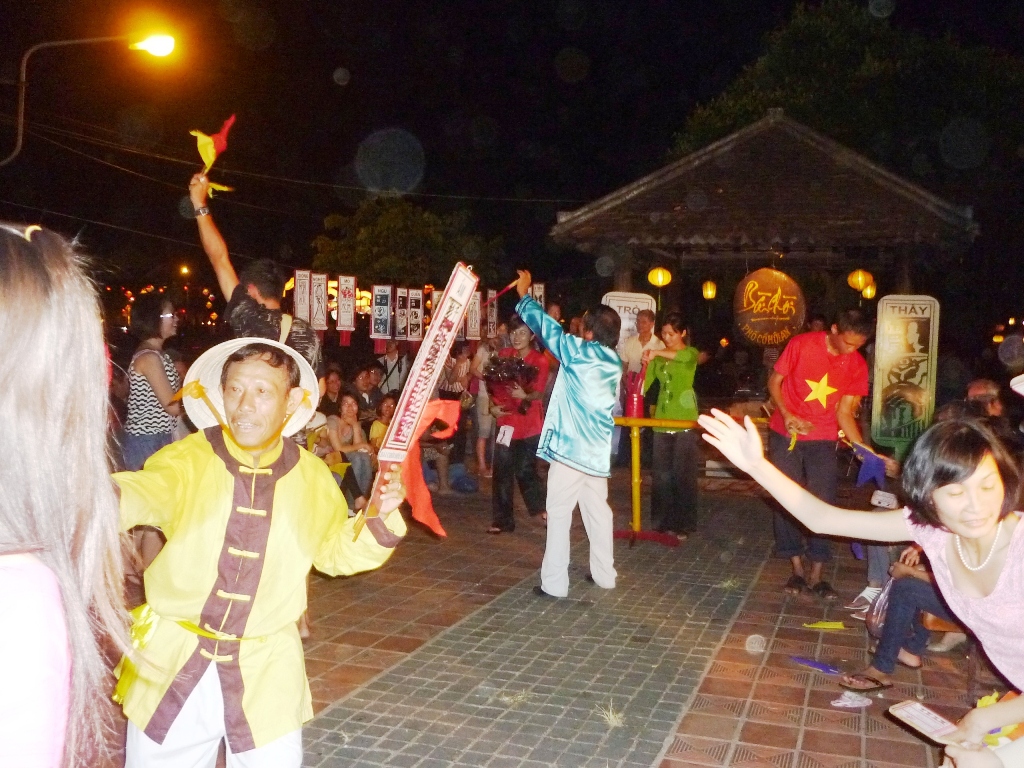
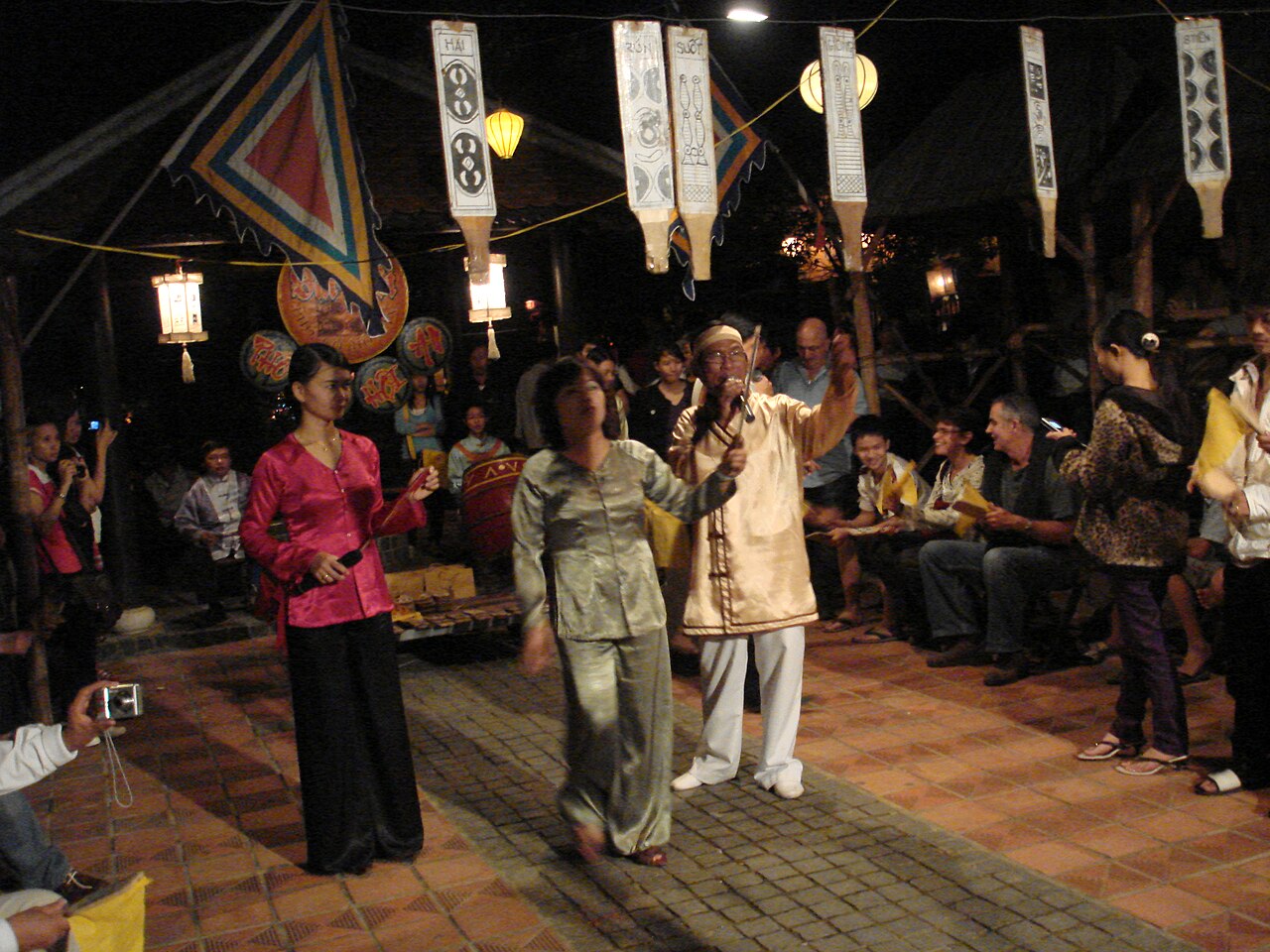
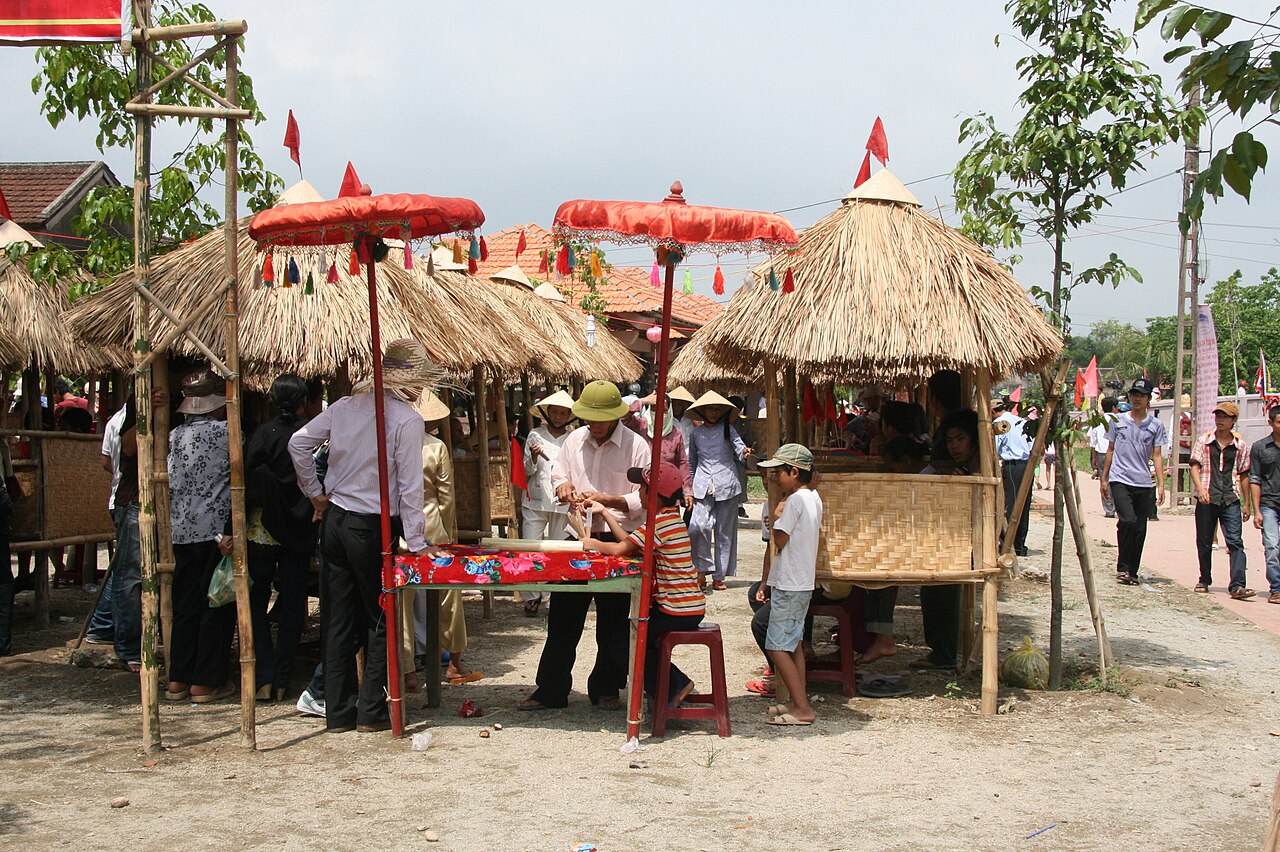
Bài Chòi is a traditional performing art of Central Viet Nam that combines music, poetry, acting, visual elements and literature. It has two closely connected forms: Bài Chòi games, traditionally played during the Lunar New Year in temporary bamboo huts, and Bài Chòi performance, in which performers known as Hiệu artists sing, recite and interact with participants and audiences. The practice has historically been found across nine central provinces, including Quảng Bình, Quảng Trị, Thừa Thiên Huế, Đà Nẵng, Quảng Nam, Quảng Ngãi, Bình Định, Phú Yên and Khánh Hòa.
During a Bài Chòi game, players occupy small huts while an Hiệu performer draws or announces cards and communicates their meanings through sung or spoken verses. The performance depends on quick responses, expressive delivery, humour and interaction with the audience. The repertoire combines inherited melodies and verses with creative performance, allowing the art to respond to particular places, occasions and audiences while retaining recognizable conventions.
11-11-2026
| Institutional and human capacities | The knowledge of Bài Chòi is held by several groups of practitioners, including Hiệu artists, solo performers, traditional card makers and artisans who construct the bamboo huts used for the games. These practitioners possess different but interconnected skills: singing and recitation, performance techniques, knowledge of the repertoire, card production and the construction of the performance setting. Family-based transmission remains particularly important. Many performers acquire their skills within their families, while specialized practitioners also teach through Bài Chòi clubs, schools and associations. By the time of UNESCO inscription, practitioners and communities had established nearly 90 teams, groups and clubs dedicated to practice and transmission, creating a network through which knowledge could continue outside traditional family settings. | |
| Transmission and education | Bài Chòi knowledge has traditionally been transmitted orally through repeated participation, observation and practice. Experienced performers teach younger generations song repertoires, singing techniques, performance skills and methods for making the cards. Family transmission therefore remains an important pathway through which knowledge of the art is maintained across generations. Contemporary transmission has expanded through clubs, schools and associations. The safeguarding measures described in the UNESCO nomination also include formal educational initiatives designed to attract younger generations, together with policies intended to encourage artists to continue practising the tradition. These approaches complement rather than replace the practical learning that takes place through participation in performances and community activities. | |
| Inventorying and research | Bài Chòi was included on Viet Nam's National List of Intangible Cultural Heritage in 2013–2014. UNESCO's Committee documentation records that the national inventory is held within the intangible cultural heritage management information system of the Department of Cultural Heritage of Viet Nam. The Departments of Culture, Sports and Tourism in the nine provinces concerned cooperate with communities to update information about the element annually. The Vietnamese Institute of Musicology also maintains a database on Bài Chòi and updates it annually. The preparation of the UNESCO nomination involved community participation in cataloguing the element and completing inventory forms, while the Department of Cultural Heritage and Vietnamese Institute of Musicology coordinated consultation through meetings and conferences held in 2014 and 2015. | |
| Policies as well as legal and administrative measures | Bài Chòi has received formal recognition through its inclusion on Viet Nam's National List of Intangible Cultural Heritage and, internationally, through inscription on UNESCO's Representative List in 2017. The UNESCO Committee recognized existing measures including policies providing incentives for artists and the development of educational programmes aimed at encouraging younger generations to engage with the practice. Safeguarding responsibilities are distributed among national and provincial cultural authorities, cultural institutions, practitioners and community groups. The nine provinces associated with the element cooperate with communities in maintaining and updating inventory information, while the Vietnamese Institute of Musicology contributes specialized documentation and research. This institutional framework connects official heritage management with the communities that continue to practise Bài Chòi. | |
| Role of intangible cultural heritage and its safeguarding in society | Bài Chòi functions as both an artistic practice and a form of community recreation. Its combination of games, singing, storytelling and performance creates opportunities for people to participate collectively rather than simply observe a staged performance. The practice has historically been particularly associated with village communities and festive occasions, including the Lunar New Year. The interactive nature of Bài Chòi is central to its social role. Performers respond to participants and audiences through song, humour and improvised or context-sensitive expression, while the game structure gives community members an active role in the event. Safeguarding therefore involves maintaining not only songs and performance techniques but also the social relationships and participatory settings through which the art remains meaningful. | |
| Awareness raising | Awareness of Bài Chòi is supported through community performances, cultural groups, schools, associations and local and national media. UNESCO's inscription process specifically noted the commitment of local and national media to raising awareness of the value of the element, while many practitioners participate voluntarily in its dissemination. Public presentations also provide opportunities to introduce Bài Chòi to audiences who may not encounter the traditional village setting. Contemporary clubs and organized performances can make the practice more visible while maintaining the relationship between singing, performance and participation that distinguishes Bài Chòi from a conventional stage concert. | |
| Engagement of communities, groups and individuals as well as other stakeholders | Community participation was an important component of the preparation of the UNESCO nomination. Practitioners and representatives of Bài Chòi groups and clubs contributed to the cataloguing process, completed inventory forms and participated in different stages of preparing the nomination. Individuals and representatives of groups and clubs also provided free, prior and informed consent to the nomination. The continued involvement of practitioners is equally important to transmission. Families, performers, card makers, hut makers, clubs and associations each contribute different forms of knowledge. The creation of numerous local teams, groups and clubs demonstrates how communities have adapted the practice to contemporary organizational settings while continuing to transmit its artistic and technical knowledge. | |
| International engagement | Bài Chòi was inscribed on the Representative List of the Intangible Cultural Heritage of Humanity in 2017 at the twelfth session of the Intergovernmental Committee in Jeju, Republic of Korea. UNESCO assigned the element nomination file number 01222, with inscription adopted through Decision 12.COM 11.b.35. The UNESCO nomination also made the element's inventory, community-consent documentation, photographs and audiovisual material accessible as part of the international safeguarding framework. The nomination process connected Vietnamese cultural institutions and practitioners with the Convention's international mechanisms while retaining community participation as a central part of the recognition process. UNESCO's nomination records include a dedicated ICH inventory, community-consent documentation, mandatory photographs and a film documenting Bài Chòi in Central Viet Nam. | |
| References | Documentary Sources
Photographic Credits
|
|








.jpeg)



.png)


.jpeg)
.jpg)

.png)
.jpg)