
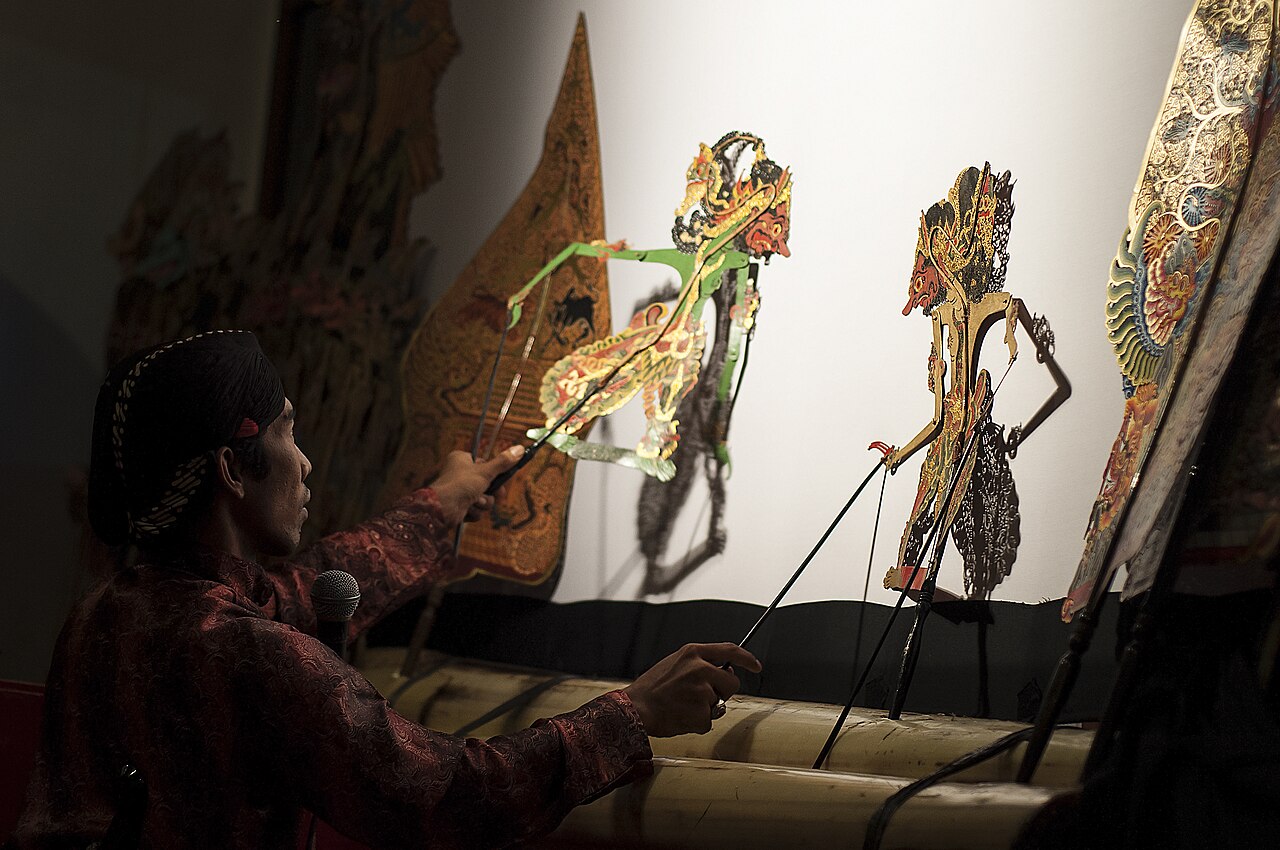
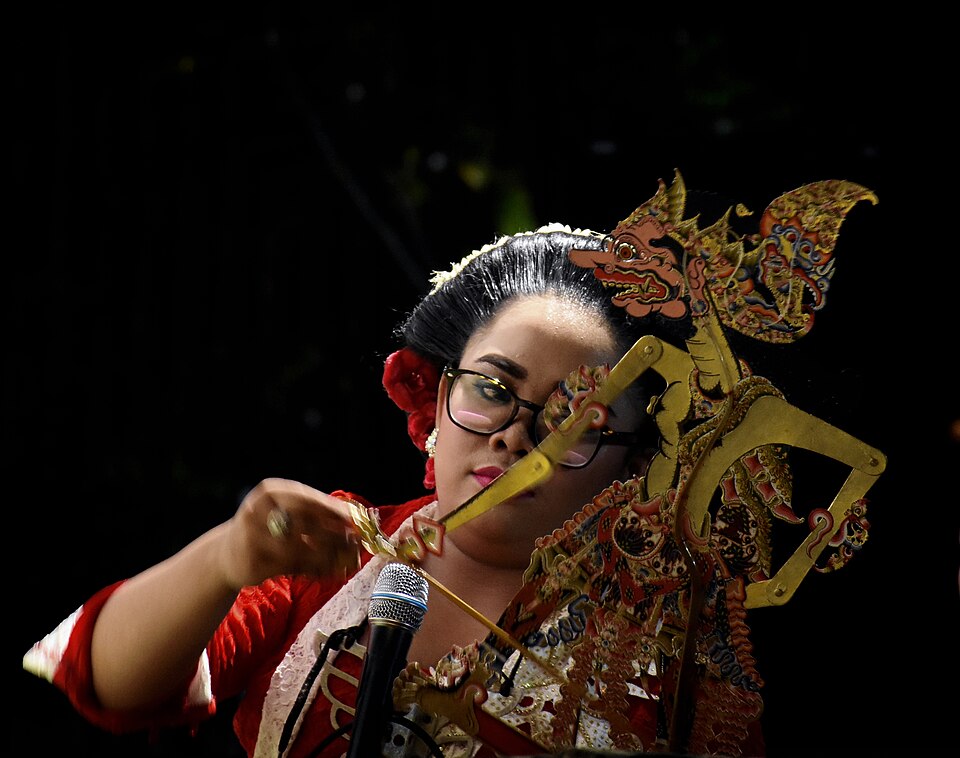
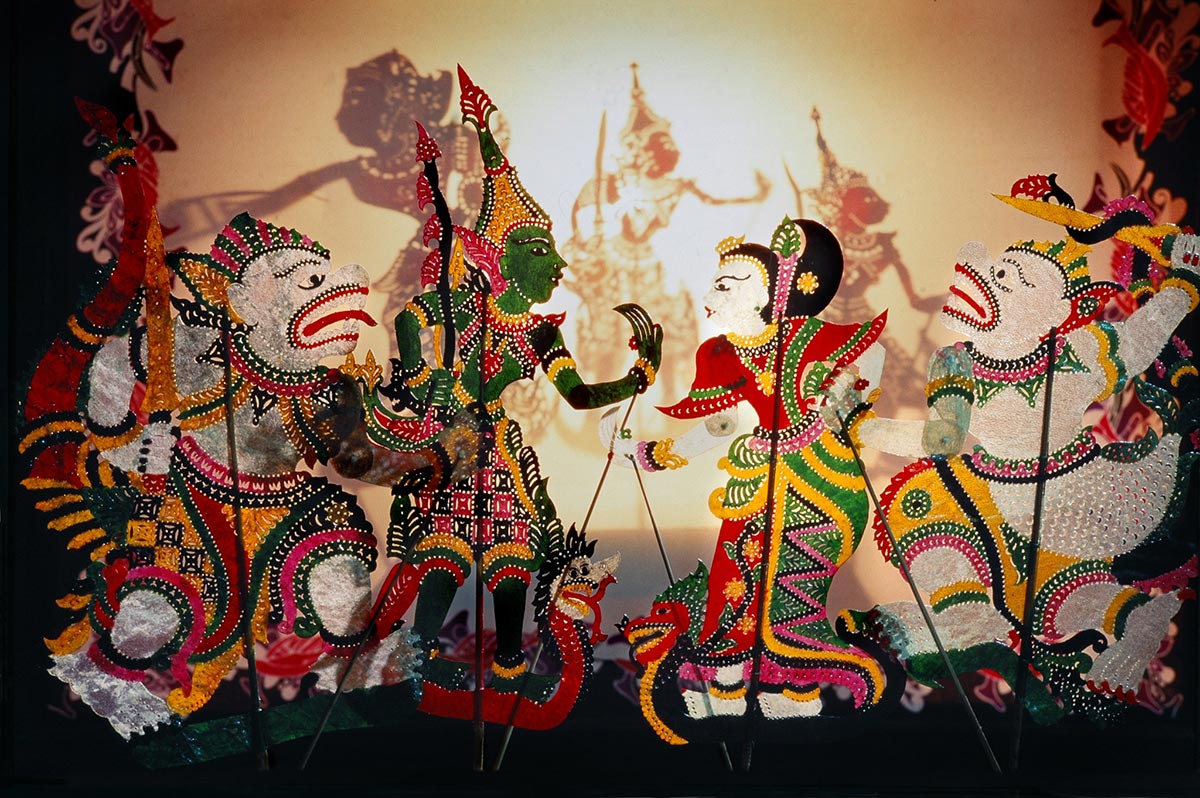
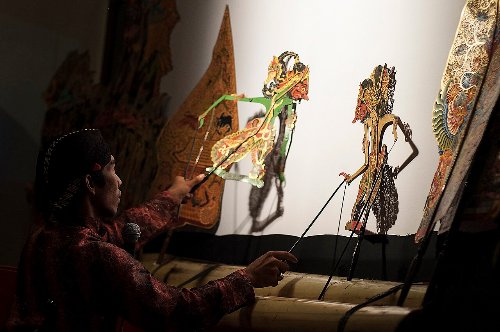
Wayang Kulit is a traditional Indonesian shadow-puppet theatre most strongly associated with Java. Its performances use intricately cut and painted leather puppets, traditionally made from animal hide, whose articulated limbs are manipulated by a dalang, or master puppeteer. A lamp illuminates a stretched screen, known as the kelir, allowing the puppets’ shadows to become the central visual element of the performance. The dalang controls the characters, voices their dialogue, narrates the story, and coordinates the action with the accompanying musicians.
Performances commonly draw on the Ramayana and Mahabharata, alongside local stories, Javanese interpretations, and episodes involving comic characters known as the punakawan. The musical ensemble typically features a gamelan orchestra, with singers sometimes contributing vocal passages. The repertoire can communicate moral reflection, philosophical ideas, social criticism, humour, and local values. Although Java is especially associated with Wayang Kulit, related forms and regional adaptations exist across Indonesia, each reflecting its own cultural and artistic environment.
10-22-2026
| Institutional and human capacities | The dalang is central to Wayang Kulit because the role combines puppetry, storytelling, vocal performance, dramatic timing, knowledge of the repertoire, and coordination with musicians. A skilled dalang must understand characters and narratives, manipulate numerous puppets, distinguish individual voices, and respond to the atmosphere of a live audience. Puppet makers, gamelan musicians, singers, teachers, and other supporting practitioners contribute essential knowledge that makes the performance possible. Indonesia’s Sekretariat Nasional Pewayangan Indonesia (SENA WANGI), or Indonesian National Wayang Secretariat, has worked on research, documentation, training, and the development of traditional wayang schools known as sanggar. UNESCO records that SENA WANGI was established in 1975 and has supported the documentation and safeguarding of different wayang traditions. Arts institutions, cultural organisations, local practitioners, and government agencies also contribute to the wider ecosystem. These capacities are most effective when they sustain the relationships between experienced artists, apprentices, musicians, and communities in which performances remain meaningful. UNESCO, SENA WANGI. | |
| Transmission and education | Wayang Kulit requires extended practical learning. Aspiring dalang acquire knowledge of stories, characters, poetic language, vocal styles, puppet movements, musical cues, and the timing of a performance. Much of this knowledge is embodied and experiential: learners develop their skills through observation, rehearsal, guidance from experienced practitioners, and participation in performances. The craft of preparing and manipulating puppets, as well as the musicians’ knowledge of accompanying the dramatic action, forms part of this broader transmission process. A major safeguarding initiative took place between 2005 and 2007 through UNESCO’s project for implementing Indonesia’s National Action Plan for Wayang puppet theatre. The programme developed teaching manuals, audiovisual materials, and guidebooks, and supported 15 sanggar as pilot institutions. Its wider objectives included strengthening transmission from master artists to younger performers and supporting several forms of wayang. Although this programme addressed the broader wayang tradition rather than Wayang Kulit alone, it demonstrates how practical apprenticeship can be supported through structured educational resources and community-based training. | |
| Inventorying and research | The preparation of Indonesia’s original UNESCO nomination involved research undertaken by SENA WANGI in 2002. The resulting documentation contributed to the recognition of Indonesian Wayang puppet theatre, first proclaimed a Masterpiece of the Oral and Intangible Heritage of Humanity in 2003 and subsequently incorporated into UNESCO’s Representative List in 2008. Documentation associated with the tradition includes descriptions of performance practices, practitioners, puppet forms, musical accompaniment, and safeguarding initiatives. These records provide an important reference for understanding wayang as a diverse family of related traditions rather than a single uniform performance style. Documentation has also been supported through the Indonesian Wayang Database Centre and research conducted by cultural institutions and scholars. UNESCO’s broader project records describe inventories of practitioners and sanggar, field research, publications, audiovisual educational materials, and guidebooks. Indonesia’s national intangible heritage inventory system also provides for periodic updates and consultation with communities. For Wayang Kulit, the continuing value of this work lies in recording the distinctive knowledge of regional practitioners, the development of their repertoires, the construction of puppets, and changes in performance settings and transmission. | |
| Policies as well as legal and administrative measures | Indonesia’s Wayang puppet theatre was proclaimed a UNESCO Masterpiece in 2003 and inscribed on the Representative List of the Intangible Cultural Heritage of Humanity in 2008. This international recognition applies to the broader wayang theatre tradition, encompassing leather shadow puppets and other forms. It acknowledges the artistic complexity and cultural significance of the tradition, while providing an international framework for encouraging its continued practice and transmission. National protection also includes the recording of traditional cultural expressions and initiatives supporting artists and cultural organisations. Indonesia’s Directorate General of Intellectual Property has reported measures to record wayang-related traditional cultural expressions and protect eligible creative works associated with performances, music, and adaptations. Such protection is particularly relevant where traditional repertoire meets contemporary production, publication, or commercial use. Legal recognition, however, cannot by itself ensure that the knowledge remains alive; it must work alongside opportunities for practice, teaching, and community participation. | |
| Role of intangible cultural heritage and its safeguarding in society | Wayang Kulit has long served as entertainment, storytelling, moral education, and a medium for reflecting on human conduct and social relationships. Its narratives explore loyalty, duty, conflict, power, wisdom, and the consequences of individual choices. Through the dalang’s interpretation, inherited stories can speak to contemporary concerns, and comic interludes allow performers to address everyday experiences and social issues. The relationship between the performance and its audience makes the tradition a form of cultural communication, not simply a display of historical stories. The tradition also brings together different forms of knowledge and artistic expression. Puppet craftsmanship, music, oral literature, dramatic improvisation, and performance conventions coexist within a shared event. The meaning of a performance may differ across communities and settings, reflecting local religious, philosophical, and social contexts. Safeguarding Wayang Kulit therefore involves maintaining the connections between its artistic components and the people who practise and interpret them, while allowing the tradition to remain relevant through living performance. | |
| Awareness raising | Wayang Kulit reaches audiences through village and community performances, cultural festivals, educational programmes, museums, exhibitions, recordings, and digital media. The traditional screen, distinctive puppets, gamelan accompaniment, and dramatic storytelling provide recognisable points of entry for people encountering the art form for the first time. Cultural institutions and organisations such as SENA WANGI also support its visibility through documentation, publications, seminars, and performances. International presentations have helped introduce wayang to audiences beyond Indonesia. In April 2008, for example, Indonesian Wayang performances were presented at the United Nations Office at Geneva in cooperation with international organisations, accompanied by a photography exhibition. Contemporary recordings and online archives also make performances available for study and appreciation. Such initiatives can broaden understanding, but meaningful awareness requires more than displaying puppets or presenting shortened excerpts: audiences benefit from learning about the dalang’s expertise, the musicians’ roles, the cultural context of the stories, and the diversity of regional wayang traditions. | |
| Engagement of communities, groups and individuals as well as other stakeholders | Wayang Kulit depends on a network of practitioners rather than on the dalang alone. Puppet makers prepare and maintain the figures; musicians and singers provide the musical framework; teachers and senior performers pass on specialised knowledge; and cultural groups organise opportunities for rehearsal and performance. Audiences also contribute to the tradition’s social life by attending performances, responding to the story, and sustaining demand for occasions in which the art is practised. The safeguarding programme of 2005–2007 placed particular emphasis on sanggar as spaces for learning and transmission. Supporting these schools, documenting practitioners, and developing educational resources helped connect established artists with younger learners. Continued community engagement requires attention to the different needs of regional traditions and to the working conditions of their practitioners. It also requires respect for community knowledge and recognition of the artists whose labour sustains performances. Community participation is most meaningful when practitioners help shape documentation, teaching activities, and decisions about how their traditions are presented to wider audiences. | |
| International engagement | The international history of Wayang puppet theatre includes its proclamation as a UNESCO Masterpiece in 2003 and its inscription on the Representative List in 2008. The nomination and subsequent safeguarding initiatives helped bring greater attention to Indonesia’s puppet traditions, while creating opportunities for international cooperation in documentation, education, and the exchange of expertise. UNESCO’s earlier safeguarding programme was supported through Japan Funds-in-Trust and implemented in collaboration with Indonesian partners. International engagement has also included performances abroad, research exchanges, audiovisual documentation, and the work of organisations connecting practitioners with international cultural networks. These activities provide opportunities for dialogue about puppetry, storytelling, and the preservation of living performance traditions. Nevertheless, international recognition is not an endpoint: the continuing vitality of Wayang Kulit depends on practitioners being able to perform, teach, create, and adapt the tradition within their own cultural settings. Its international significance ultimately rests on the knowledge and creativity of the people who continue to bring its stories to life. | |
| References |
|
|






.jpeg)

.png)
.jpeg)
.jpg)
.png)
.jpg)