
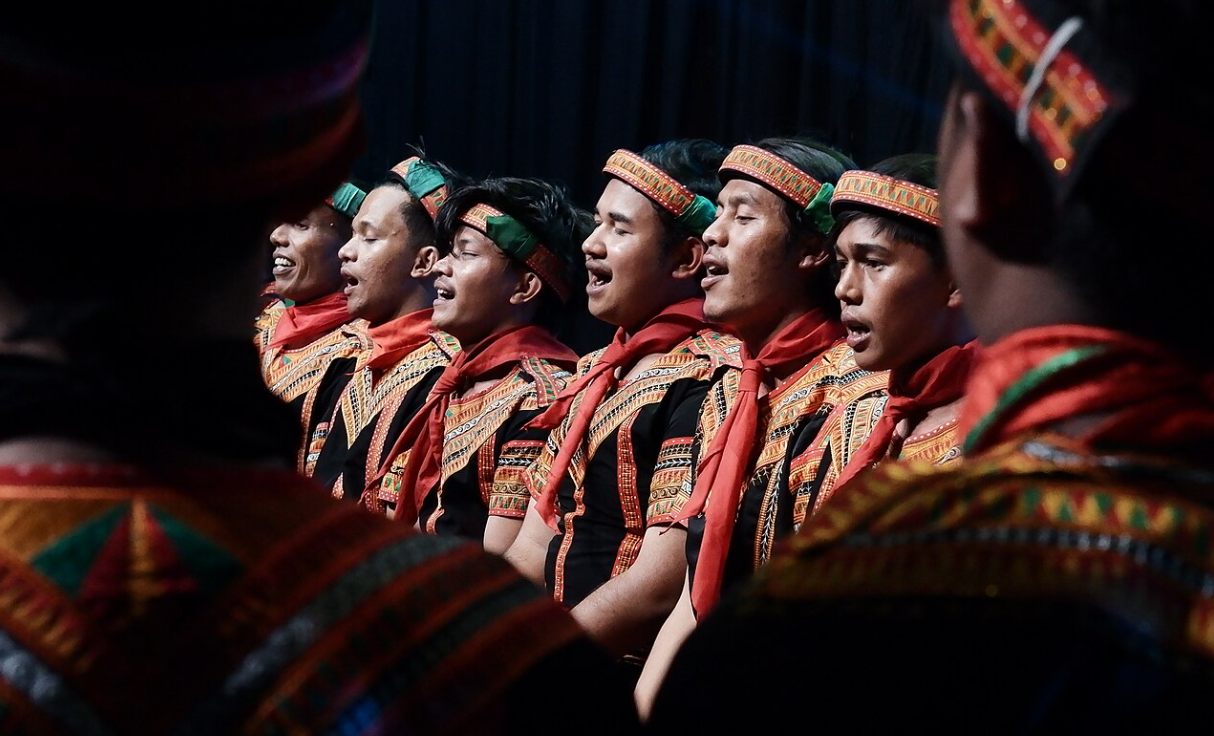
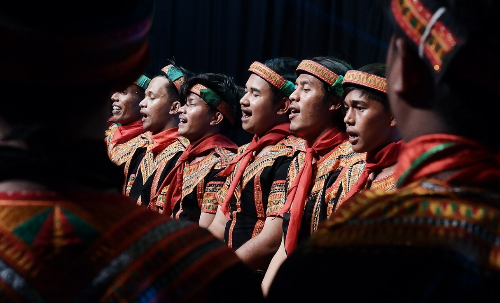
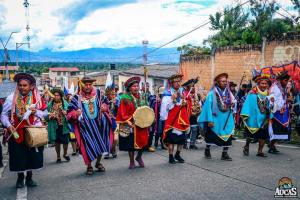
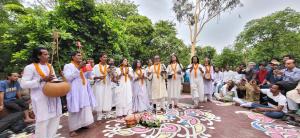
Saman is a traditional performing art of the Gayo people of Aceh, northern Sumatra, Indonesia. Performers sit on their heels or kneel in tightly arranged rows, using coordinated handclaps, chest and thigh slaps, finger clicks, and movements of the head and torso to create intricate rhythms. The pace can change rapidly, demanding close attention to the leader and precise coordination among the dancers. Black costumes decorated with colourful Gayo motifs contribute to the performance's distinctive appearance, with patterns associated with nature and noble values.
The performance combines movement with sung verses, largely in the Gayo language. Led by a figure known as the pengangkat, the lyrics may communicate religious guidance, moral teachings, affection, humour and observations about community life. Saman is performed during religious and national celebrations and other important gatherings, strengthening relationships between villages. Its cultural significance lies not only in the technical achievement of the dancers but also in the shared language, collective discipline and community relationships that make the performance meaningful.
10-22-2026
| Institutional and human capacities | Saman relies on a network of performers, leaders, trainers, cultural enthusiasts, customary leaders, religious figures, teachers and public institutions. Experienced practitioners carry knowledge of the movement sequences, rhythm changes, sung poetry and the ways a group responds to its leader. The pengangkat has a particularly important role in guiding the performance, coordinating its progression and sustaining the relationship between words and movement. The tradition also depends on the spaces and resources that allow groups to rehearse and perform. Costumes, instruction and participation in performances involve financial costs, while the departure of young people for education or employment can weaken local transmission. UNESCO's 2011 assessment highlighted ageing leaders without successors, reduced opportunities for informal learning and insufficient resources as threats. Safeguarding therefore involves strengthening the people, organizations and community settings that support the practice, rather than concentrating only on the dancers visible during public performances. | |
| Transmission and education | Saman has traditionally been transmitted through observation, repetition and participation in community life. Younger performers learn to coordinate their movements with others, follow changes in rhythm, remember sequences and recite verses. This learning involves more than physical technique: performers must develop an understanding of the lyrics, the discipline of the group and the cultural occasions on which Saman is practiced. Informal learning spaces have historically been important, including mersah, communal prayer and gathering spaces for young men. Since UNESCO's 2011 inscription, safeguarding efforts have supported transmission through traditional institutions, newly established organizations, youth and student groups, and expanded performance opportunities. Indonesia's 2020 reporting also noted that the practice had spread into rural and urban settings and beyond Indonesia, while emphasizing that Gayo communities must remain central to decisions about its future. During the COVID-19 pandemic, practitioners and organizations also developed online forms of transmission and promotion. These efforts broaden access to learning, although they do not replace the value of sustained practice with experienced performers. | |
| Inventorying and research | Saman's formal documentation predates its UNESCO inscription. Inventory data was submitted by the Office for Safeguarding of History and Cultural Values in Banda Aceh and accepted in 2010 by Indonesia's Directorate General of Cultural Values, Arts and Film. The process was especially significant because important earlier documentation had been lost in the 2004 tsunami. Indonesia subsequently prepared nomination file No. 00509, containing the description of the element, community-consent documentation, photographs and a film. The nomination was developed through a participatory process involving practitioners and community representatives alongside government institutions. Documentation has continued through UNESCO's periodic reporting system for elements on the Urgent Safeguarding List. Indonesia submitted reports in 2015, 2019 and 2023, with the latest examined by UNESCO's Intergovernmental Committee in 2024. That review recorded safeguarding activities, including the diversification of performance occasions, transmission initiatives, networking, youth engagement, documentation and education. It also emphasized the importance of preserving skills in reciting verses in the Gayo language. The next report is due in 2027, providing a further opportunity to assess the tradition's condition and the progress of safeguarding measures. | |
| Policies as well as legal and administrative measures | In 2011, UNESCO inscribed Saman on the List of Intangible Cultural Heritage in Need of Urgent Safeguarding. The decision recognized the tradition's contribution to friendship, solidarity and the historical continuity of the Gayo people, while identifying weakening transmission, fewer performance opportunities and the disappearance of cultural spaces as serious concerns. The Committee called for stronger educational initiatives and encouraged cooperation among community organizations, researchers, cultural associations and government bodies. Indonesia's subsequent safeguarding framework has involved central and regional authorities, community organizations and traditional institutions. UNESCO's 2020 review emphasized the need for Gayo communities to remain at the centre of safeguarding decisions as Saman spread more widely. In 2024, the Committee acknowledged progress in transmission, promotion, networking and youth involvement, while calling for continued support for practitioners, cultural spaces and the Gayo-language verses. These measures provide an ongoing framework for action; the Urgent Safeguarding inscription remains an important reminder that continued transmission cannot be assumed. | |
| Role of intangible cultural heritage and its safeguarding in society | Saman expresses Gayo identity through the combination of language, movement, music-like bodily rhythms and collective discipline. The performers' close coordination makes cooperation central to the art: each person must listen, observe and respond to the group. The sung verses add another dimension, carrying religious teachings, humour, advice and reflections on social life. Preserving Saman therefore also means sustaining the expressive possibilities of the Gayo language and the knowledge associated with its oral poetry. The tradition's role in strengthening relationships between villages is particularly significant. Invitations to perform create occasions for communities to meet, exchange skills and demonstrate their knowledge. Saman connects cultural continuity with social participation, allowing the tradition to remain meaningful through repeated gatherings rather than solely through formal presentations. Safeguarding its social role is consequently as important as maintaining the choreography or costumes. | |
| Awareness raising | Public performances, cultural festivals, educational activities and audiovisual documentation introduce Saman to audiences beyond the communities in which it is traditionally practiced. UNESCO's nomination film and photographic record have helped make its distinctive choreography, costumes and sung verses visible internationally. The growth of youth and student groups, noted in Indonesia's periodic reporting, has also expanded opportunities for new generations to encounter the tradition. Awareness raising is most effective when it creates pathways toward participation and learning. Performances can attract interest, but the knowledge required to sustain Saman develops through repeated practice, guidance from experienced practitioners and familiarity with the lyrics. Safeguarding initiatives have therefore combined promotion with education, networking and efforts to create more occasions for performance. Maintaining the Gayo-language verses remains a particular priority, ensuring that the tradition is understood as a living cultural expression rather than only a striking visual spectacle. | |
| Engagement of communities, groups and individuals as well as other stakeholders | The safeguarding of Saman has involved performers and trainers as well as enthusiasts, customary and religious leaders, teachers, community organizations and government representatives. UNESCO's original decision recognized the broad participation involved in the nomination and the importance of community consent. Subsequent reviews have emphasized that Gayo communities should continue to guide safeguarding decisions, particularly as Saman becomes more widely practiced in urban settings, educational institutions and communities beyond its traditional region. Community engagement also involves creating conditions in which young people can learn and participate. Traditional institutions, newer organizations, youth groups and student communities contribute to the transmission network, while practitioners adapt activities to changing circumstances. The online initiatives developed during the COVID-19 pandemic demonstrated how communities and institutions could maintain connections under difficult conditions. Long-term continuity, however, depends on ensuring that these wider networks support the knowledge, authority and cultural priorities of the Gayo communities who sustain the tradition. | |
| International engagement | UNESCO's 2011 inscription brought international attention to Saman and established a framework for monitoring its condition. The subsequent reporting cycle has enabled Indonesia to document safeguarding efforts, report changes in transmission and receive guidance from the Intergovernmental Committee. UNESCO's 2020 review acknowledged the growth of the Saman community while stressing the importance of maintaining Gayo leadership. Its 2024 review recognized progress and encouraged further work on documentation, education, cultural spaces and sung poetry. International visibility has also helped connect Saman with wider audiences, including youth and student communities outside its original region. Yet its future depends on sustained work at the local level: supporting experienced practitioners, maintaining opportunities for learning and performance, and transmitting the Gayo-language verses. The hope expressed by communities for Saman eventually to move from the Urgent Safeguarding List to the Representative List reflects an aspiration for improved viability. Any such transition depends on the continued safeguarding process and UNESCO's assessment of the element's condition. | |
| References |
|
|






.jpeg)



.png)



.jpeg)
.jpg)

.png)
.jpg)