
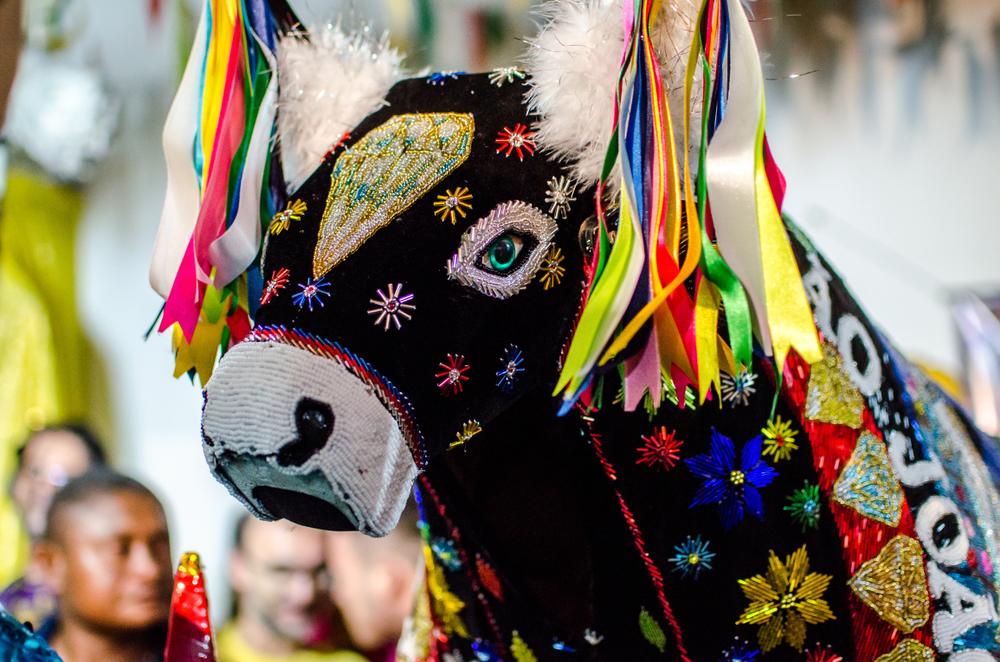
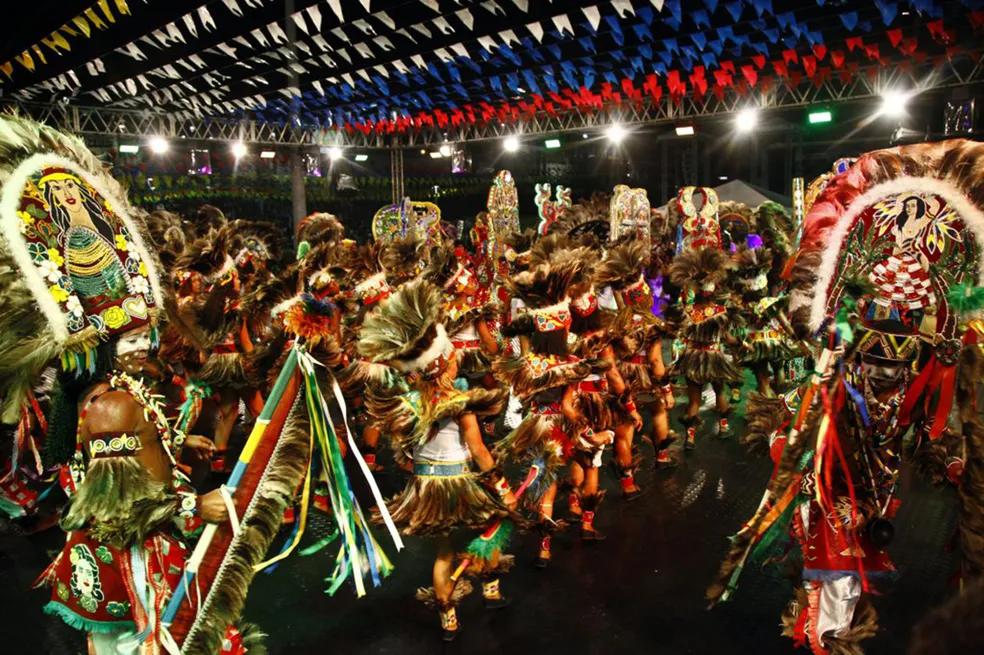
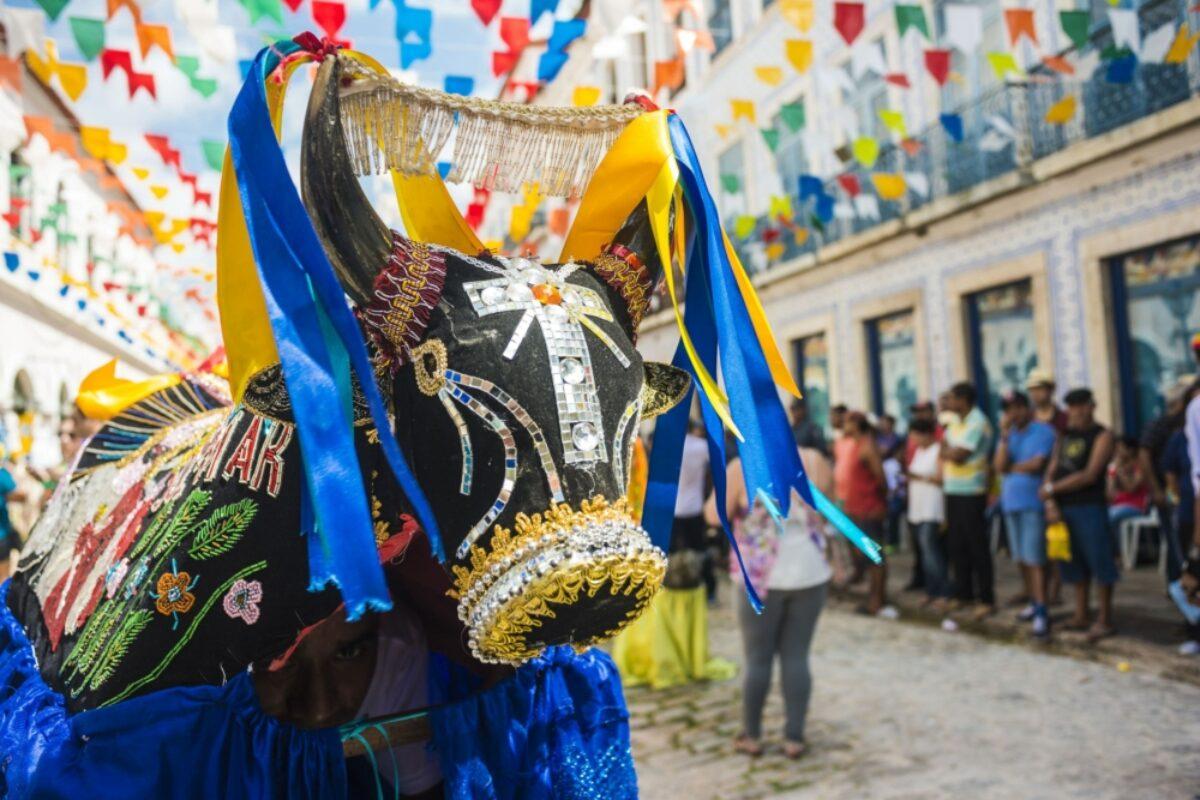
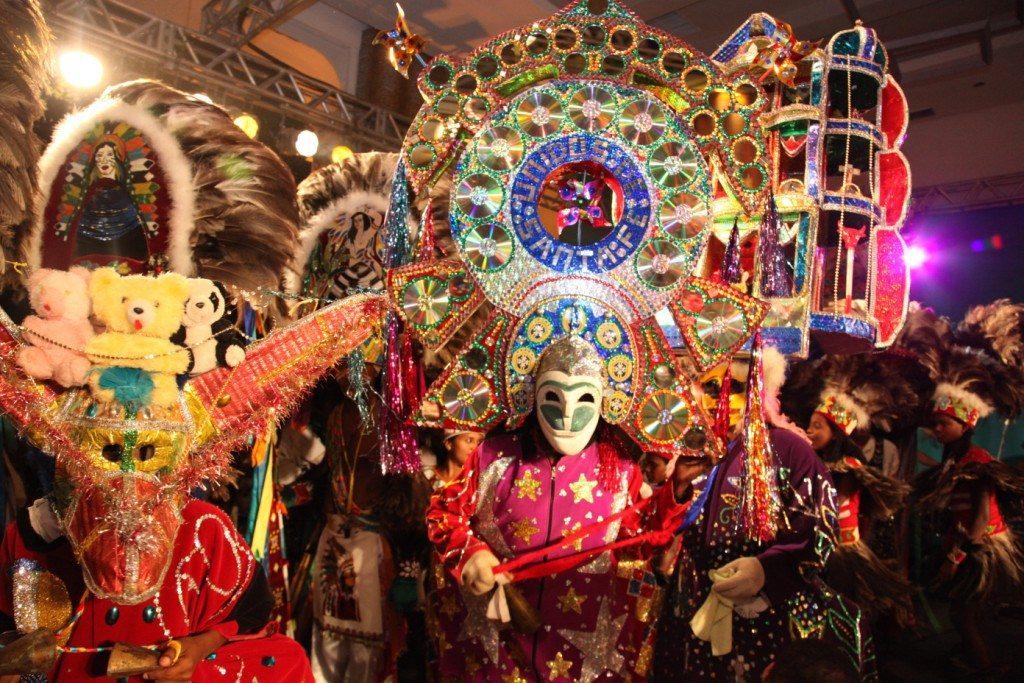
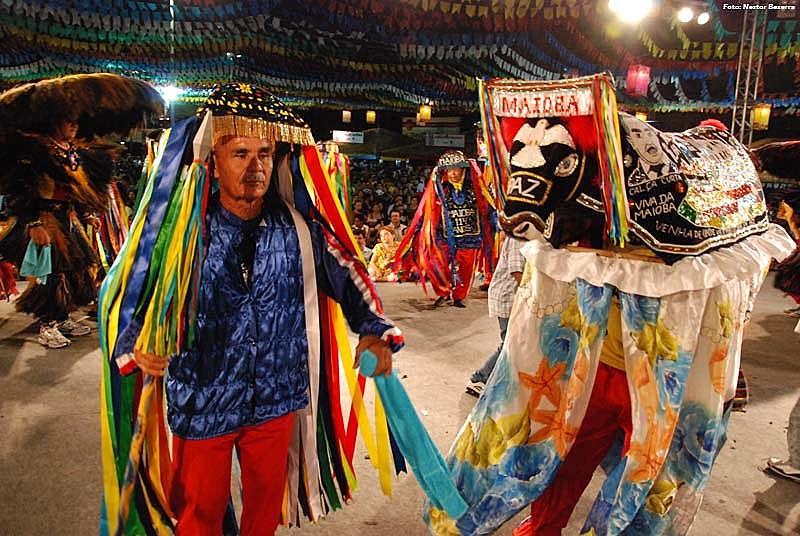
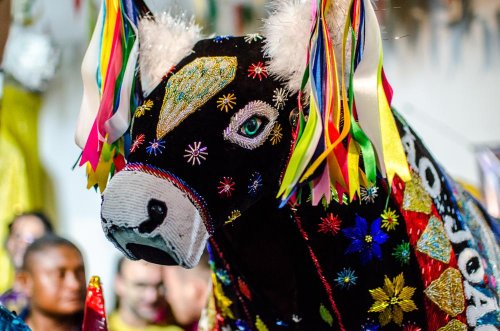
Bumba-meu-boi is a cultural complex from Maranhão that brings together music, dance, theatrical performance, religious devotion, storytelling, craftsmanship and festive celebration. At its center is the figure of the Boi, whose symbolic life follows a recurring cycle of birth, performance, death and renewal. The traditional narrative tells of Catirina and Pai Francisco, whose actions surrounding the death of a prized ox set the story in motion and eventually lead to its resurrection.
The practice unfolds through a yearly cycle of rehearsals, the baptism of the Boi, public performances and the ritual of its death. Groups, known as Bois or batalhões, maintain distinct styles called sotaques, including Matraca, Baixada, Zabumba, Costa de Mão and Orquestra. Each has its own musical arrangements, instruments, costumes, movements and performance characteristics, making the cultural complex a constellation of related local traditions rather than a single standardized performance.
09-30-2026
| Institutional and human capacities | The knowledge of Bumba-meu-boi is carried by brincantes, the participants who sing, dance, play instruments, create costumes and embody the many characters of the performance. Cantadores, vaqueiros, cazumbas, caboclos de pena, Catirina, Pai Francisco and other figures each contribute to the expressive world of the Boi. Masters and group leaders hold extensive knowledge of repertoire, choreography, music, ritual organization and craftsmanship. The preparation of a Boi also depends on a broad network of makers and organizers. Communities spend much of the year preparing instruments, embroidering costumes, renewing the decorated leather covering of the Boi and rehearsing new and traditional toadas. IPHAN's safeguarding framework recognizes the communities themselves as central partners in planning and implementing measures for the tradition's continuity. | |
| Transmission and education | Knowledge is transmitted through participation in the Boi's yearly cycle. Children and young people encounter the tradition through families, neighborhoods, rehearsals and community groups, gradually learning songs, rhythms, movements, characters and the responsibilities associated with participating in a Boi. The process is practical and collective: young brincantes learn by watching experienced practitioners and eventually taking part themselves. Formal safeguarding initiatives have strengthened this process through workshops and educational programs. IPHAN's “O Boi vai à Escola” project introduced children to the tradition through stories, animation, educational materials and the repertoire of Costa de Mão groups. Other workshops have directly transmitted dance, music, embroidery and costume-making knowledge from masters to younger participants, particularly in communities where certain forms of Bumba-meu-boi face difficulties maintaining new generations of practitioners. | |
| Inventorying and research | Documentation of Bumba-meu-boi has sought to record the extraordinary diversity of the tradition across Maranhão. Research has examined its musical structures, characters, costumes, performance sequences, religious dimensions, instruments, local histories and different sotaques. The national registration dossier treats the Boi as a living practice whose forms continue to transform through the communities that perform them. Participatory research has also supported safeguarding by documenting groups and their knowledge while making their experiences available for educational and cultural initiatives. Publications such as Bumba-meu-boi: som e movimento bring together research on the musical and performative dimensions of the practice. Such documentation is particularly important for less numerous traditions, including Costa de Mão, where some groups have faced serious difficulties maintaining their activities. | |
| Policies as well as legal and administrative measures | Bumba-meu-boi was registered by Brazil as intangible cultural heritage in 2011 through IPHAN's heritage system. The recognition encompasses the broader cultural complex and its different sotaques, rather than establishing one version as the definitive form. In 2019, UNESCO inscribed the Cultural Complex of Bumba-meu-boi of Maranhão on the Representative List of the Intangible Cultural Heritage of Humanity. Safeguarding is organized through a framework intended to be shared with the communities that sustain the tradition. IPHAN established a safeguarding plan addressing long-term sustainability, community participation, knowledge transmission, documentation and public dissemination. A community-oriented management structure has also been developed to support dialogue between practitioners, cultural institutions and public authorities. | |
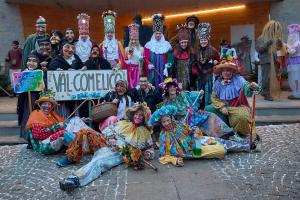
| Role of intangible cultural heritage and its safeguarding in society | The Boi is simultaneously a festive character, a sacred symbol and a center of community life. The cycle is connected to the June celebrations of Saint Anthony, Saint John, Saint Peter and Saint Marçal, while many groups also maintain relationships with Afro-Brazilian religious traditions such as Tambor de Mina and Terecô. For some groups, the Boi is created through a promise or spiritual obligation, giving its annual cycle a meaning that extends beyond entertainment. The preparation itself strengthens relationships between generations, families and neighbors. Workers, students, farmers, fishermen, merchants and other community members contribute their time and skills to the Boi. Through rehearsals, costume-making, music, performance and ritual, the tradition provides a shared framework through which communities express devotion, identity, creativity and memories of their own local histories. | |
| Awareness raising | During the June season, Bumba-meu-boi becomes highly visible throughout Maranhão. Arraiais, community celebrations and São Luís festivities bring groups before large audiences, allowing the distinctive music, costumes, characters and sotaques of different Bois to be encountered beyond their home communities. Awareness initiatives increasingly present the Boi as a complex living heritage rather than simply a spectacular festival. Educational publications, films, exhibitions and public cultural programs explain the meaning of the cycle, the work of the brincantes and the diversity of the sotaques. In 2025, an official ceremony at the Capela de São Pedro in São Luís formally celebrated the UNESCO recognition together with the Boi communities, linking international recognition with the people who sustain the tradition. | |
| Engagement of communities, groups and individuals as well as other stakeholders | The Boi depends on collective participation from the earliest stages of preparation. Groups organize rehearsals, compose and learn toadas, prepare instruments, create costumes and construct the Boi itself. During performances, musicians, dancers and characters interact continuously, creating a collective event in which the boundaries between artistic performance and community celebration remain fluid. Safeguarding initiatives have increasingly emphasized this community structure. Festivals, competitions, workshops and forums create opportunities for groups to meet and exchange knowledge, while specific initiatives address traditions considered especially vulnerable. The transmission workshops for Costa de Mão groups in Tajipuru, for example, brought masters together with younger participants to teach dance, music, embroidery and costume-making, directly connecting safeguarding with community continuity. | |
| International engagement | UNESCO's 2019 inscription placed the Cultural Complex of Bumba-meu-boi of Maranhão within the international framework for safeguarding intangible cultural heritage. The recognition reflects the practice's combination of musical, choreographic, theatrical and playful expression and its relationship with sacred traditions through the figure of the Boi. International recognition has also encouraged broader documentation and public understanding of Maranhão's cultural diversity. At the same time, the safeguarding approach emphasizes that international visibility must remain connected to the communities and practitioners who give the tradition its meaning. The continuing value of international engagement therefore lies not only in presenting the Boi to new audiences, but in supporting the conditions under which its different local forms can continue to be practiced and transmitted. | |
| References |
|
|




.jpeg)


.png)
.jpeg)
.jpg)
.png)
.jpg)


_(31711258567).jpg)