
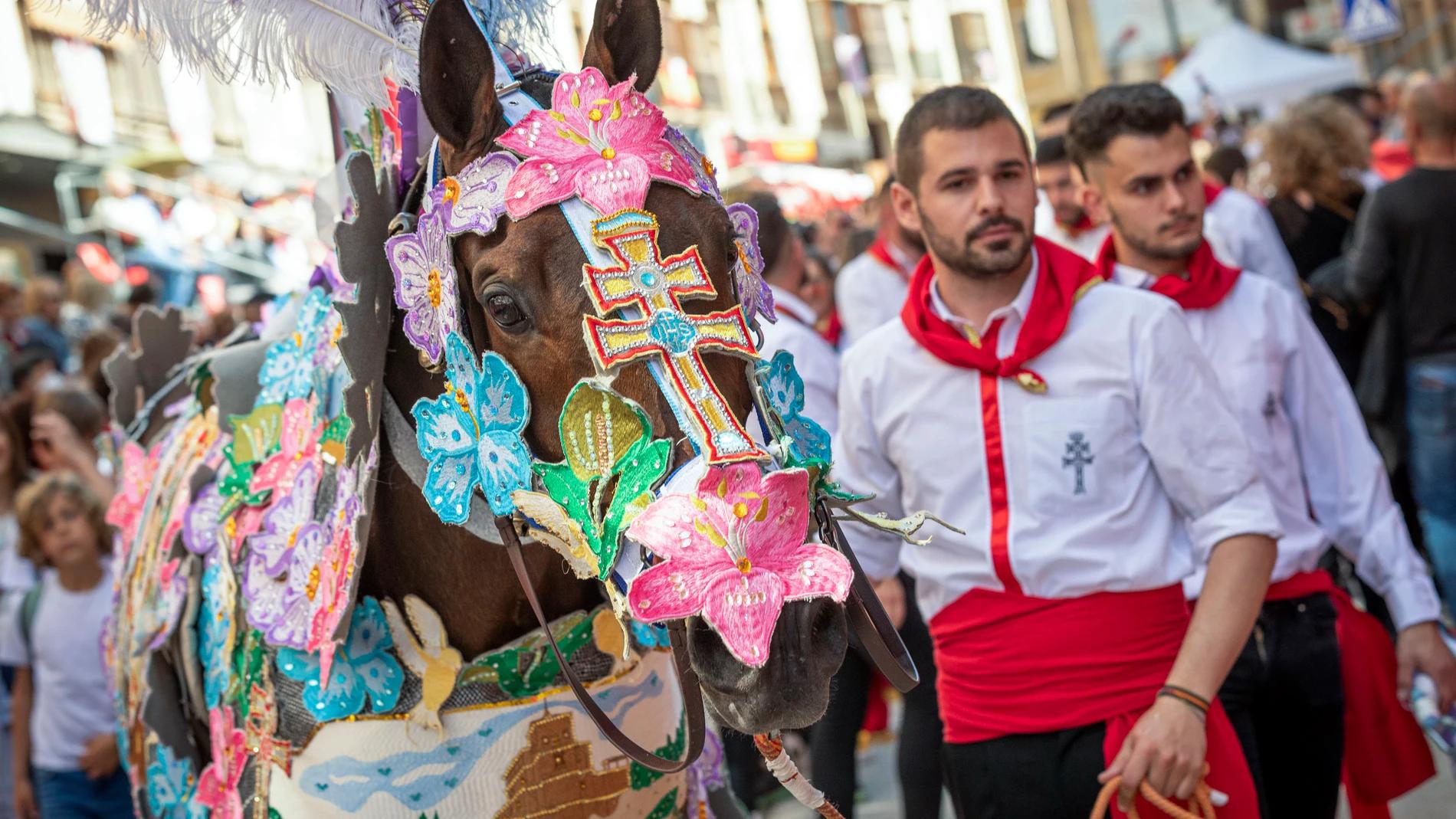
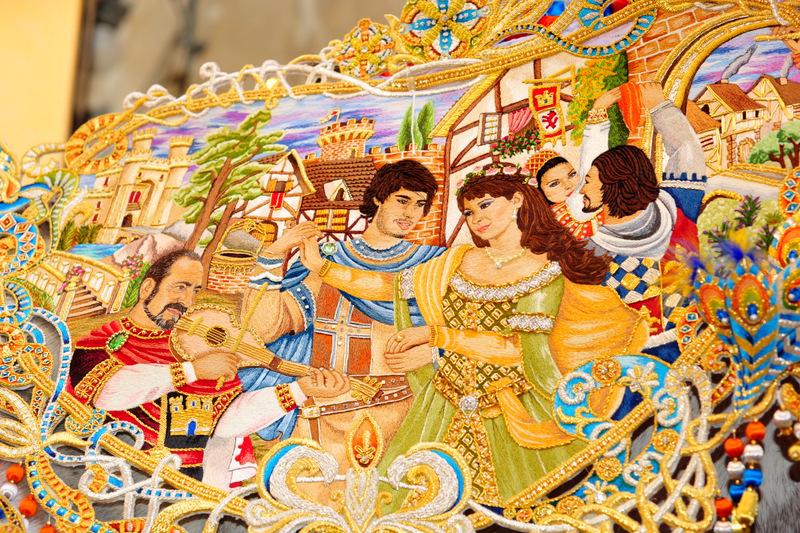
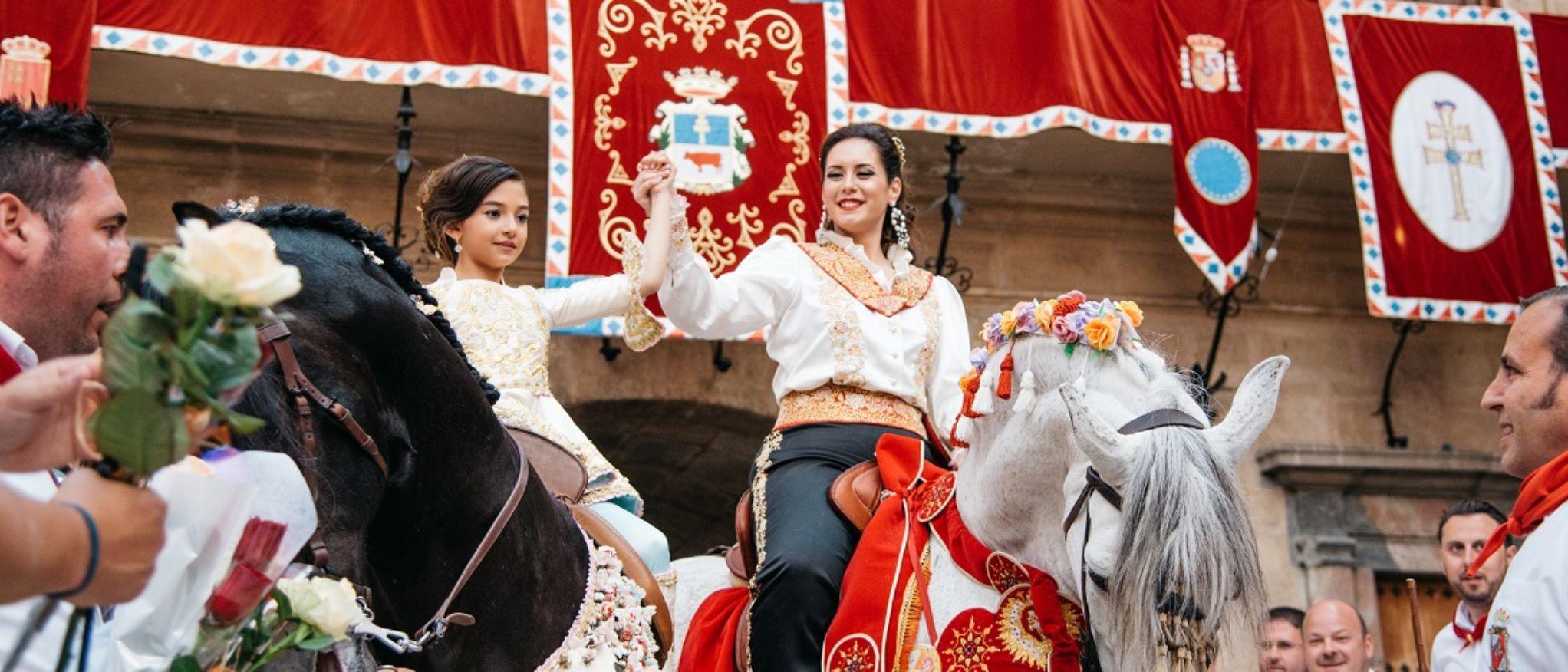
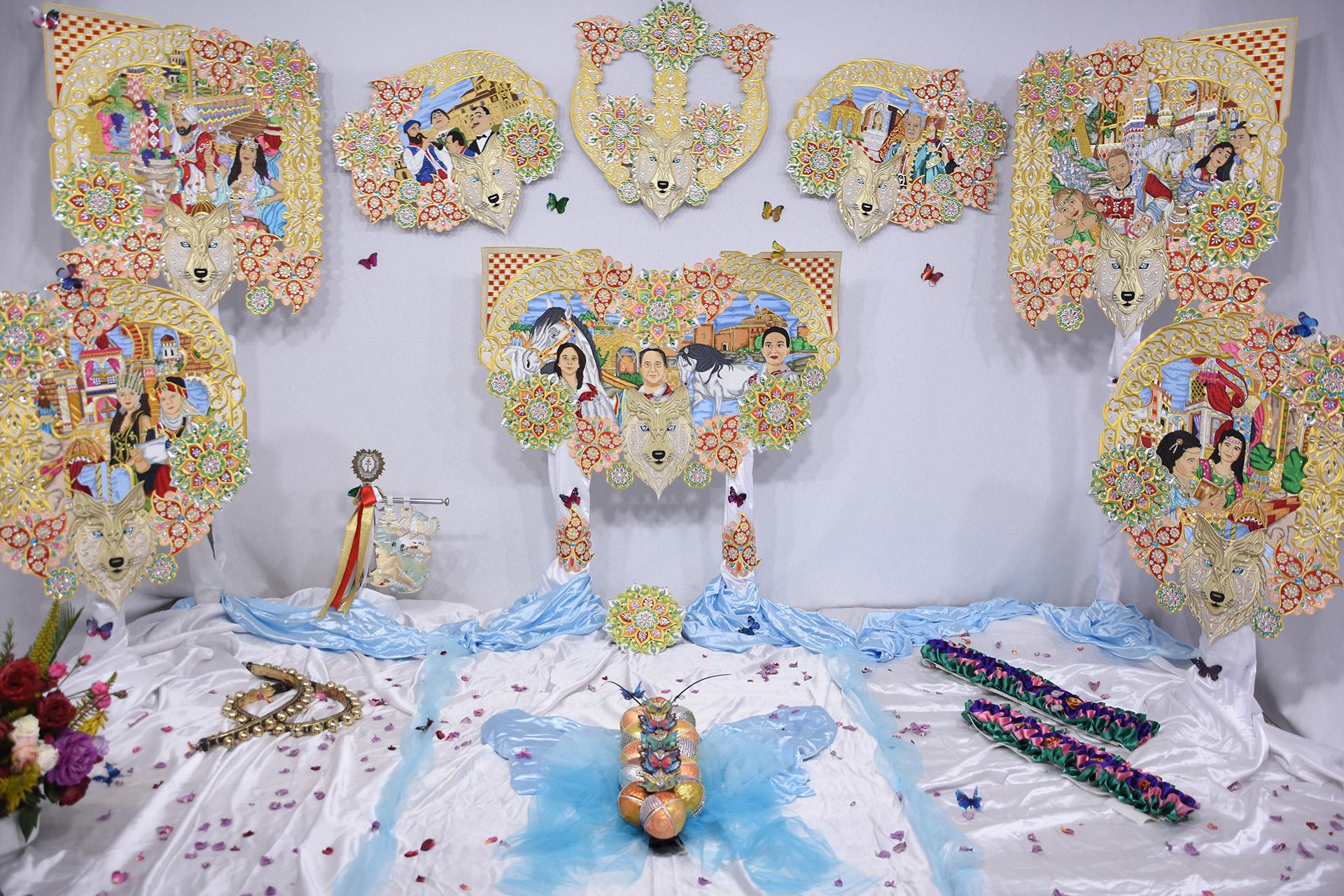
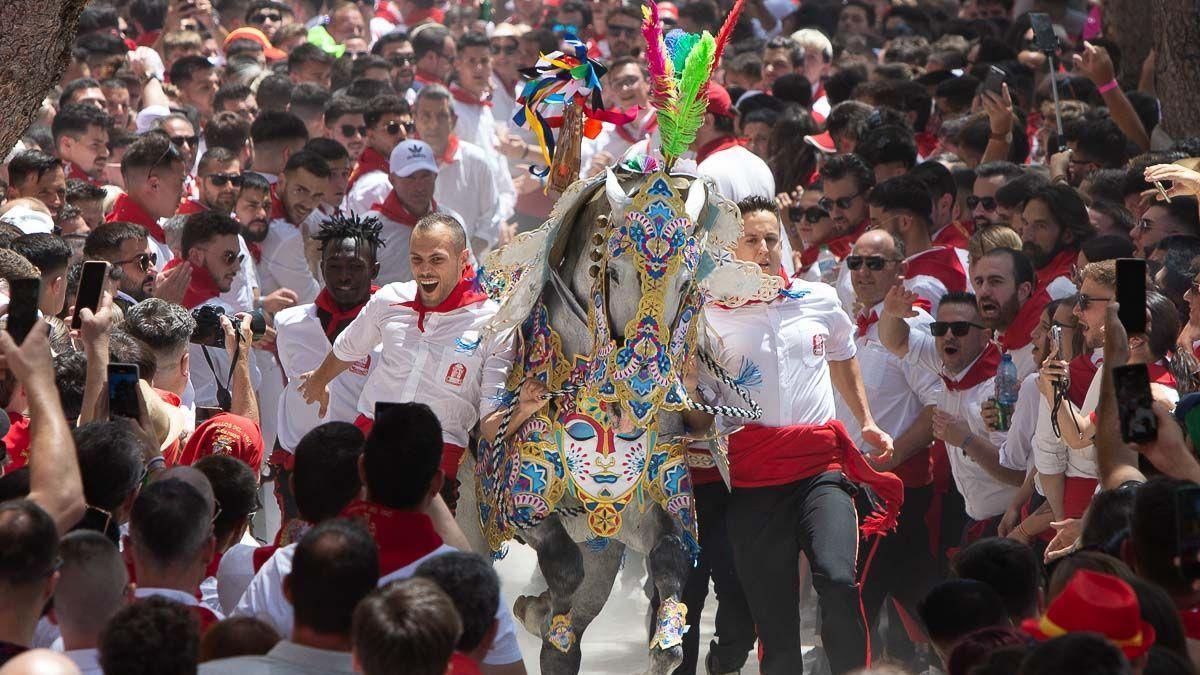
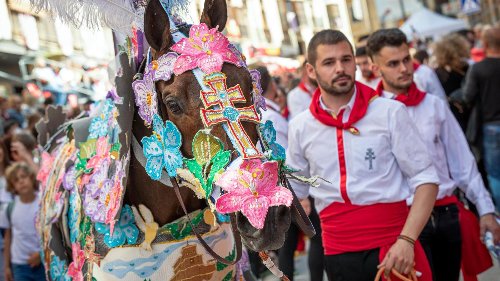
Every year from 1 to 3 May, the people of Caravaca de la Cruz in the Region of Murcia gather for the Wine Horses, a central tradition of the festivities dedicated to the Santísima y Vera Cruz. The horse is the protagonist of a sequence of activities that begins with its care throughout the year and culminates in its presentation, parade and celebrated ascent toward the castle. The most distinctive moment of the tradition is the enjaezamiento, the elaborate dressing of the horse in a complete set of embroidered pieces made with silk, coloured threads, gemstones and gold and silver ornamentation. Each set is specially produced for its horse and represents months of artistic and collective work.
The celebration brings together two knowledge systems that have long been connected to the identity of Caravaca: horse breeding and wine-growing. On 2 May, four caballistas run alongside each horse during the timed ascent of the steep Castle Hill, creating a demanding demonstration of coordination between people and animal. The festival also includes the presentation and exhibition of the embroidered mantos, allowing the community to appreciate the craftsmanship that can be difficult to see during the excitement of the race. UNESCO inscribed Wine Horses on the Representative List in 2020.
09-28-2026
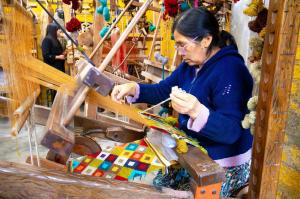
| Institutional and human capacities | The living structure of the Wine Horses is built around the local peñas caballistas, community associations that organize participation, finance the costly horse trappings and maintain teams of people with different responsibilities. The Bando de los Caballos del Vino provides an important coordinating structure, bringing together the peñas and supervising central activities of the celebration. Horse breeders, handlers, designers, embroiderers, craftsmen and families contribute different forms of knowledge, while the four caballistas accompanying each horse require extensive familiarity with the animal and the demanding conditions of the race. Embroidery has become one of the most specialized areas of local cultural knowledge. Contemporary enjaezamientos can contain numerous individually produced pieces, combining design, textile preparation, silk embroidery, metallic thread, decorative elements and precise fitting to the horse. Recent municipal programmes have specifically targeted younger people, including a 2025 training course in silk-and-gold embroidery for young participants and a 2026 professional training programme intended to strengthen the continuity of embroidery connected with the Wine Horses. | |
| Transmission and education | Transmission takes place through participation rather than through a single formal curriculum. Knowledge of caring for, breeding, harnessing and handling the horses is passed through families and groups, while embroidery knowledge is transmitted through workshops and families of embroiderers. Young people gradually become familiar with the celebration by accompanying older participants, observing preparations and taking on practical responsibilities within their peñas. Children are also deliberately included in safeguarding activities. UNESCO's inscription decision noted children's peñas, school workshops and activities designed to familiarize younger generations with the festival. Local schools have participated in educational activities concerning the history, symbolism and visual elements of the Wine Horses, while contemporary training programmes are providing more specialized opportunities for young people to learn silk-and-gold embroidery. | |
| Inventorying and research | Documentation of the Wine Horses combines institutional heritage records with knowledge maintained by the community itself. The tradition was declared an Intangible Asset of Cultural Interest by the Region of Murcia in 2011, and it was subsequently inscribed on the UNESCO Representative List in 2020. The national heritage inventory records the communities involved, the organization of the festival, the role of the peñas and the specialized production of the embroidered horse clothing. Community participation has been particularly important in documenting the tradition. The initiative for the UNESCO nomination came from local people, and the Bando and its associated peñas participated in the preparation and support of the nomination. The regional inventory is periodically updated with information supplied by the community concerning changes in the element and its current situation. The Caballos del Vino Museum also preserves objects, visual material and historical information concerning the development of the celebration and its distinctive craftsmanship. | |
| Policies as well as legal and administrative measures | Safeguarding of the Wine Horses has developed through several levels of recognition. In 2011, the Region of Murcia formally declared the Wine Horses of Caravaca de la Cruz an Intangible Asset of Cultural Interest. This provided a regional legal framework for recognizing the tradition as part of the cultural heritage of Murcia. The subsequent UNESCO inscription in 2020 strengthened its international visibility while maintaining the community of Caravaca at the centre of its safeguarding. Current measures increasingly address the continuity of the knowledge behind the celebration rather than simply preserving the festival as an annual event. Training programmes for embroidery, support for artisan activity, documentation, children's participation and the continued organization of the peñas all contribute to keeping the skills active. UNESCO has also emphasized that safeguarding should maintain strong community participation and pay particular attention to animal welfare and the possible effects of excessive tourism. | |
| Role of intangible cultural heritage and its safeguarding in society | The Wine Horses provide a powerful social space in which different forms of local knowledge become visible at the same time. The horse is not simply a racing animal: it connects breeders, handlers, embroiderers, families, peñas and spectators. The preparation of a horse and its manto requires cooperation over many months, while the final race transforms that preparation into a collective public experience. UNESCO describes comradeship and solidarity as important values expressed through the celebration. The tradition also connects contemporary Caravaca with its agricultural and equestrian history. Wine-growing and horse-breeding have historically formed part of the area's economy and cultural identity, while the festival continues to give those relationships a visible place in contemporary community life. The relationship between horse and human, based on care, coordination and collaboration, is itself considered knowledge transmitted between generations. | |
| Awareness raising | The embroidered mantos provide one of the most visible ways for the tradition to communicate its cultural meaning. Before the main race, peñas display their completed work so that residents and visitors can examine the embroidery closely. These exhibitions reveal details that can easily disappear when the horse is moving rapidly through the streets, and they allow the community to appreciate the artistic and technical work carried out throughout the year. The Caballos del Vino Museum further supports public understanding by presenting the historical development of the celebration and its changing forms of horse decoration. Contemporary exhibitions, educational activities and public demonstrations of embroidery bring the tradition beyond the two most intense days of the festival. In 2026, the Spanish Ministry of Culture's Museo del Traje also presented an exhibition and demonstration dedicated to Caravaca embroidery, extending public attention to the craftsmanship behind the horses. | |
| Engagement of communities, groups and individuals as well as other stakeholders | Participation in the Wine Horses is organized through a dense network of local relationships. The peñas are not merely competition teams: they provide a social framework through which people contribute money, labour, artistic skills, horse knowledge and organizational work. Their members prepare the animals, commission or produce the mantos, participate in parades and races, and collectively represent their neighbourhoods and social networks within the celebration. Community participation also extends beyond the direct competitors. Spectators follow the preparation of the mantos, discuss the designs, attend exhibitions and gather along the route of the race. The participation of children and younger members creates an additional pathway for continuity. The community's role was also evident in the UNESCO nomination itself: local people initiated the process and the associations of the Bando formally supported it. | |
| International engagement | The 2020 UNESCO inscription placed the Wine Horses within an international conversation about living equestrian heritage. The inscription recognizes not only the spectacular race but also the broader body of knowledge surrounding horse care, breeding, handling, embroidery and the relationship between humans and animals. It also provides an opportunity to compare Caravaca's tradition with other horse-centred cultural practices while preserving its distinctive local character. International visibility is therefore most meaningful when it continues to support the people who maintain the tradition in Caravaca. The challenge is to ensure that increased attention does not reduce the Wine Horses to a spectacular tourist event. UNESCO specifically highlighted the need to avoid excessive tourism and to keep animal welfare central to safeguarding. The continued development of local training, documentation, community organization and responsible public presentation allows the tradition to remain rooted in the people and skills that give it meaning. | |
| References |
|
|




.jpeg)


.png)
.jpeg)
.jpg)

.png)
.jpg)


_(31711258567).jpg)