
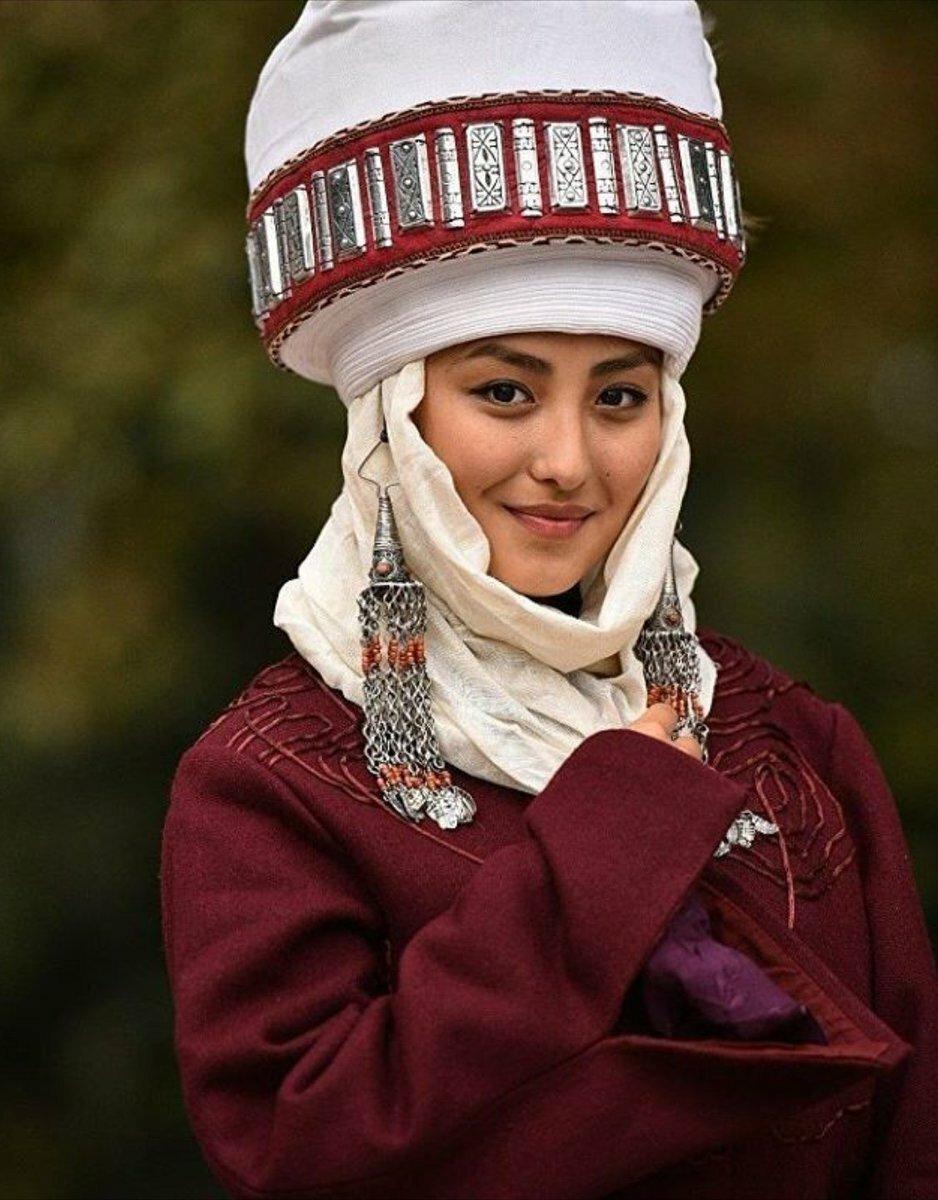
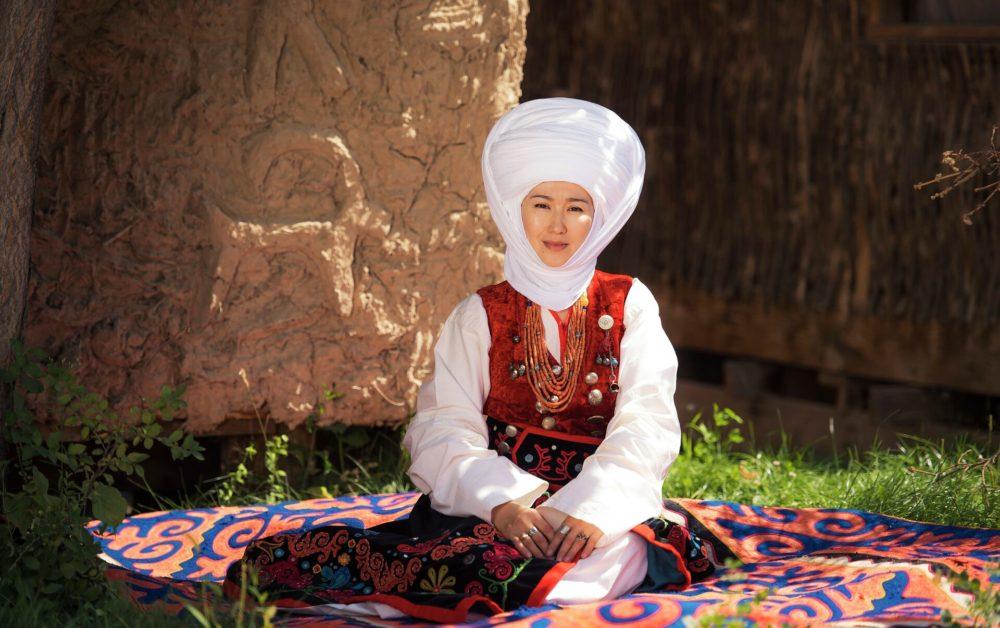
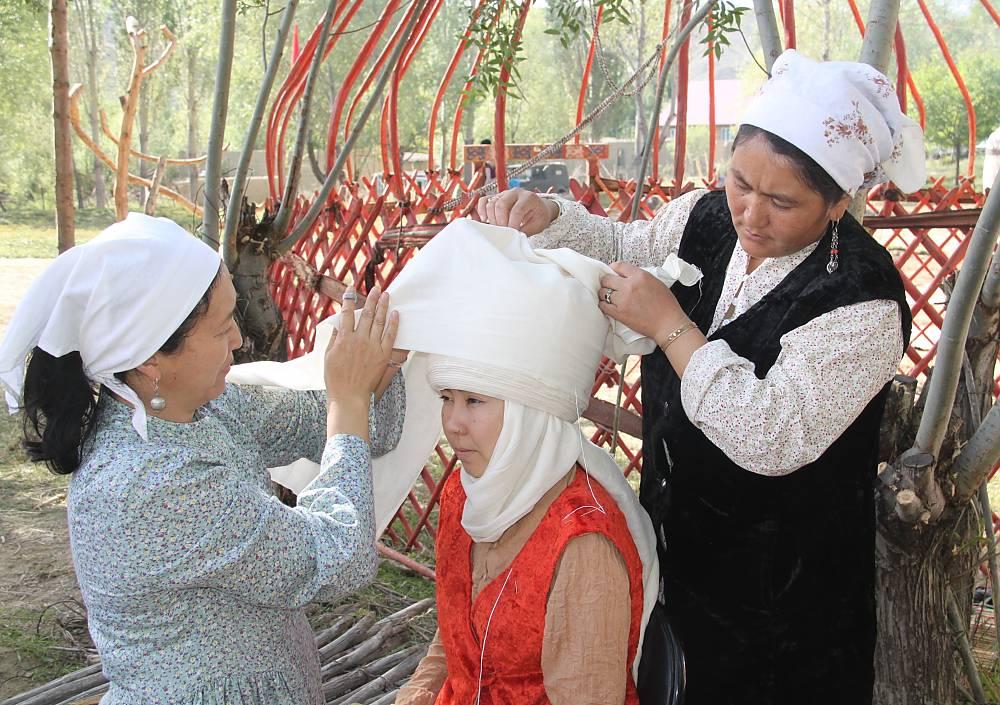
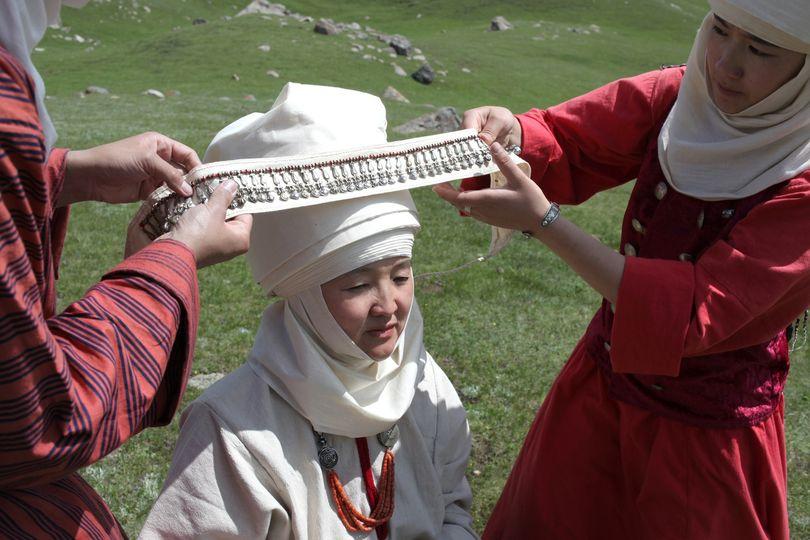
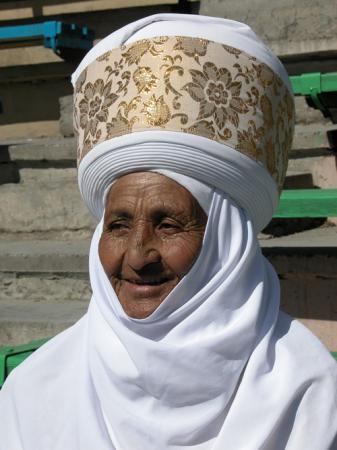
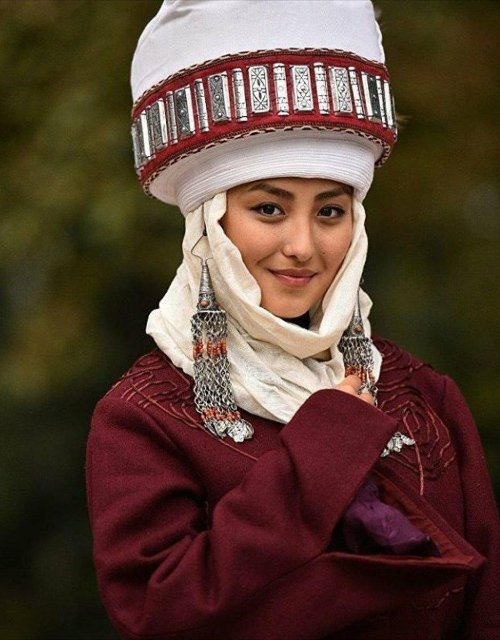
Elechek is a traditional Kyrgyz women's headdress consisting of a hair cap and a very long piece of white fabric wrapped around the head in many layers like a turban. The fabric may extend to around 40 metres and is finished with embroidery, ribbons and jewellery. Its most significant ceremonial use is the wrapping of a bride's first elechek at her family's home before she leaves to join the groom. The ritual marks a major transition in a woman's life and is accompanied by blessings, rhyming chants and good wishes for her future.
Elechek is not a single fixed design. Communities across Kyrgyzstan have developed different ways of wrapping and decorating it, reflecting local knowledge and aesthetic traditions. A married woman may wear the headdress at important occasions throughout her life, changing its form according to the occasion. In some mountainous communities, elechek has also remained part of everyday dress, demonstrating that the practice extends beyond the wedding ceremony into ordinary life.
09-21-2026
| Institutional and human capacities | The principal bearers of elechek knowledge are women, particularly mothers, grandmothers and other senior women who know how to prepare the fabric, wrap it correctly, create its decorative elements and conduct the associated rituals. The wrapping of a bride's first elechek is traditionally conducted by women from her family, giving experienced women an important role in guiding younger generations through a significant transition in life. Safeguarding has brought these community bearers into collaboration with cultural institutions, researchers and civil-society organizations. The Kiyiz Duino Public Foundation has supported workshops, documentation and community activities, while the UNESCO nomination involved representatives of communities, the Ministry of Culture, the National Commission, the National Academy of Sciences, NGOs and living-heritage specialists. | |
| Transmission and education | Elechek is traditionally transmitted informally from mothers to daughters and from older women to younger members of the community. Much of the knowledge is acquired by participating in wedding ceremonies and other family celebrations, where younger women observe the preparation and wrapping process and gradually learn the skills themselves. The transmission therefore combines practical technique with knowledge of appropriate occasions, decoration and ritual behavior. New forms of transmission have developed alongside these family-based practices. Women have organized workshops and demonstrations in different regions, while vocational-school activities have introduced students to wrapping techniques, embroidery and the making of elechek jewellery. Community festivals in places such as Tong District have also provided spaces where different wrapping styles and associated rituals can be demonstrated to younger generations and wider audiences. | |
| Inventorying and research | Elechek forms part of the Intangible Cultural Heritage National Inventory of the Kyrgyz Republic. The national inventory is administered through cooperation between cultural authorities, the National Academy of Sciences and the national intangible heritage structures, with updates drawing on information from communities, NGOs and individuals. Elechek itself was included in the national inventory in 2008 and supplemented in 2015. Community-based inventorying has been particularly important because there is no single national form of elechek. Activities conducted across all regions have documented different styles of wrapping, associated rituals, decorative knowledge and ways of wearing the headdress. The resulting documentation has also been transformed into educational video lessons, allowing knowledge recorded during inventory work to become a resource for further transmission. | |
| Policies as well as legal and administrative measures | The recognition of elechek has developed through a participatory national inventory and a community-supported UNESCO nomination. A working group established in 2019 brought together community representatives, government institutions, researchers, NGOs and heritage specialists to prepare the nomination. Community members provided free, prior and informed consent through written statements and filmed testimony. UNESCO subsequently inscribed Elechek on the Representative List in 2023. The safeguarding approach places continued transmission and documentation alongside public recognition. Rather than treating the headdress only as a material object, the national and international heritage framework recognizes the associated wrapping techniques, rituals, oral blessings, decorative skills and regional variations as interconnected knowledge. This approach helps maintain the living cultural context in which the headdress has meaning. | |
| Role of intangible cultural heritage and its safeguarding in society | The elechek ceremony provides a cultural space in which women accompany a bride as she moves from one stage of life to another. Elder women wrap the headdress while offering blessings and rhyming chants that express wishes for health, longevity, fertility, family harmony and a successful future. These spoken traditions connect the physical act of wrapping with values and knowledge transmitted through generations. Its social role continues after marriage. Elechek can accompany important occasions throughout a woman's life, while its different forms reflect changing circumstances and local customs. Through these uses, the headdress becomes a visible expression of belonging, family continuity and Kyrgyz women's cultural knowledge rather than simply an item of traditional clothing. | |
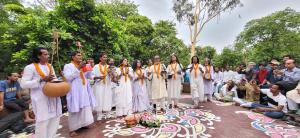
| Awareness raising | Public demonstrations and cultural festivals have helped make elechek knowledge visible to younger generations and urban audiences. In Bishkek, the 2018 “100 Elecheks in One Hour” initiative invited participants to learn wrapping techniques as part of the Oymo Festival and preparations surrounding the World Nomad Games. Such activities transformed a household and ceremonial practice into an accessible public learning experience. More recently, elechek has continued to appear in major cultural events. During the 2026 World Nomad Games, a large elechek procession was organized in Kyrchyn Gorge using 40 metres of fabric, presenting the headdress as a symbol of Kyrgyz heritage and drawing attention to the cultural role of women. Demonstrations and masterclasses have likewise introduced visitors to regional wrapping methods and the historical uses of different forms. | |
| Engagement of communities, groups and individuals as well as other stakeholders | Community engagement is embedded in the practice itself. The wedding wrapping ritual is carried out by women from the bride's family, while elder women provide practical guidance, blessings and ritual knowledge. Younger women learn by taking part in ceremonies and celebrations, creating a direct relationship between participation and transmission. The contemporary safeguarding process has expanded this network to include community associations, craftswomen, students, researchers and cultural institutions. Community-based activities across Kyrgyzstan have documented local variations rather than replacing them with a single standardized form. This emphasis on regional diversity allows different communities to remain active participants in defining and transmitting their own elechek knowledge. | |
| International engagement | Elechek became an internationally recognized element when Kyrgyzstan successfully nominated it to UNESCO's Representative List in 2023. The nomination process itself created international visibility for a practice that had previously been transmitted primarily through family and community settings. UNESCO's recognition places particular emphasis on the relationship between the physical headdress, traditional knowledge and the rituals surrounding its use. International engagement also provides opportunities for Kyrgyz communities to present the diversity of their women's heritage through exhibitions, cultural festivals, documentation and educational materials. The UNESCO documentation includes community photographs and video lessons showing regional styles, wrapping practices and ceremonial knowledge, allowing the practice to be encountered beyond the communities in which it continues to be lived. | |
| References |
|
|














.jpeg)



.png)






.jpeg)
.jpg)



.png)
.jpg)


_(31711258567).jpg)