
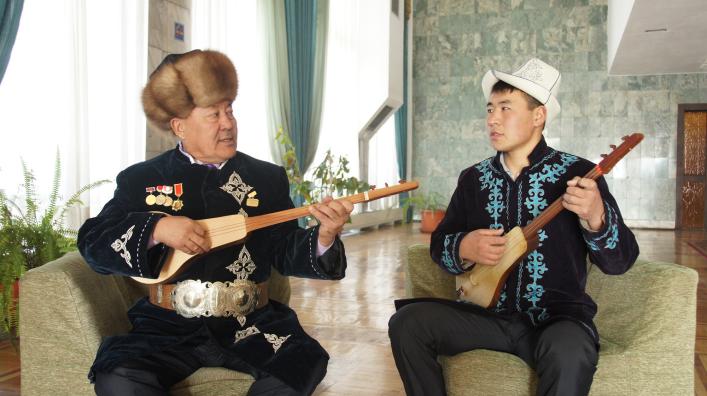
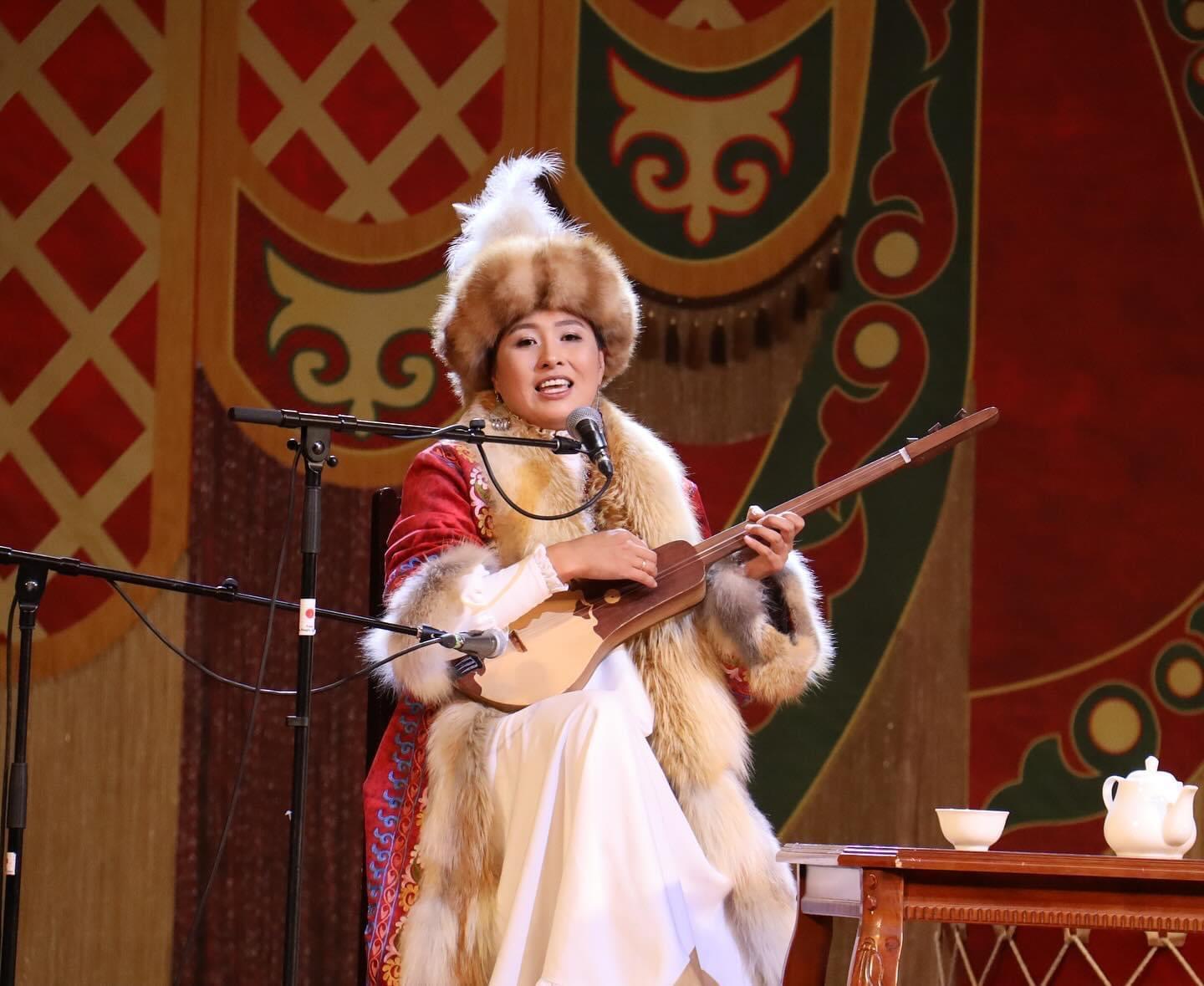
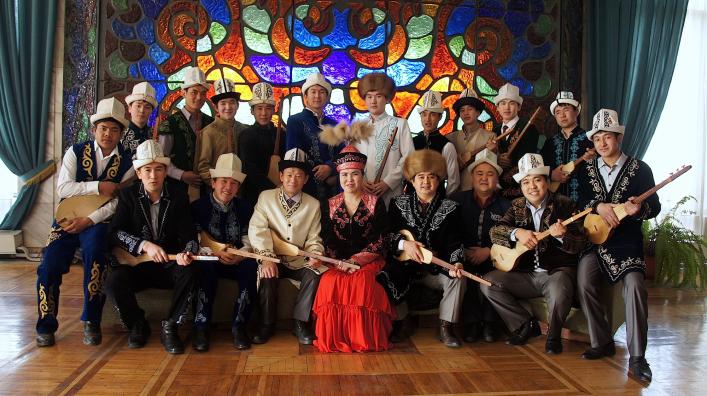
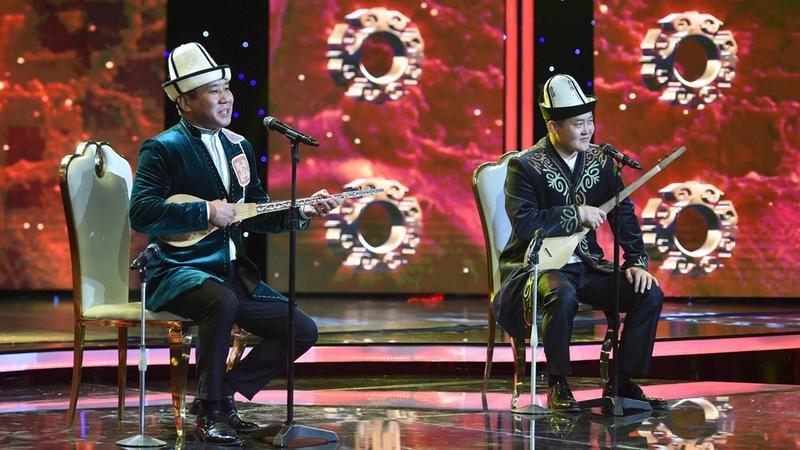
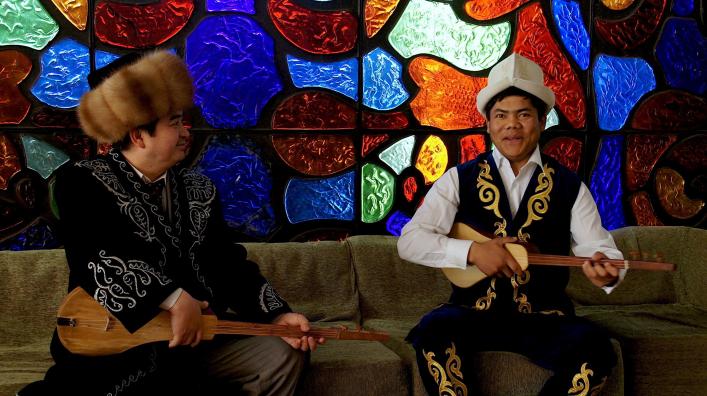
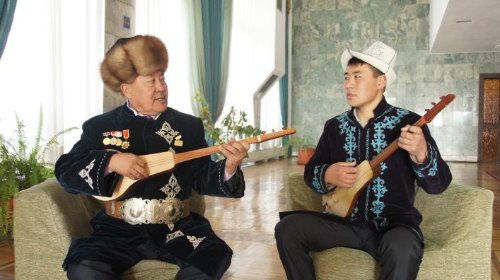
Aitysh is a living tradition of improvised oral poetry in which two akyns sit opposite one another and compose verses spontaneously in response to a topic, a question or the words of their counterpart. In Kyrgyzstan, the tradition is closely associated with the tokmo akyn, the poet-improviser who accompanies the performance on the komuz, Kyrgyzstan's traditional three-stringed instrument. The exchange can move rapidly between humor, satire, praise, philosophical reflection and observations about everyday life, requiring the performer to combine poetic language, musical rhythm, memory, wit and immediate judgment. UNESCO inscribed Aitysh/Aitys on the Representative List in 2015 as a shared element of Kyrgyzstan and Kazakhstan.
Within Kyrgyz communities, Aitysh has long been part of gatherings and celebrations, from family occasions to larger public events. The audience is not simply a passive observer: subjects may be proposed by those present, and the performers respond to the social atmosphere around them. This makes each encounter different. A successful tokmo akyn must listen carefully, understand the situation and transform it into poetry without preparation, turning the performance into a form of public conversation in which language itself becomes the instrument of exchange.
09-18-2026
| Institutional and human capacities | The principal bearers of the Kyrgyz tradition are the tokmo akyns, whose abilities extend well beyond memorizing a repertoire. They develop command of poetic forms, vocabulary, melody, rhythm, performance, humor and the cultural references needed to respond appropriately to changing subjects. The tradition also depends on musicians and teachers who support the performers, while researchers and cultural institutions contribute to its documentation and study. Kyrgyzstan's safeguarding approach recognizes the tokmo akyn community as an active participant rather than merely an object of documentation. The UNESCO nomination included direct evidence of community consent, including statements from practitioners themselves. The continuing presence of established and younger tokmo akyns provides the human foundation through which the art remains a practiced skill rather than simply a recorded literary form. | |
| Transmission and education | Aitysh is learned through close contact with experienced performers. Older akyns transmit poetic and musical knowledge to younger practitioners, traditionally through observation, imitation and repeated performance. The learner gradually develops the ability to compose verses while maintaining rhythm and musical accompaniment, eventually moving from guided participation toward independent improvisation. UNESCO's safeguarding framework specifically identifies both formal and non-formal transmission as priorities. The educational process also develops qualities that cannot be acquired from written texts alone: speed of thought, attentive listening, confidence before an audience, sensitivity to language and the ability to construct an appropriate response within seconds. UNESCO documentation records meetings between older and younger generations of tokmo akyns as well as a traditional teacher-to-follower educational process, demonstrating that intergenerational contact remains central to the practice. | |
| Inventorying and research | Aitysh was included in Kyrgyzstan's national intangible cultural heritage inventory in 2007, providing an early institutional record of the practice before its international inscription. The UNESCO nomination subsequently brought together community practitioners, researchers and public institutions to document the element and demonstrate its continued practice. Documentation is particularly important for an art whose essential material is created in the moment. Recording performances preserves not only individual verses but also melodies, rhythms, styles of delivery, interaction between performers and responses from audiences. Research therefore contributes to understanding Aitysh as both an oral tradition and a performing art, while avoiding the assumption that a fixed written repertoire can fully represent an improvisational practice. | |
| Policies as well as legal and administrative measures | The national inventory established a foundation for the recognition and safeguarding of Aitysh within Kyrgyzstan. Its subsequent inscription on the UNESCO Representative List in 2015 was undertaken jointly with Kazakhstan, reflecting the historical and cultural connections across the two countries. UNESCO's Committee emphasized that safeguarding measures should respect this multinational character and encourage coordination between the two States Parties. The safeguarding framework includes strengthening formal and non-formal transmission, continuing documentation and research, promoting the tradition publicly and monitoring its implementation. These measures are particularly relevant to Aitysh because its continuity depends on maintaining opportunities for actual performance: a poetic art based on spontaneous exchange can only remain alive when practitioners continue to meet, perform, compete and respond to audiences. | |
| Role of intangible cultural heritage and its safeguarding in society | Aitysh gives communities a distinctive space for discussing the world around them through poetry. Performers can address everyday experiences, relationships, local concerns and wider social questions while using humor and verbal creativity to engage their listeners. UNESCO identifies the practice as a platform for social communication and recognizes that performers may use competitions to raise important social issues. The value of the tradition therefore lies not only in preserving old poetic forms but also in maintaining the ability to speak creatively about the present. Each performance brings inherited knowledge into contact with a new situation, allowing the tradition to remain responsive to changing communities and circumstances. The most memorable expressions can circulate beyond the original performance and enter wider popular use as sayings or memorable phrases. | |
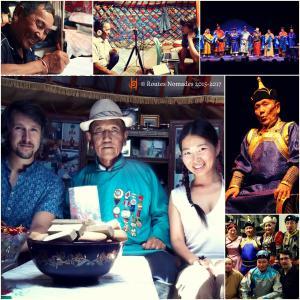
| Awareness raising | Aitysh continues to appear at local celebrations, cultural gatherings and major public events throughout Kyrgyzstan. Its public visibility allows audiences who may not themselves practice improvisational poetry to encounter the tradition as a living performance rather than as an archival form. Contemporary cultural programmes can also bring younger performers into contact with established akyns, creating public spaces where skills and styles become visible across generations. Large cultural gatherings provide additional opportunities for the tradition to reach diverse audiences. At Kyrgyzstan's international nomadic-cultural events, for example, Aitysh can be presented alongside traditional music, crafts and other forms of cultural expression, while performances involving Kyrgyz and Kazakh akyns demonstrate the shared heritage of the two communities. | |
| Engagement of communities, groups and individuals as well as other stakeholders | Community participation is built into the structure of Aitysh itself. Unlike a performance in which the audience simply receives a prepared text, Aitysh develops through interaction. Listeners can influence the themes addressed by the performers, while their reactions help shape the atmosphere and direction of the exchange. The community therefore forms part of the social environment in which improvisation acquires meaning. The tradition has also become more inclusive in its contemporary practice. Although Aitysh was historically performed primarily by men, UNESCO notes that many women now participate and use the form to express their own aspirations and viewpoints. The presence of both established and emerging performers, together with audiences, teachers, researchers and cultural organizations, creates a broader network through which the practice continues to develop. | |
| International engagement | Aitysh/Aitys is a shared cultural tradition of Kyrgyzstan and Kazakhstan, and its UNESCO inscription in 2015 was submitted jointly by the two countries. The Kyrgyz expression is particularly associated with the tokmo akyn and komuz, while the Kazakh form is associated with the akyn and dombra. Recognizing these distinctions allows each community to maintain its own performance traditions while acknowledging their shared cultural foundations. International recognition has also encouraged greater attention to the transmission and visibility of oral improvisation in Central Asia. UNESCO's Committee specifically encouraged the States Parties to promote the element internationally while making its lyrics more accessible through translation. Continued encounters between Kyrgyz and Kazakh akyns provide a particularly direct form of cultural exchange: the shared heritage is not presented as a fixed historical object, but experienced through performers responding to one another in real time. | |
| References |
|
|














.jpeg)







.png)







.jpeg)
.jpg)

.png)
.jpg)


_(31711258567).jpg)