
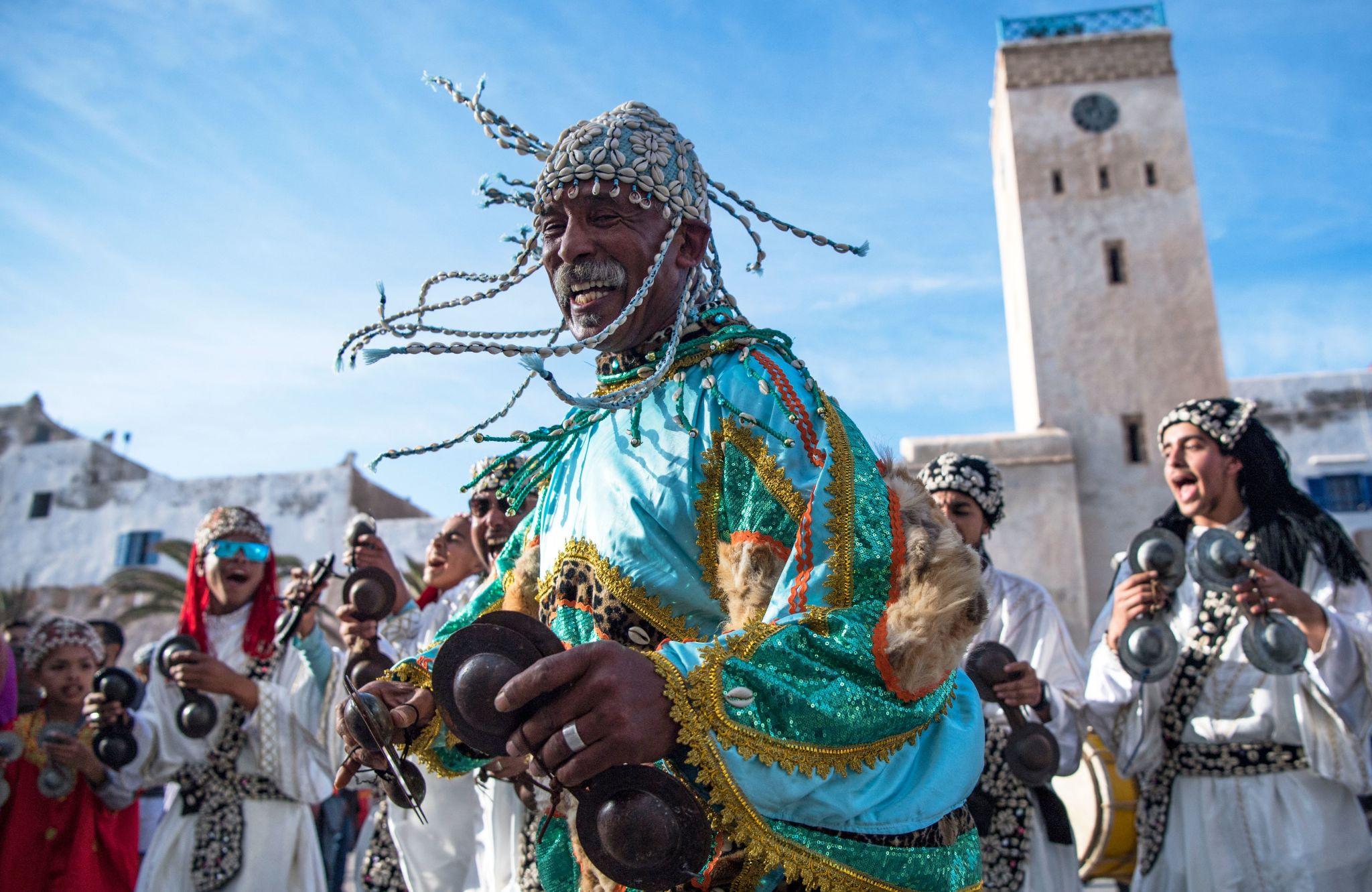
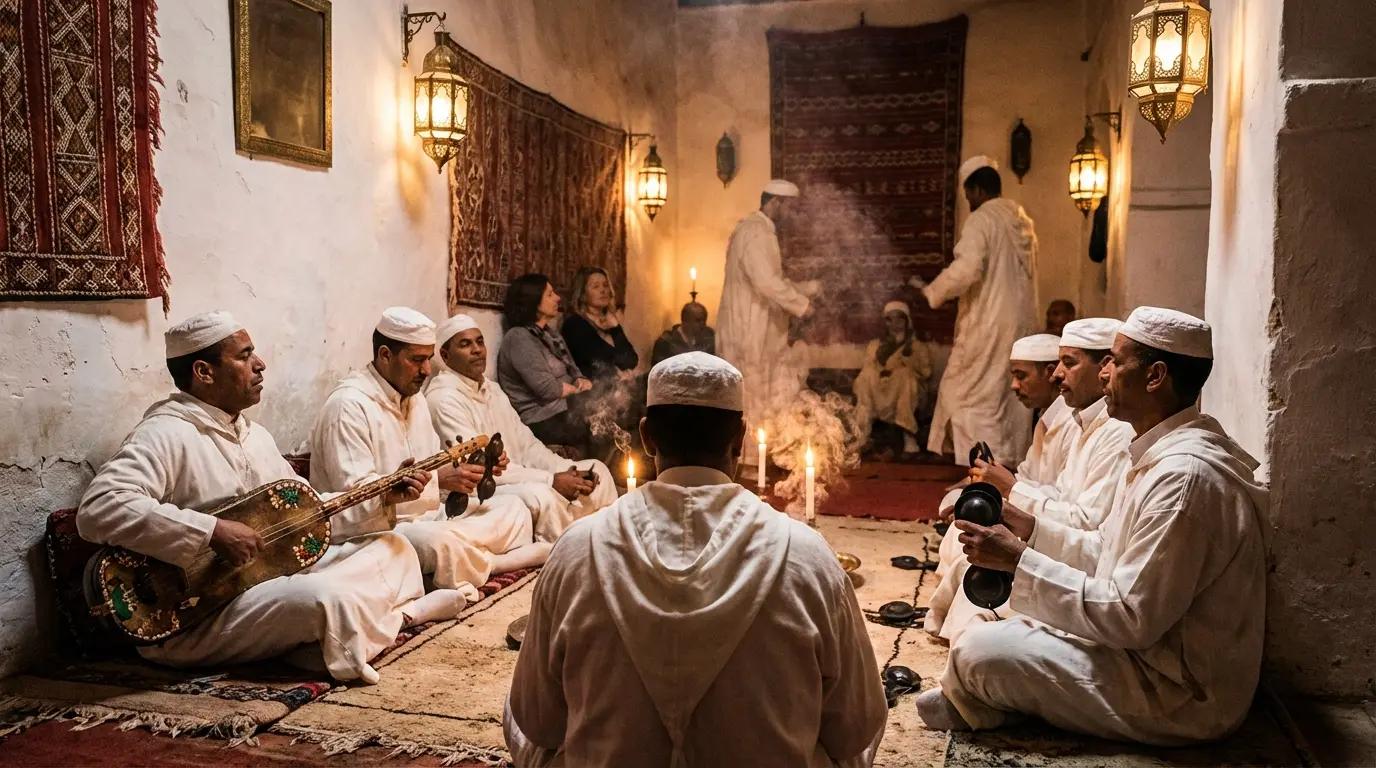
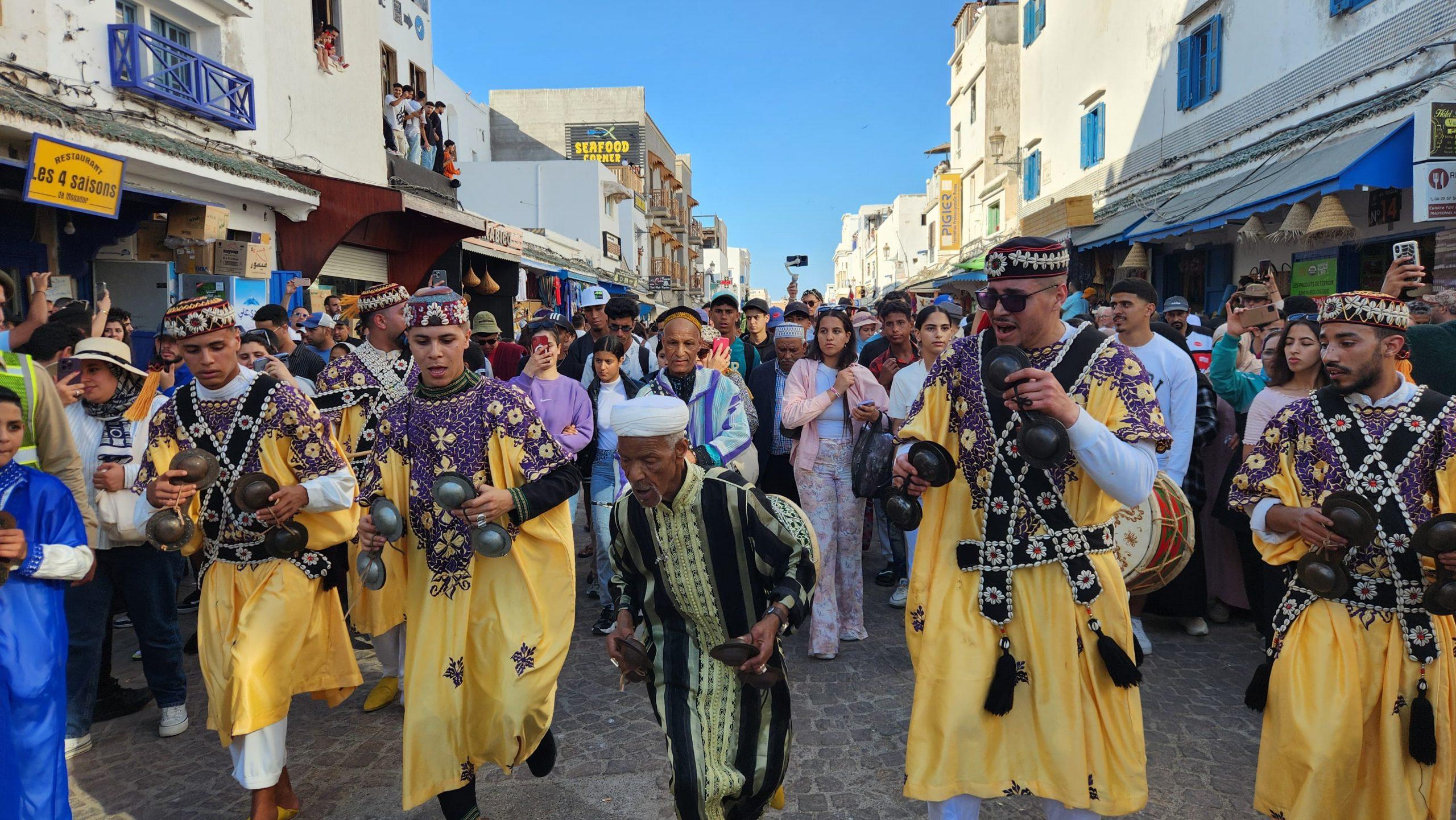
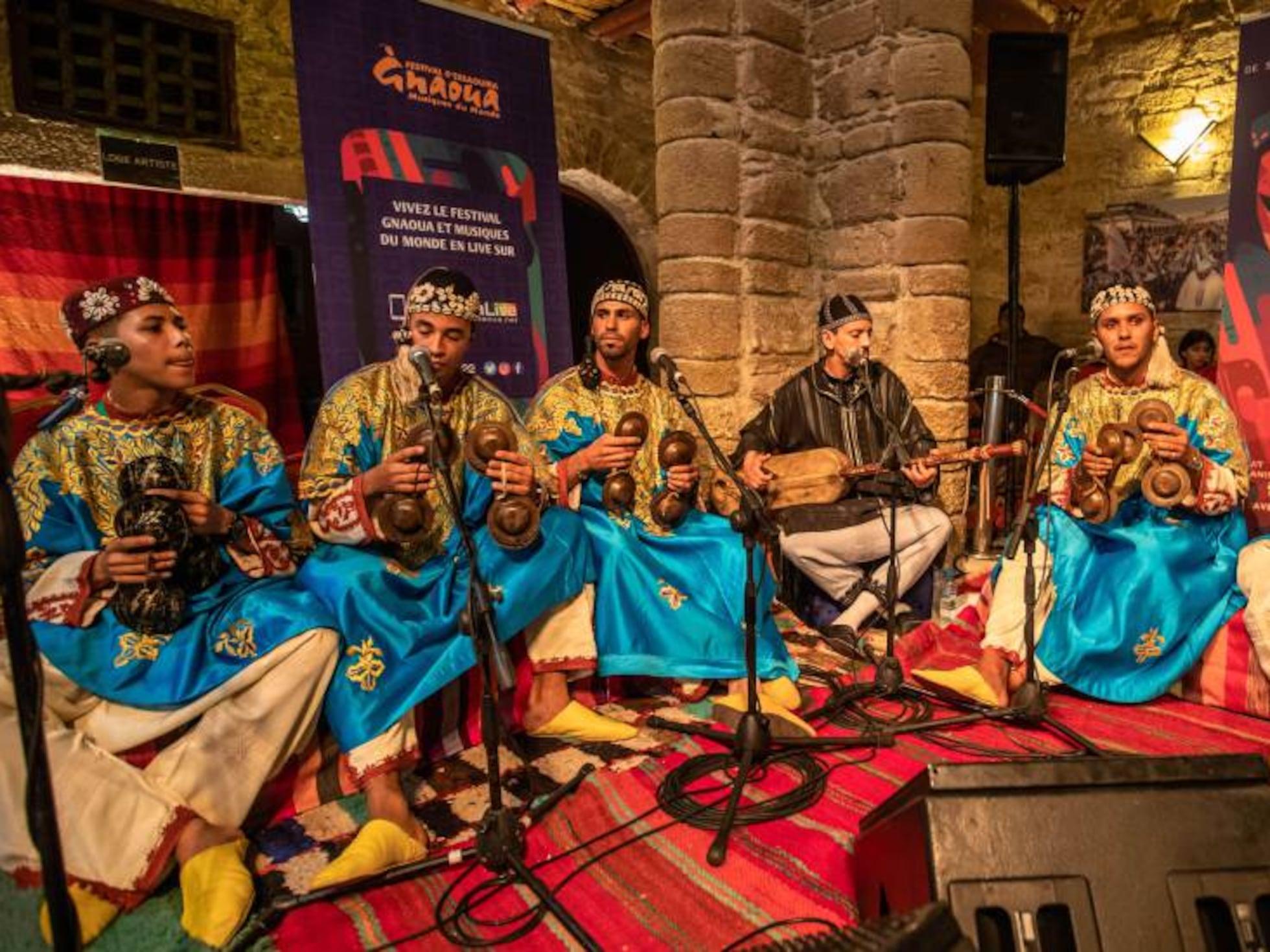
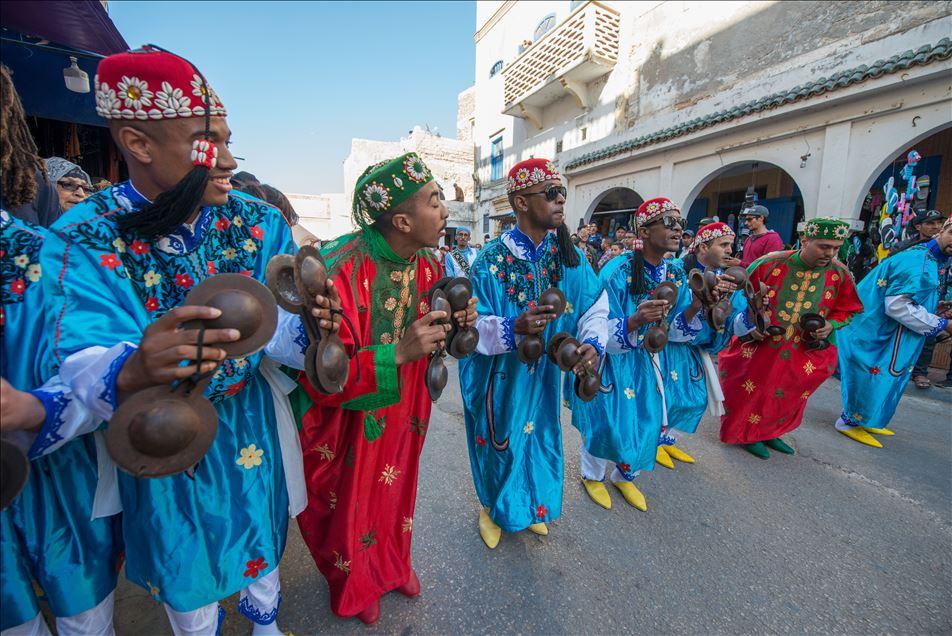
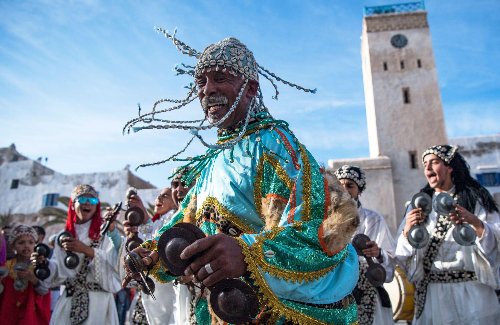
Gnawa is a living Moroccan tradition in which music, dance, fraternal practices and therapeutic rituals come together across sacred and secular settings. Its musical language is led by the maâlem, the master musician, whose guembri accompanies sung poetry and is answered by the metallic rhythm of the qraqeb castanets, collective singing and dance. In ritual contexts, performances may form part of an overnight lila, where music, movement, invocation and communal participation create a sustained ceremonial experience. The tradition carries memories of communities whose histories are connected to sub-Saharan Africa, while its contemporary practice has become an established part of Morocco's diverse cultural identity. UNESCO inscribed Gnawa on the Representative List of the Intangible Cultural Heritage of Humanity in 2019.
Essaouira has become one of the most visible centers of Gnawa practice, with generations of maâlems developing distinctive musical lineages and transmitting knowledge through families, apprenticeships and community performance. Yet Gnawa extends well beyond Essaouira, with practitioners and brotherhoods active in cities and rural areas throughout Morocco. Its strength lies in the ability of musicians and communities to maintain the ritual and musical foundations of the tradition while allowing it to remain present in contemporary cultural life.
09-18-2026
| Institutional and human capacities | The maâlem remains central to Gnawa's human heritage. Becoming a master involves more than learning to play the guembri: practitioners acquire songs, rhythms, ceremonial sequences, dance, knowledge of ritual contexts and the responsibilities associated with guiding performances. Transmission has traditionally taken place through close observation and practical participation, often within families or through relationships between experienced masters and younger musicians. Contemporary Essaouira continues to demonstrate this lineage-based transmission, with younger practitioners learning directly from established maâlems. Safeguarding is supported by Moroccan cultural institutions alongside community organizations and practitioners. The Yerma-Gnaoua Association played a central role in initiating the UNESCO nomination in 2013 and in bringing practitioners and public institutions together during the preparation of the nomination and safeguarding measures. UNESCO's decision identifies documentation, academic research, communication, awareness raising, and financial and logistical support as the principal safeguarding axes developed with the communities. | |
| Transmission and education | Gnawa knowledge is transmitted through participation rather than through musical notation alone. Young musicians learn melodies, rhythms, lyrics and instrumental techniques by listening to masters, practicing alongside experienced performers and gradually taking on greater responsibilities. In Essaouira, established maâlems continue to train younger musicians, while contemporary festivals create opportunities for emerging performers to appear alongside senior practitioners. Recent festival programming has explicitly presented intergenerational transmission as part of the living tradition. This transmission also extends beyond the instruments themselves. Young practitioners encounter the social and ceremonial dimensions of Gnawa through community gatherings, performances and rituals, learning how music functions within relationships between musicians, participants and audiences. Contemporary training initiatives, including workshops and music-development programmes associated with the Essaouira festival, provide additional spaces where traditional knowledge can meet new generations and new forms of musical practice. | |
| Inventorying and research | Gnawa was incorporated into the Inventory and Documentation of Moroccan Cultural Heritage in 2015, with the process involving practitioners and communities during festivals and special events. The Directorate of Cultural Heritage within Morocco's Ministry of Culture is responsible for maintaining and updating the national inventory. Community participation was also central to the UNESCO nomination, with the Yerma-Gnaoua Association supporting the documentation process and the preparation of the nomination file. Documentation has extended beyond listing the element itself to recording its practitioners, performances and associated knowledge. Morocco's safeguarding framework identified documentation and archiving as one of its principal areas of action, alongside academic and university research. The resulting record provides a basis for understanding Gnawa not simply as a musical genre but as a broader cultural practice encompassing ritual, social relationships, performance and transmission. | |
| Policies as well as legal and administrative measures | The national inventory provided an institutional foundation for Gnawa's recognition, while the community-led nomination process brought practitioners directly into discussions about how the tradition should be safeguarded. UNESCO's 2019 decision recognized that the proposed safeguarding measures had been developed together with the communities concerned and that Moroccan state institutions would provide financial support for their implementation. The UNESCO inscription does not replace community transmission; instead, it provides an international framework supporting continued safeguarding. The nomination process itself demonstrated a model in which community organizations, practitioners, researchers and government institutions contributed to documenting the tradition and defining measures for its continuity. UNESCO also specifically encouraged Morocco to give greater attention to recognizing the active role of women in Gnawa practice. | |
| Role of intangible cultural heritage and its safeguarding in society | Gnawa provides a cultural space in which music connects memory, spirituality, community relationships and historical experience. Its repertoire, ritual practices and musical lineages preserve knowledge carried through generations, while collective performance creates opportunities for people to participate in a shared cultural experience. In ritual settings, music and movement may take on therapeutic dimensions, while in other settings Gnawa functions through communal gatherings, celebrations and public performance. The tradition also demonstrates how cultural heritage can remain socially meaningful while entering new environments. In contemporary Morocco, Gnawa is performed in intimate community settings, public spaces and major festivals, allowing the same musical heritage to operate across different contexts. The continuing presence of master musicians and younger performers shows how safeguarding can involve both maintaining inherited knowledge and creating space for its contemporary expression. | |
| Awareness raising | The Gnaoua and World Music Festival of Essaouira, established in 1998, has become an important public platform for Gnawa musicians and for encounters between Gnawa and other musical traditions. Its programme brings maâlems together with musicians from Morocco and abroad, while concerts, discussions and educational activities create opportunities for audiences to encounter the tradition in different forms. In 2026, the festival brought more than 400 artists, including 42 maâlems, into performances across Essaouira. Public awareness also takes place within everyday cultural spaces. Gnawa musicians perform in Moroccan cities and participate in local, regional and national festivals, allowing the tradition to remain visible beyond specialized heritage events. UNESCO's documentation itself records urban processions, rural gatherings and other community settings, reflecting the variety of contexts through which Gnawa continues to be practiced. | |
| Engagement of communities, groups and individuals as well as other stakeholders | Community participation has been fundamental to the safeguarding of Gnawa. The Yerma-Gnaoua Association initiated the UNESCO nomination, while practitioners and communities participated in meetings, workshops, festivals and activities connected with documenting the tradition and developing safeguarding measures. UNESCO specifically recognized the community's role throughout the nomination process and noted the evidence of community consent provided through personalized video testimony. The living community includes maâlems, musicians, dancers, ritual participants, families, associations and audiences whose involvement gives the tradition its social character. The continued emergence of younger performers in Essaouira demonstrates that participation is not limited to preserving an older repertoire: new practitioners are entering established lineages, forming their own groups and carrying the music into contemporary cultural spaces. | |
| International engagement | Gnawa's international presence has grown alongside its continued community practice in Morocco. Essaouira's festival has created sustained encounters between Moroccan maâlems and musicians from Africa, Europe, the Americas and other regions, producing collaborations that place Gnawa instruments and rhythms into dialogue with jazz, blues, African music and contemporary genres. These encounters have allowed practitioners to reach international audiences while maintaining the identity of Gnawa as a Moroccan living tradition. International engagement also operates through cultural research and institutional exchange. The 2026 festival continued partnerships involving universities and international music institutions, including programmes focused on Gnaoua culture, its origins, hybridizations and contemporary expressions. Such initiatives connect practitioners, researchers and students while creating additional spaces for the knowledge surrounding Gnawa to be studied, discussed and transmitted. | |
| References |
|
|





.jpeg)

.png)


.jpeg)
.jpg)

.png)
.jpg)


_(31711258567).jpg)