
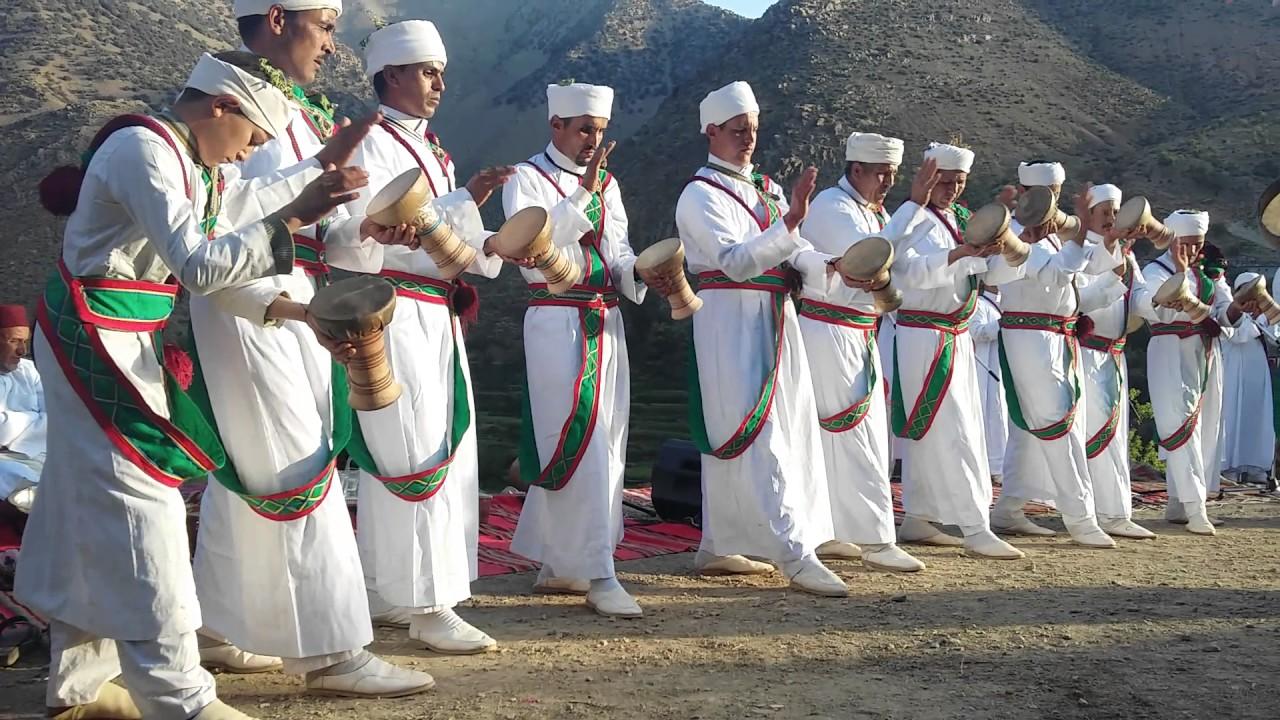
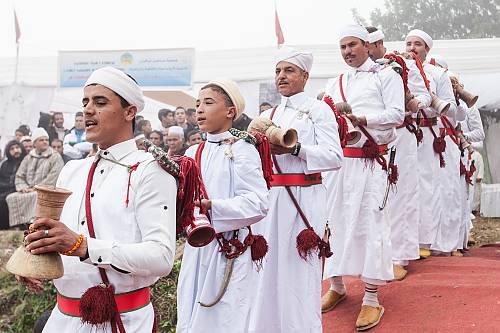
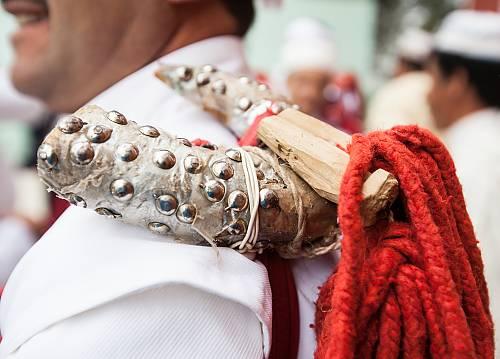
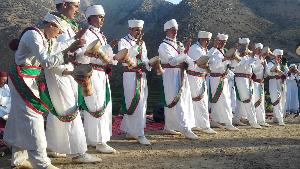
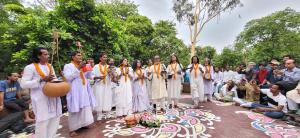
Taskiwin is a collective dance rooted in the western High Atlas of central Morocco. Its name comes from the richly decorated tiskt, the horn traditionally carried by each dancer. A group performs coordinated shoulder movements to the rhythm of tambourines and flutes, creating a highly physical choreography in which rhythm, posture and collective synchronization are inseparable. Historically associated with martial imagery, bravery and episodes of conflict, the dance has developed into a form performed during celebrations and community gatherings, where its social role is now more prominent than its martial origins.
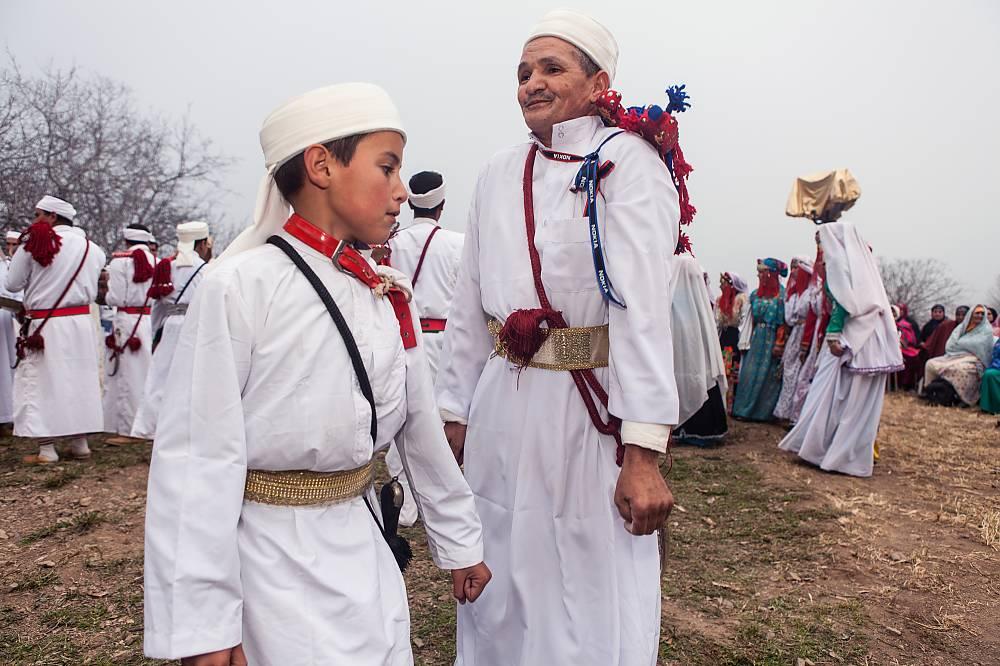
The practice is particularly associated with rural communities on the northern and southern slopes of the western High Atlas in Taroudant Province, including Touramat and Tigouliane. Its meaning comes not only from the movements but from the gathering itself: dancers, musicians and spectators share a performance space in which local memory, Amazigh expression and community relationships are renewed. The dance's characteristic shoulder movements, percussion, flutes and decorated accessories together form a recognizable cultural vocabulary of the High Atlas.
09-16-2026
| Institutional and human capacities | Taskiwin has traditionally depended on experienced dancers and musicians who learned by watching and participating alongside older practitioners. This human knowledge extends beyond choreography to the preparation of the musical instruments and the making and decoration of the accessories used in performances. The decline of these crafts has therefore been treated as part of the safeguarding challenge rather than as a separate issue. Morocco's safeguarding efforts have gradually created a wider network around these practitioners. Community associations established in the western High Atlas were followed by the formation of the National Taskiwin Federation, while the Ministry of Culture has supported practitioners, festivals and training activities. The national festival has also created opportunities for groups from different regions to meet, perform and exchange knowledge. | |
| Transmission and education | For generations, Taskiwin was learned informally: young people watched experienced dancers, joined performances and gradually acquired the movements, rhythms and coordination required to participate. This direct form of learning remains fundamental because the dance depends on bodily knowledge that is difficult to separate from the social environment in which it is performed. UNESCO identifies this informal transmission as one of the defining characteristics of the practice. Safeguarding has increasingly added educational activities to this traditional process. Morocco's safeguarding plan has included training workshops for young people, school clubs and cooperation with educational institutions, particularly in Taroudant. The national reporting process has also emphasized the importance of maintaining the communities' mother tongue as part of transmission, recognizing that the cultural context surrounding the dance matters as much as learning its physical movements. | |
| Inventorying and research | Taskiwin was incorporated into Morocco's National Inventory of Intangible Cultural Heritage in 2014, with the participation of the communities concerned. The Cultural Heritage Directorate within the Ministry of Culture is responsible for administering and periodically updating the inventory. This gave the communities a formal means of documenting a practice that had previously been maintained primarily through living transmission. Research has continued alongside safeguarding. Field missions have been used to identify and document Taskiwin groups and practices, while festivals have incorporated conferences, exhibitions and exchanges with researchers and students. Particular attention has also been directed toward documenting instrument-making and accessory-making skills, since the disappearance of these crafts would directly affect the ability of dancers to maintain the traditional form of the performance. | |
| Policies as well as legal and administrative measures | Taskiwin's inclusion in Morocco's national inventory established the first formal layer of state recognition. In 2017, Morocco successfully nominated the practice for UNESCO's List of Intangible Cultural Heritage in Need of Urgent Safeguarding, explicitly acknowledging that the tradition had become restricted to a limited number of villages and faced serious transmission problems. The resulting safeguarding framework has developed around several interconnected measures: strengthening associations, creating the National Taskiwin Federation, supporting practitioners, organizing a recurring national festival, establishing youth training, documenting the practice and developing funding partnerships. The 2022 UNESCO examination specifically noted these measures and encouraged Morocco to continue annual festivals, educational transmission and documentation of both the dance and its associated crafts. | |
| Role of intangible cultural heritage and its safeguarding in society | Although Taskiwin carries the visual language of a martial dance, its contemporary social function is broader. UNESCO notes that the practice has evolved from its martial origins and now accompanies celebrations, helps resolve tensions within or between communities and encourages social integration. Its coordinated movements require participants to act together, turning physical performance into a demonstration of collective harmony. For young people in the western High Atlas, the dance has also functioned as a means of socialization. Its importance therefore lies not only in preserving an old choreography but in maintaining a setting where generations can meet, perform together and recognize a shared cultural vocabulary. Safeguarding Taskiwin consequently means maintaining the social circumstances that allow people to dance it, rather than preserving only a sequence of movements on a stage. | |
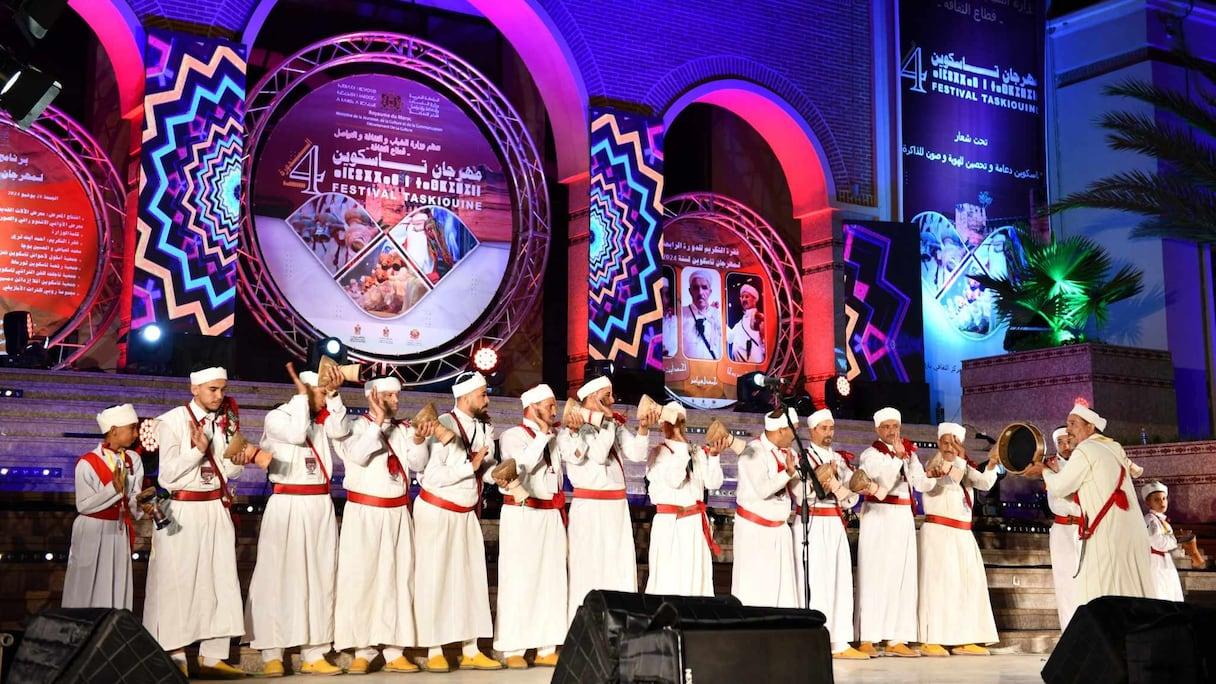
| Awareness raising | The creation of the National Taskiwin Festival has become one of Morocco's principal public mechanisms for raising awareness. Held in Taroudant and involving groups from different regions, the festival combines performances with conferences, exhibitions and recognition of senior practitioners. The 2024 fourth edition brought together 15 popular groups and included an exhibition demonstrating the manufacture of Taskiwin accessories. The festival has consequently become more than a performance event. It provides a public setting in which younger generations can see experienced practitioners, researchers can discuss the tradition, craftspeople can demonstrate associated knowledge and communities can present their own forms of Taskiwin to wider Moroccan audiences. The fifth national edition was held in Taroudant in October 2025 under the theme of ensuring the continuity of the tradition. | |
| Engagement of communities, groups and individuals as well as other stakeholders | The safeguarding of Taskiwin has involved a notably broad group of participants. During the UNESCO nomination process, elderly practitioners, young people, women, different categories of bearers, researchers and local stakeholders participated in consultations and provided community consent. This participation was important because the nomination was initiated through a local association rather than being imposed solely as a government heritage project. Community engagement has continued through associations, local dance groups, the National Taskiwin Federation, festivals and educational activities. The emergence of new associations in villages has provided organizational structures through which practitioners can coordinate performances and safeguarding activities. The challenge remains to keep participation meaningful enough that Taskiwin continues to function as a community practice rather than becoming only a staged representation of rural heritage. | |
| International engagement | Morocco's international engagement around Taskiwin is centered on UNESCO's urgent safeguarding framework. The nomination process was supported through UNESCO International Assistance, which helped the local Targa-Aide association work with communities, elected representatives, the Cultural Heritage Directorate and researchers to prepare the nomination dossier between 2014 and 2016. The 2017 inscription subsequently connected local safeguarding in the western High Atlas with international mechanisms for protecting endangered living heritage. Morocco has continued reporting to UNESCO on the condition of Taskiwin, with the most recent periodic report submitted in December 2025. The international process has therefore functioned not simply as recognition, but as a continuing framework through which Morocco reports on transmission, youth involvement, documentation and the viability of the tradition. | |
| References |
|
|










.jpeg)




.png)






.jpeg)
.jpg)


.png)
.jpg)


_(31711258567).jpg)