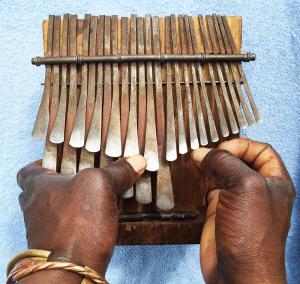

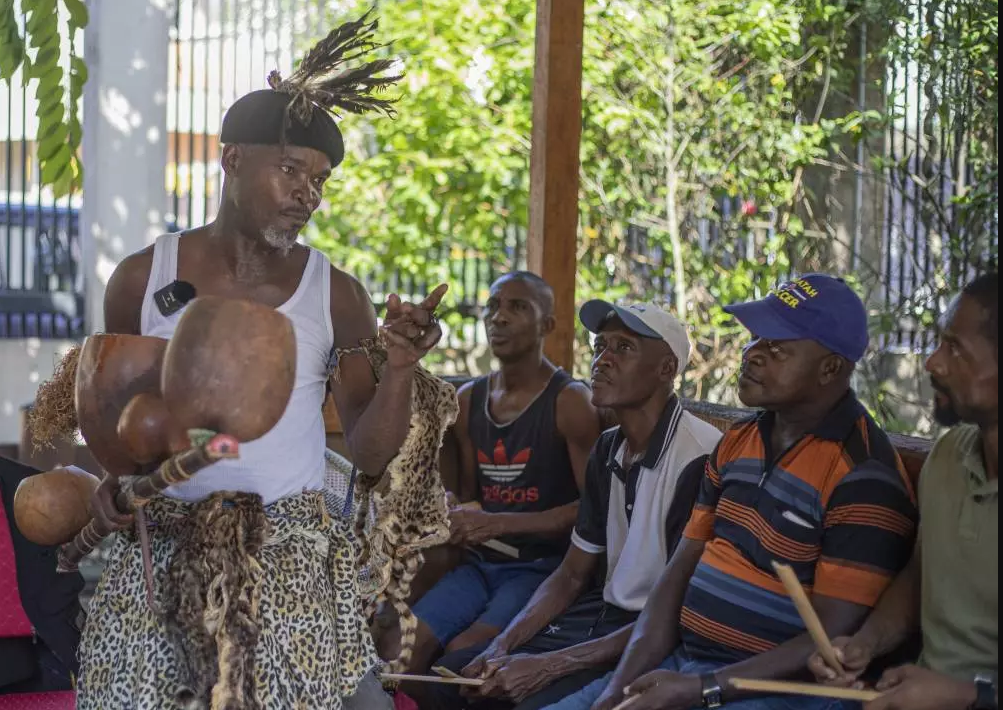
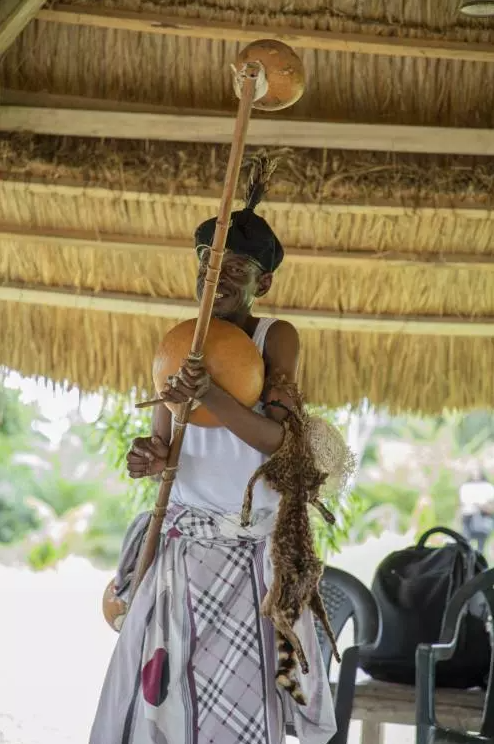
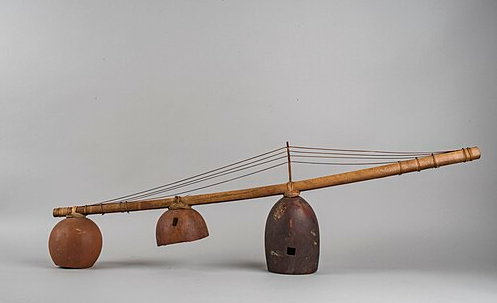
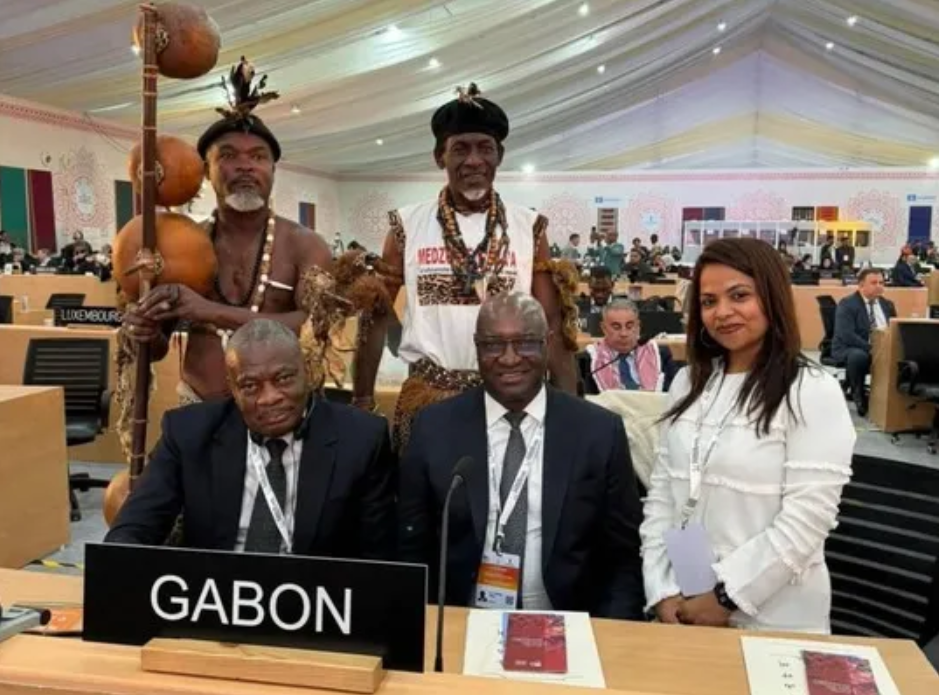
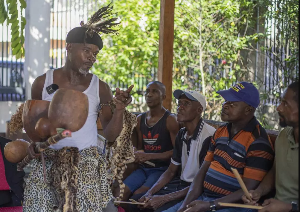
In Gabon, Mvet Oyeng brings together the epic story, the storyteller, the musician and the instrument itself. The mbôm mvet, or Mvet storyteller, performs extended narratives accompanied by a traditional string instrument, singing and dancing. The audience may clap, sing, respond and interact with the storyteller, making the performance a shared act of remembering and interpretation. The tradition exists in sacred and popular forms. Sacred Mvet is connected to important occasions and follows more restricted processes of initiation, while popular Mvet is more flexible and appears in public celebrations and contemporary performances
Within Gabon, the tradition has a particularly visible presence in the cultural life of the Ekang communities. Mvet narratives preserve histories, language, values and ideas concerning social relationships, while the performance itself creates a space in which knowledge can be heard, discussed and remembered collectively. The Gabonese expression of Mvet is therefore not limited to the instrument: it is an interconnected practice of storytelling, music, performance, audience participation and knowledge transmission.
09-16-2026
| Institutional and human capacities | The safeguarding of Mvet Oyeng in Gabon brings together practitioners, storytellers, instrument makers, cultural associations, researchers and public heritage authorities. The General Directorate of Cultural Heritage has responsibility for maintaining Gabon's national ICH inventory, while organizations such as the Association des Diseurs Mvet du Gabon (ADIMEG) and Génération Ekang have participated in documentation, awareness activities and the preparation of the multinational UNESCO nomination. Human capacity is nevertheless rooted in the practitioners themselves. Experienced Mvet storytellers transmit performance knowledge through direct participation and practical learning, while craftspeople maintain the knowledge required to make the instruments. The Gabonese safeguarding environment has increasingly connected these practitioners with museums, cultural organizations and public events, giving traditional specialists new spaces in which their knowledge can remain active rather than being treated solely as archival material. | |
| Transmission and education | Mvet is traditionally transmitted through ritual, observation and hands-on learning. The distinction between sacred and popular Mvet is important here as sacred knowledge follows more structured initiation processes, while popular performance allows more open forms of learning and participation. Women can also become storytellers, particularly within the popular form, although instrument making and playing have traditionally been more strongly associated with men. In contemporary Gabon, transmission is also being brought into public cultural spaces. Since 2022, the Medzô Me y'Aba'a gatherings in Libreville have provided a recurring setting for discussion and presentation of Mvet and other Ekang cultural knowledge. The National Mvet Oyeng Day, established through an earlier Gabonese initiative and held publicly at the National Museum, has added another space where masters, younger learners, students and wider audiences can encounter the tradition. | |
| Inventorying and research | Gabon gave Mvet a formal place within its heritage documentation system when it was entered into the National Register of Intangible Cultural Heritage in 2019. The inventory process was not presented as an exercise conducted solely by government officials, the communities concerned participated actively in the different stages of inventorying. This community involvement subsequently became part of the evidence supporting the element's UNESCO inscription. The 2024 multinational nomination further expanded this documentation, producing a Gabonese ICH inventory alongside corresponding inventories from Cameroon and Congo. This has allowed the Gabonese expression of Mvet to be documented within its own national context while recognizing that the wider Ekang tradition crosses present-day state borders. | |
| Policies as well as legal and administrative measures | Gabonese safeguarding has developed through several layers of recognition. The national registration of Mvet in 2019 provided a formal heritage framework, while the cultural authorities and community representatives subsequently participated in the multinational process that resulted in UNESCO inscription in 2025. The UNESCO decision confirms that safeguarding measures for Mvet Oyeng have been incorporated into the plans and policies of the submitting States and that free, prior and informed consent from the communities was documented. Public cultural programming has become part of this safeguarding environment. The National Mvet Oyeng Day was created in Gabon as a mechanism for safeguarding and raising awareness, with its first national edition held at the National Museum in Libreville in March 2025. The second edition followed on 21 March 2026, demonstrating that the practice's recent international recognition is being accompanied by continuing national activity. | |
| Role of intangible cultural heritage and its safeguarding in society | Mvet remains significant because its narratives do more than entertain. Through stories, songs and dialogue, the practice carries local history, language and community values between generations. UNESCO's documentation identifies respect, justice, cooperation, peace, conflict resolution and social cohesion among the values associated with the practice. The performance creates a setting in which these ideas are communicated through narrative rather than separated from everyday cultural life. The Gabonese safeguarding approach therefore treats Mvet as a resource for cultural continuity as well as performance. Its public presentation allows younger people and wider audiences to encounter knowledge that might otherwise remain within specialist or ritual settings, while the continuing role of experienced storytellers preserves the authority of those who carry the tradition. | |
| Awareness raising | Libreville has become an important contemporary space for making Mvet visible. The National Mvet Oyeng Day at the National Museum has brought together storytellers, students, researchers, cultural associations, volunteers, institutions and members of the public. Its first edition in 2025 attracted more than 500 participants and combined conferences, discussion, performances and reflection on the future of Mvet in Gabon. The continuing Medzô Me y'Aba'a gatherings provide another form of public awareness, using recurring cultural meetings to discuss different forms and dimensions of Mvet. Together, these activities move awareness beyond occasional performances: Mvet becomes a subject of public conversation, cultural education and contemporary reflection within Gabon. | |
| Engagement of communities, groups and individuals as well as other stakeholders | Mvet Oyeng depends on a network of people rather than a single specialist role. Storytellers carry the narratives, musicians perform the instrument, craftspeople maintain instrument-making knowledge, organizers and sponsors create performance opportunities, and audiences actively participate through clapping, singing, rhythmic responses and dialogue. This interaction is particularly important because the audience helps transform the narrative into a collective performance. Gabonese activities surrounding Mvet have increasingly brought these different participants together. The 2025 National Mvet Oyeng Day, for example, brought masters and apprentice practitioners into the same space as pupils, university students, associations, NGOs, cultural institutions and general visitors. Such gatherings demonstrate that safeguarding is taking place through participation and encounters between generations, rather than through documentation alone. | |
| International engagement | Mvet Oyeng is inherently transnational. The Ekang cultural community extends across contemporary national borders, and Gabon worked together with Cameroon and Congo on the UNESCO nomination. The multinational process allowed the three countries to document their respective national contexts while presenting Mvet Oyeng as a shared cultural tradition. Gabon participated in the preparatory work and provided community consent and a national ICH inventory as part of the nomination dossier. The 2025 inscription created a new international dimension for Gabonese Mvet. Rather than turning Mvet into an exclusively Gabonese heritage, the recognition places Gabon's practitioners within a broader Ekang cultural network while giving the Gabonese expression a formal place in international safeguarding discussions. Subsequent national activities in 2026, including the second National Mvet Oyeng Day, show how international recognition has been followed by continued domestic cultural activity. | |
| References |
|
|





















.jpeg)





.png)












.jpeg)

.jpg)



.png)
.jpg)


_(31711258567).jpg)