
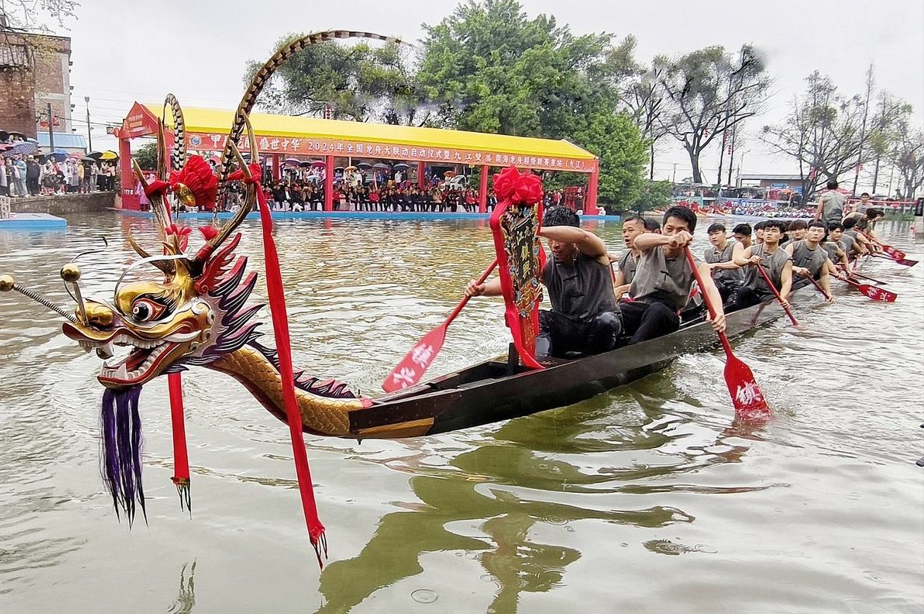
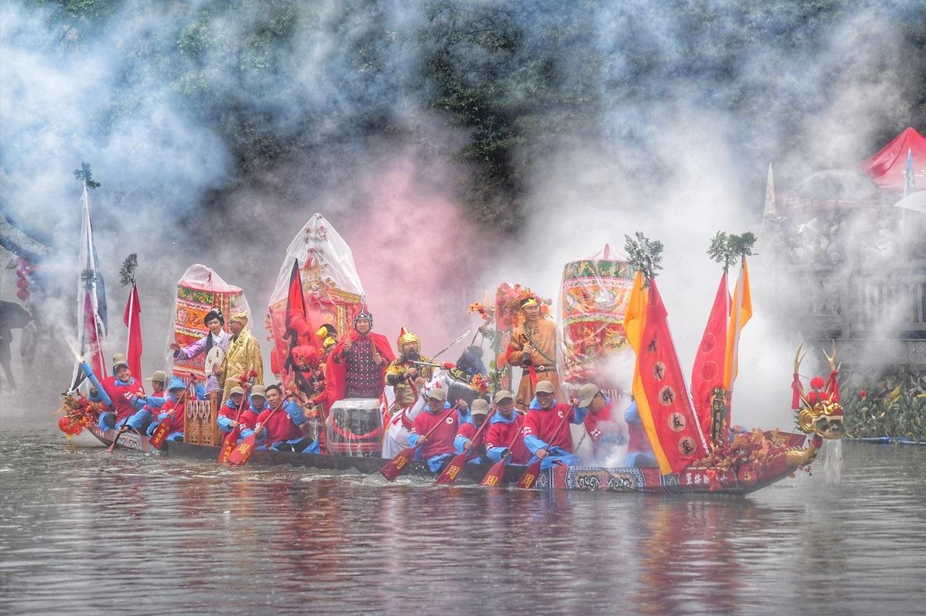
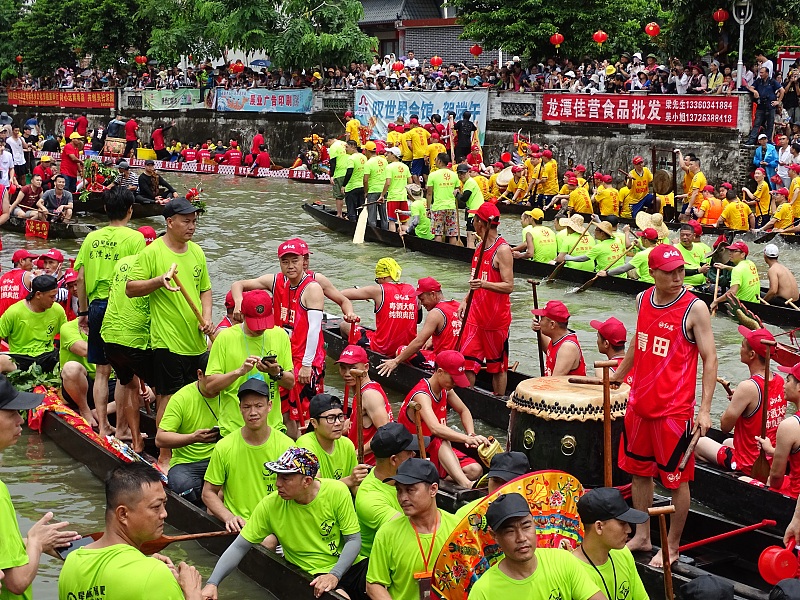
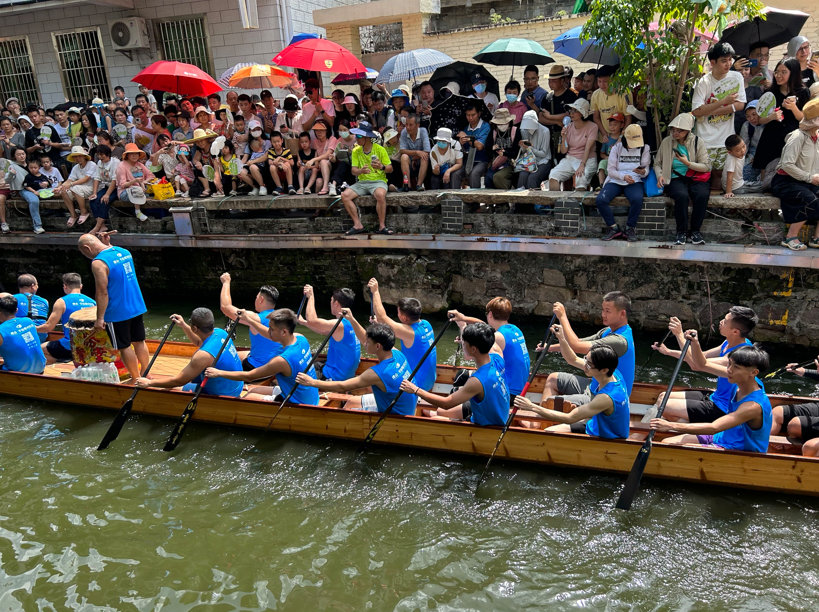
In Foshan, the Dragon Boat Festival is not defined only by the moment a race begins. Each year, communities prepare their boats, renew relationships with waterways, gather crews and carry out ceremonies that connect the arrival of Duanwu with village identity and collective memory. Across areas such as Nanhai and Shunde, dragon boats become the focus of a wider cultural life involving ritual, craftsmanship, food, music, competition and cooperation. The waterways themselves become temporary cultural spaces in which communities gather to celebrate traditions that have been maintained across generations.
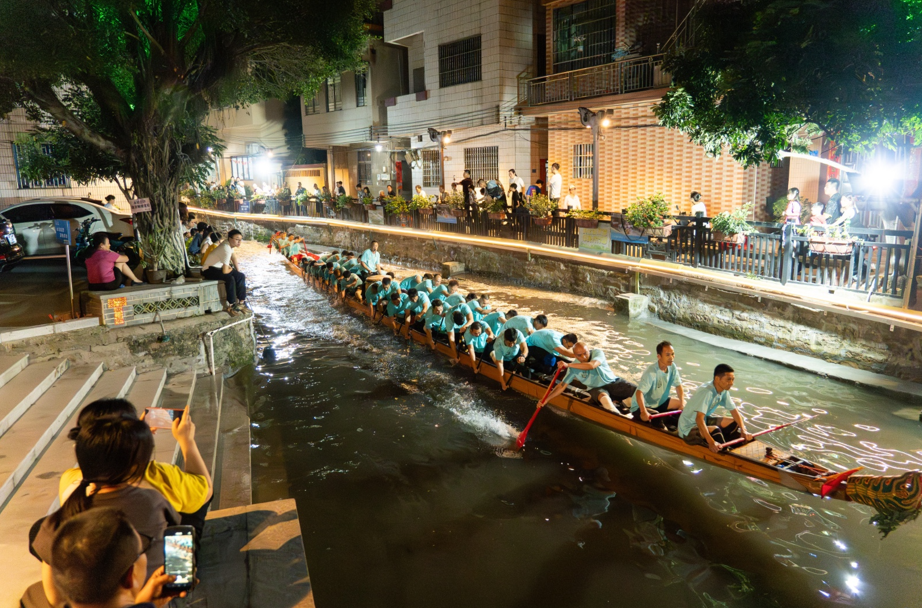
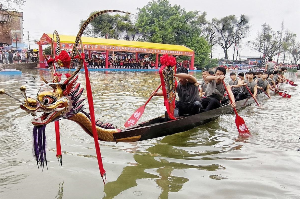
Foshan's dragon boat culture is especially distinctive because of the diversity of its local practices. In Diejiao, long boats race through narrow and winding village canals, requiring crews to coordinate extraordinary movements around sharp bends. In Yanbu, the centuries-old Yanbu Old Dragon is brought from its resting place beneath the riverbed and awakened through annual rituals before returning to the water. These traditions demonstrate that the dragon boat is not simply a piece of sporting equipment: it can be a cultural object connected with ritual life, local history and the collective identity of the communities that care for it.
09-04-2026
| Institutional and human capacities | The continuation of dragon boat traditions in Foshan depends on a broad network of community knowledge. Boat builders and craftspeople maintain knowledge of materials, structure and repair, while experienced paddlers pass on the physical techniques needed to control long vessels. Drummers, helmsmen, ritual participants and community organizers also contribute specialized roles, demonstrating that the practice depends on coordinated knowledge rather than on individual competition alone. Local cultural institutions provide additional support through heritage recognition, documentation and public programming. However, the strongest capacity remains within village communities, where dragon boats are maintained as shared cultural responsibilities. The example of the Yanbu Old Dragon illustrates this relationship particularly clearly: its annual awakening, worship rituals, river journey and communal dragon boat meal depend on collective participation and knowledge maintained by the local community. | |
| Transmission and education | In Foshan, dragon boat knowledge is transmitted largely through participation. Younger generations grow familiar with the boats by observing preparations, joining community activities and gradually learning the responsibilities involved in paddling and maintaining a vessel. In racing communities, physical coordination is learned collectively, as participants must understand not only their own movement but also the rhythm and position of the entire crew. Transmission also includes cultural knowledge that extends beyond racing. Younger community members encounter traditions such as dragon boat awakening, eye-dotting ceremonies, communal meals and visits between associated dragon boat communities. These practices help explain why the boat matters to the people who care for it, ensuring that the tradition is transmitted as a broader form of cultural life rather than only as a competitive sport. | |
| Inventorying and research | Foshan's dragon boat traditions have been documented through local heritage initiatives, historical records, journalism and research on southern China's water-based communities. Historical sources trace dragon boat activity in the Foshan region back to the Ming dynasty, while surviving boats and ritual traditions provide important material evidence of the long relationship between local communities and their waterways. Research should continue to document the diversity of Foshan's dragon boat culture at the community level. The narrow-canal racing traditions of Diejiao, the centuries-old Yanbu Old Dragon and the dragon boat customs of Shunde represent different expressions of a wider cultural landscape. Recording these differences is essential because Foshan's heritage lies not in a single standardized form of racing, but in the ways individual communities have developed and maintained their own relationships with dragon boats. | |
| Policies as well as legal and administrative measures | The inscription of the Dragon Boat Festival on UNESCO's Representative List in 2009 provides international recognition for the wider cultural traditions associated with Duanwu. At the local level, Foshan has also developed heritage protection frameworks for specific dragon boat traditions, helping recognize practices that are rooted in particular communities rather than treating the festival as a single uniform event. Policy support is particularly important as traditional communities experience urban development and growing tourism. Safeguarding measures should therefore support the physical environments necessary for dragon boat culture, including waterways, storage spaces and community gathering areas. Protection must also recognize the people who maintain the boats and rituals, ensuring that heritage policies strengthen the living practice rather than preserving only its most visually spectacular moments. | |
| Role of intangible cultural heritage and its safeguarding in society | Dragon boat traditions strengthen relationships between people, communities and waterways. The preparation of a boat requires cooperation, while paddling demands collective rhythm and trust. Ceremonies surrounding the awakening and launching of boats connect contemporary communities with earlier generations, allowing cultural memory to be renewed each time the boats return to the water. Safeguarding therefore involves more than protecting races or preserving historic vessels. It means maintaining the conditions that allow communities to gather, train, conduct ceremonies and care for their shared boats. The Yanbu Old Dragon demonstrates this particularly well: its cultural significance lies not only in its age, but also in the continuing rituals and relationships that bring the boat back into community life each year. | |
| Awareness raising | The growing visibility of Foshan's dragon boat traditions has created important opportunities for public awareness. The distinctive racing of Diejiao, sometimes described as a form of “dragon boat drifting,” has introduced large audiences to the remarkable skills required to navigate long vessels through narrow village canals. Public events, media coverage and cultural programs have also drawn attention to the broader heritage surrounding the festival. Awareness raising should nevertheless communicate that the most dramatic races represent only one part of the tradition. Visitors and audiences should also encounter the preparation of boats, ceremonial practices, communal meals and the relationships between neighboring communities. By presenting these deeper dimensions, public awareness can encourage respect for dragon boat culture as living heritage rather than simply as an exciting sporting spectacle. | |
| Engagement of communities, groups and individuals as well as other stakeholders | Community participation is the foundation of Foshan's dragon boat traditions. Villages organize crews, prepare boats, arrange ceremonies and gather along rivers and canals during the festival season. Participation extends beyond the paddlers themselves: families, elders, ritual participants and spectators all contribute to the social environment surrounding the boats. The cooperative nature of racing provides one of the clearest expressions of this participation. A dragon boat moves successfully only when its crew acts collectively, responding to rhythm, direction and the changing conditions of the water. In this sense, the boat becomes a powerful expression of community cooperation, while the festival creates an opportunity for local identities and relationships to be renewed through shared action. | |
| International engagement | Foshan's dragon boat traditions form part of a wider international cultural landscape connected with the Dragon Boat Festival. The UNESCO recognition of the festival has created opportunities for international audiences to learn about the traditions associated with Duanwu, while dragon boat racing has also developed as an international sporting activity in many countries. For Foshan, meaningful international engagement should emphasize the cultural knowledge behind the boat. Exchanges involving craftspeople, community practitioners, researchers and cultural institutions could explore traditional boat construction, water-based heritage, ritual practices and collective forms of transmission. Such engagement would allow Foshan to share its distinctive traditions internationally while maintaining the connection between the dragon boat and the communities, waterways and cultural relationships from which its heritage continues to grow. | |
| References |
|
|














.jpeg)










.png)















.jpeg)
.jpg)




.png)
.jpg)


_(31711258567).jpg)