
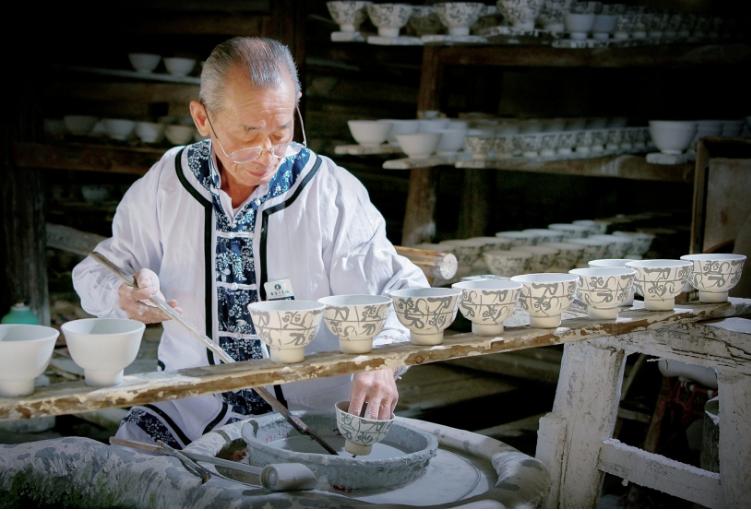
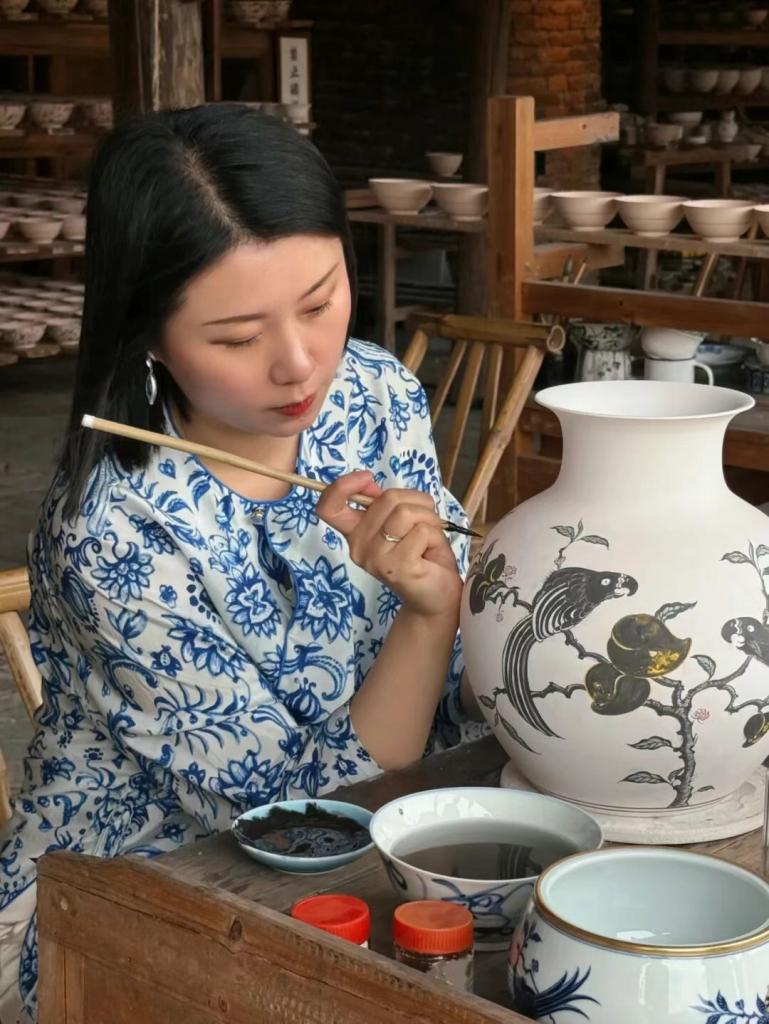
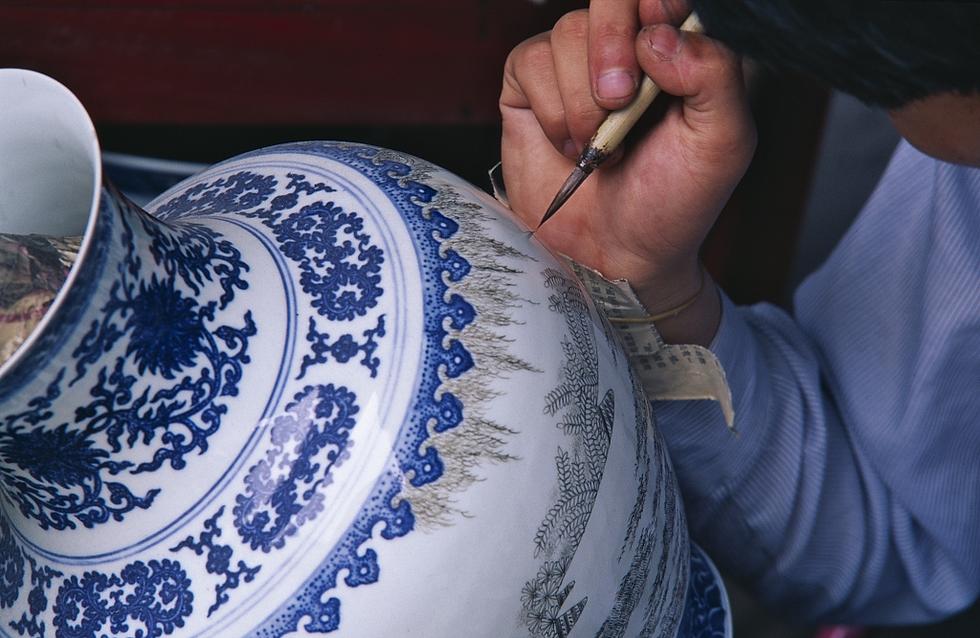
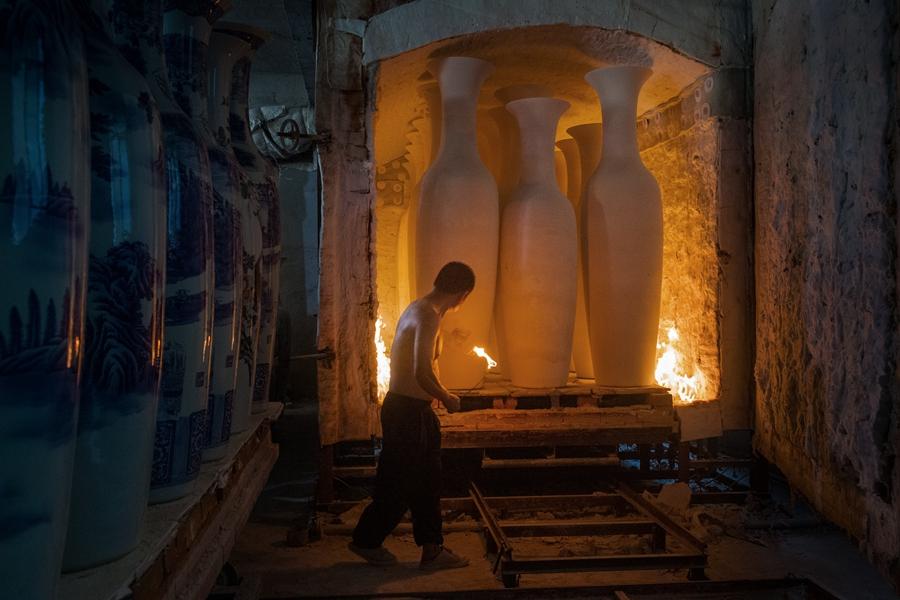
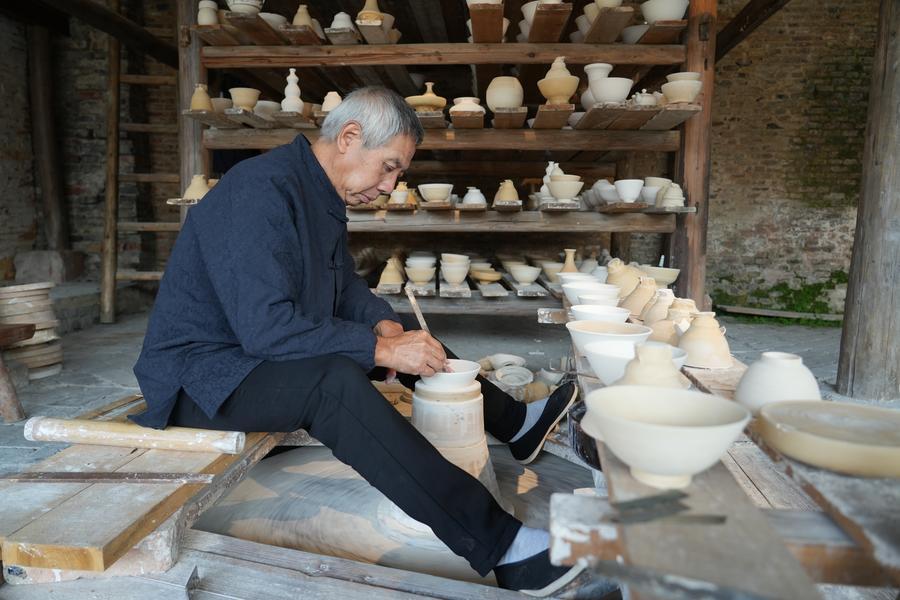
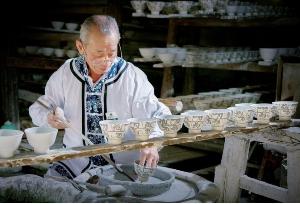
Jingdezhen's porcelain-making heritage is built upon a highly specialized body of knowledge that brings together raw materials, manual skills, decorative practices, kiln knowledge and generations of experience. The craft begins with the preparation of porcelain materials and continues through forming, trimming, decoration, glazing, firing, selection and finishing. These processes are not isolated techniques: they depend on one another and require practitioners to understand how materials and techniques respond at every stage of production. This interconnected knowledge is what gives Jingdezhen's handicraft porcelain-making its distinctive character.
The tradition developed over many centuries. Important forming techniques were already established during the Song period, while the Yuan period brought the development of the combination of porcelain stone and kaolin known as the “binary formula” and the refinement of blue-and-white underglaze decoration. During the Ming and Qing periods, the production system became exceptionally specialized, with numerous occupations participating in the preparation, forming, decoration, glazing and firing of a single vessel. This knowledge was maintained through practical experience, specialization and direct transmission from experienced craftspeople to apprentices.
Today, Jingdezhen continues to be a place where these skills are practiced, taught and adapted. Handcrafted porcelain is present in workshops, studios, educational settings and productive safeguarding bases, allowing traditional knowledge to remain connected to everyday making rather than existing only as historical knowledge. The continued practice of porcelain making gives the community an opportunity to preserve established techniques while also developing new forms, designs and applications suited to contemporary life.
08-25-2026
| Institutional and human capacities | The strength of Jingdezhen's porcelain heritage lies in the people who continue to carry its different areas of knowledge. The craft has traditionally depended on specialization, with practitioners developing expertise in particular stages such as material preparation, forming, trimming, decoration, glazing and firing. This division of knowledge remains important because the heritage is not represented by a single technique or individual craftsperson, but by a wider community whose skills work together to produce porcelain. This community is supported by a growing network of safeguarding, transmission, research and productive-protection bases. Jingdezhen's Ceramic Culture Ecological Protection Zone identifies more than 100 city-level or above productive protection demonstration bases, including national- and provincial-level facilities, alongside dedicated transmission, dissemination and research bases. These spaces allow practitioners to continue making porcelain while teaching, demonstrating and researching the techniques associated with the craft. Representative bearers of the national ICH element have also contributed to maintaining particular areas of knowledge. The national ICH database records practitioners associated with Jingdezhen handicraft porcelain-making, including specialists whose work has focused on blue-and-white decoration, porcelain materials, historical techniques and other areas of craftsmanship. Their contribution demonstrates how individual expertise forms part of a much wider community knowledge system. | |
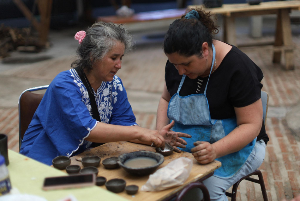
| Transmission and education | Knowledge of Jingdezhen porcelain-making has traditionally been learned through doing. Apprentices entered the craft through practical work, observed experienced practitioners, repeated individual operations and gradually developed the precision required for their particular occupation. The local tradition describes a system in which workers could devote their working lives to specialized tasks, developing a high degree of technical familiarity through continuous practice. The essential knowledge was transmitted through oral instruction, demonstration and hands-on experience. This practical form of transmission continues alongside contemporary ceramic education. Workshops, transmission bases and educational institutions provide younger learners with opportunities to encounter traditional materials and techniques directly. The city's safeguarding plans specifically call for traditional porcelain-making transmission and experience centers, research-learning facilities and ceramic craft workstations, creating additional environments where knowledge can be practiced rather than simply observed. Transmission also increasingly connects inherited knowledge with contemporary creative practice. Young craftspeople can learn established forming, decorating and firing techniques while developing their own approaches to design and production. In this way, continuity does not require every new practitioner to reproduce historical objects exactly; instead, the essential knowledge of working with porcelain is carried forward through new generations and new forms of practice. | |
| Inventorying and research | The knowledge of Jingdezhen porcelain-making has been documented through historical records, archaeological investigation, technical research, ICH inventories and the recording of individual practitioners. The national ICH inventory recognizes the craft as a distinct traditional-technology element and records its development, specialized processes and representative bearers. Research also follows the material environments in which the craft developed. Archaeological and historical investigations have documented kiln sites, raw-material sources, production facilities, transportation routes and the organization of handicraft production. UNESCO's documentation of the Jingdezhen Handicraft Porcelain Industry Sites emphasizes that these places preserve evidence of the technological processes and social organization that supported porcelain production over centuries. More recent safeguarding work has placed increasing attention on recording the knowledge carried by living practitioners. Since 2013, China's Ministry of Culture and Tourism has supported digital documentation of national-level representative bearers associated with Jingdezhen's porcelain-making techniques. These records preserve individual technical knowledge and cultural memories while providing material for future learning and research. | |
| Policies as well as legal and administrative measures | Jingdezhen Handicraft Porcelain-Making Techniques were recognized as a national-level intangible cultural heritage element in 2006. The craft was subsequently included in China's Traditional Craft Revitalization Catalogue, strengthening the policy framework for its continued transmission and development. National support has included funding for safeguarding and transmission activities and support for representative bearers. Protection has also developed at the local level. In 2020, Jingdezhen's Ceramic Culture Ecological Protection Experimental Zone was established to protect the city's wider ceramic cultural environment. Its current 2021–2035 General Plan, approved and published in 2024, places ICH at the center of an integrated approach that protects not only techniques but also the cultural spaces, production environments, materials and communities in which those techniques continue to exist. The plan specifically recognizes traditional handicraft porcelain-making as a central element of Jingdezhen's ceramic cultural ecology. It calls for the construction of transmission and experience centers, research-learning facilities, productive protection bases, craft workstations and other spaces that allow the heritage to remain active within contemporary community life. | |
| Role of intangible cultural heritage and its safeguarding in society | For the people of Jingdezhen, porcelain-making is closely connected to the identity of the city itself. The craft has shaped local occupations, workshops, production spaces and cultural life for centuries, creating a distinctive relationship between the city and the knowledge of making porcelain. The national ICH documentation describes Jingdezhen's historical development from an important ceramic-producing center into one of China's major porcelain centers, while its contemporary safeguarding continues to recognize hand production as an important part of that cultural identity. Safeguarding therefore focuses on keeping the knowledge in practice. Productive protection allows traditional techniques to continue within working environments, where practitioners can make, teach, demonstrate and refine their skills. Jingdezhen's ecological protection plan explicitly places transmission groups and practitioners at the center of protection and seeks to maintain the cultural and production environments that allow the heritage to survive. A major achievement has been the integration of heritage protection with contemporary creative and economic life. The aim is not to isolate traditional porcelain-making from change, but to maintain its essential knowledge while allowing practitioners to respond to contemporary markets, education and artistic expression. This approach gives the craft a continuing social and economic role while supporting the transmission of its specialized knowledge. | |
| Awareness raising | Jingdezhen's porcelain heritage is made visible through museums, historical kiln environments, workshops, exhibitions, educational programs and public demonstrations. These activities allow visitors and younger generations to encounter not only finished porcelain but also the processes, tools and skills through which it is produced. Public awareness increasingly emphasizes the making process. Seeing clay prepared, a vessel formed, a decoration applied or a kiln operated provides a direct understanding of why the craft requires specialized knowledge and prolonged practice. Jingdezhen's safeguarding plans consequently promote transmission and experience centers, ICH museums, specialized exhibition spaces and digital forms of presentation. The city's long-term plan proposes a network of ICH venues combining physical exhibitions with digital and interactive forms of dissemination. The craft is also introduced through educational and cultural activities that connect porcelain-making with contemporary life. Documentary production and digital recording have created additional ways of sharing practitioners' knowledge and experiences with audiences beyond the workshop. These efforts help ensure that Jingdezhen's porcelain is understood not only as a famous cultural product, but as the result of a living body of knowledge maintained by craftspeople. | |
| Engagement of communities, groups and individuals as well as other stakeholders | The continued life of Jingdezhen porcelain-making depends on the active participation of its practitioners. The craft has never been based on one isolated skill: it developed through cooperation among people responsible for different stages of production. This specialized organization created a community in which knowledge was exchanged through daily work and where the success of one stage depended on the precision of another. Contemporary safeguarding continues this participatory character by supporting working studios, productive protection bases, transmission centers and research spaces. These environments allow practitioners to remain active contributors rather than treating them solely as subjects of museum exhibitions or documentation. The city's ecological protection plan explicitly emphasizes the role of inheritors and local residents as the principal participants in the protection of the cultural environment. The contemporary craft community also includes younger makers and ceramic students who bring new approaches into the tradition. Their participation allows Jingdezhen's porcelain knowledge to move between generations while creating space for experimentation. Through this interaction, inherited techniques can remain recognizable while finding new applications in contemporary ceramic practice. | |
| International engagement | Jingdezhen's porcelain-making heritage has been international in character for centuries. Porcelain produced in the city travelled through extensive trade networks, carrying Chinese materials, technologies, decorative styles and aesthetic ideas to other parts of Asia, the Middle East, Europe and beyond. Blue-and-white porcelain in particular became a globally traded form and an influential symbol of Chinese craftsmanship. This international history is also part of the heritage's development. Jingdezhen's technological and artistic achievements were shaped within networks of exchange, while its porcelain production became an important channel through which Chinese ceramic knowledge reached other societies. UNESCO's documentation recognizes the city's historical importance not only for China but for the development of porcelain production and trade on a global scale. Today, Jingdezhen continues to present its ceramic heritage internationally through cultural exchange, exhibitions, research, education and contemporary ceramic activities. The city's Ceramic Culture Ecological Protection Zone identifies international cultural exchange and cooperation as part of its long-term objectives and seeks to strengthen Jingdezhen's role as an international center for ceramic cultural exchange. | |
| References |
|
|



















.jpeg)





.png)












.jpeg)

.jpg)


.png)
.jpg)


_(31711258567).jpg)