
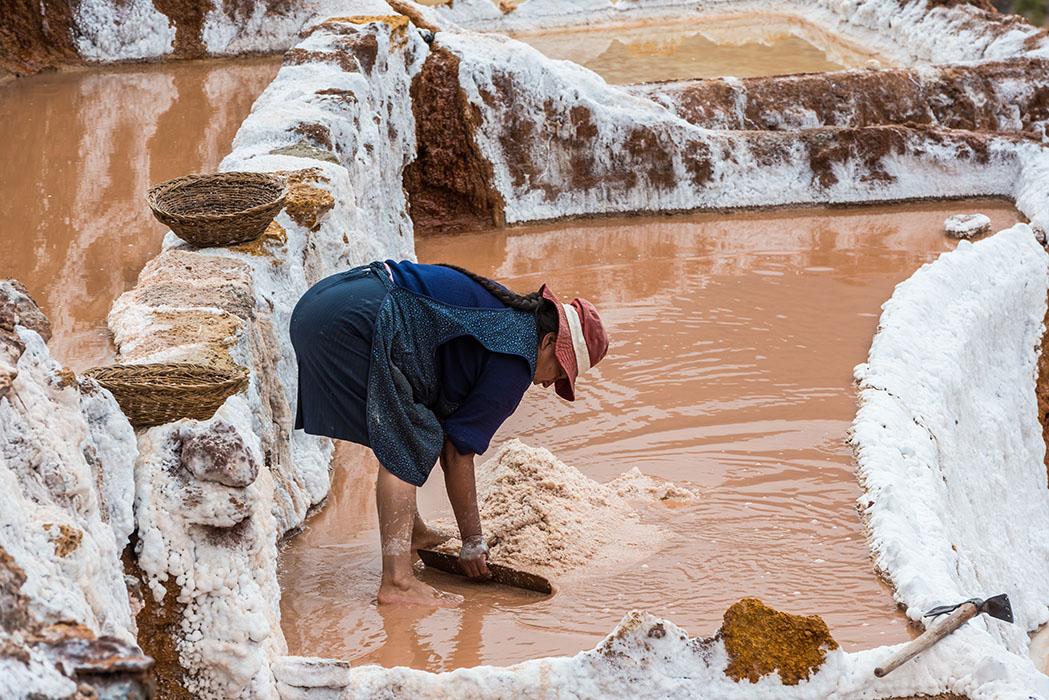
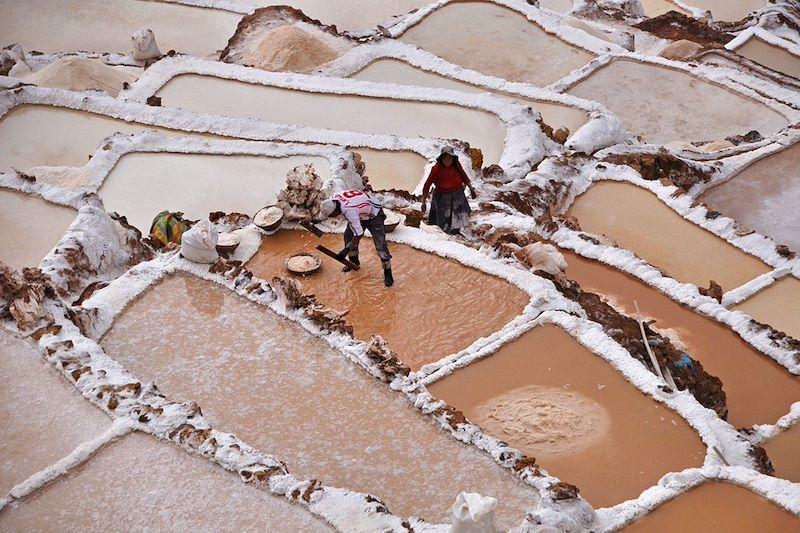
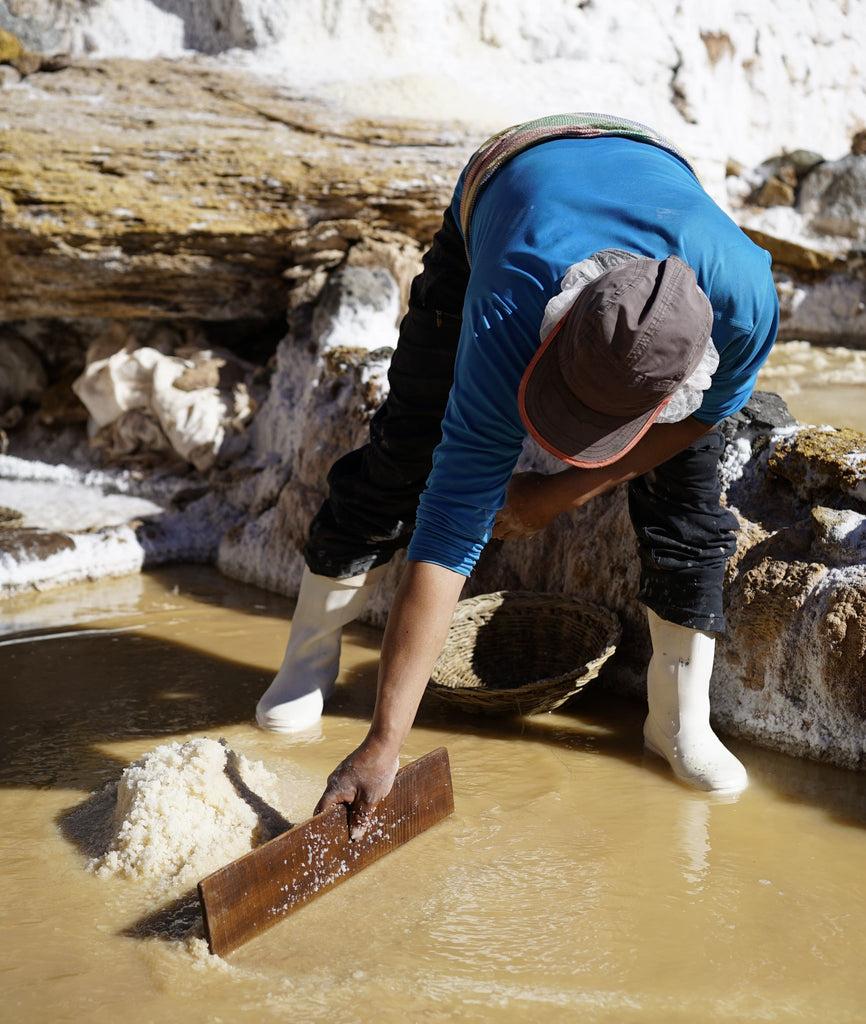
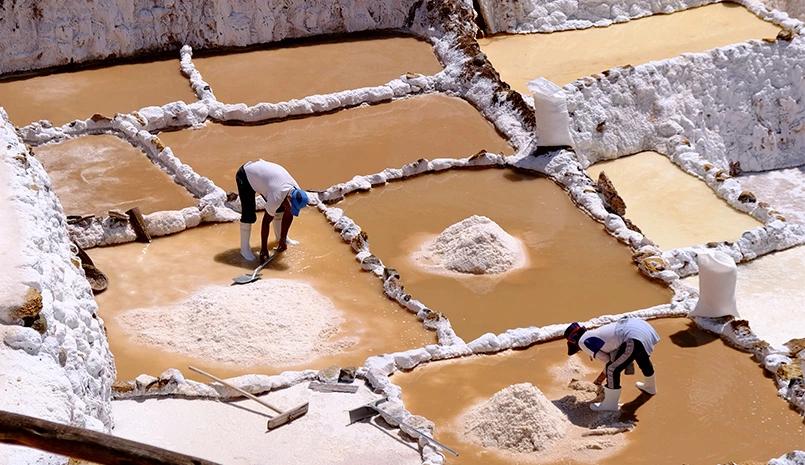
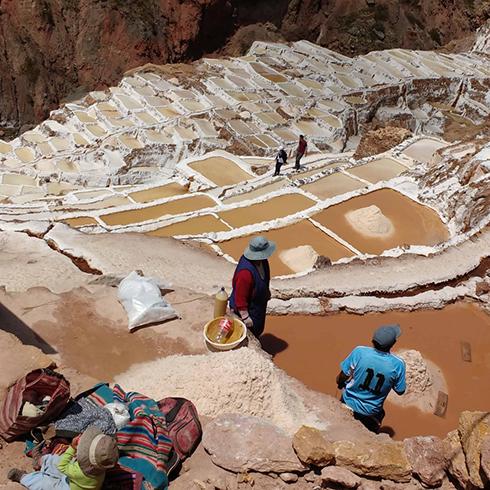
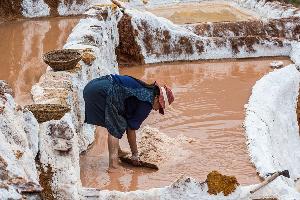
On the slopes of the Sacred Valley of Cusco, thousands of small salt ponds descend through the landscape of Maras like a vast white terrace system. Their existence depends on a naturally saline spring whose water is guided through channels into individual evaporation ponds. Through repeated cycles of filling, evaporation, crystallization and harvesting, local producers transform saline water into salt. What appears from a distance to be a striking landscape is therefore also a highly specialized productive system maintained through generations of knowledge.
Salt extraction in Maras has been practiced since pre-Hispanic times and continued through the Inca, colonial, republican and contemporary periods. Today, the practice remains closely associated with the peasant communities of Maras and Pichingoto, where knowledge of the ponds, techniques of extraction and forms of productive organization continue to be transmitted between generations. The continuity of these practices led Peru's National Institute of Culture to declare the traditional knowledge and techniques associated with salt extraction in Maras Cultural Heritage of the Nation in 2008.
The heritage of Maras lies not simply in salt as a finished product, nor in the spectacular appearance of the salt terraces. It lies in the accumulated knowledge required to make the system function: understanding the saline water, maintaining the ponds and channels, regulating production according to climatic conditions, harvesting the crystallized salt, organizing access to productive resources and transmitting responsibilities within families and communities.
08-21-2026
| Institutional and human capacities | The production system is maintained principally by members of the communities of Maras and Pichingoto, whose families possess and work individual salt ponds. Traditional productive knowledge is combined with communal forms of organization and contemporary administration through Marasal S.A., the communal enterprise responsible for activities including the treatment, packaging and commercialization of salt. Human knowledge is highly specialized despite the apparent simplicity of the process. Producers must understand the condition of the ponds, the movement of saline water, evaporation, crystallization and the appropriate moment for harvesting. Their expertise is therefore simultaneously agricultural, hydraulic, environmental and productive. | |
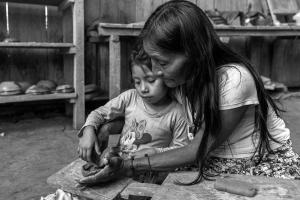
| Transmission and education | Knowledge associated with Maras salt production is traditionally learned through participation in productive life. MINCETUR records that the knowledge and traditions associated with working the ponds are transmitted from parents to children, with many older producers recalling that they began working in the salt ponds during childhood alongside their parents and grandparents. Transmission encompasses both technical knowledge and social responsibilities. Younger generations learn how to prepare and maintain ponds, direct the saline water, recognize suitable conditions for harvesting and participate in the collective organization surrounding production. In this sense, the salt ponds function as an informal educational environment in which knowledge is acquired through observation, repetition and practical experience. | |
| Inventorying and research | Maras has been documented from archaeological, historical, ethnographic and landscape perspectives. Archaeological and historical evidence indicates that exploitation of the saline spring predates the Inca period, while later records demonstrate the continued importance of salt production under colonial and republican systems. MINCETUR identifies continuous exploitation from the Early Horizon through the present. Recent research has increasingly approached Maras as a cultural landscape, examining the relationship between its physical configuration, production techniques, territorial organization and contemporary community life. A 2024 study published by the Pontificia Universidad Católica del Perú emphasizes that the significance of Maras lies in the continued relationship between the landscape and the productive techniques through which salt remains a defining element of local life. The UNESCO World Heritage Centre has likewise documented the material and immaterial dimensions of the salt mines, noting the continuity of traditional exploitation methods and their relationship with the communities of Maras and Pichingoto. | |
| Policies as well as legal and administrative measures | The knowledge and traditional techniques associated with salt extraction in Maras were declared Cultural Heritage of the Nation through National Directorial Resolution No. 719/INC on 5 June 2008, under the category of traditional productive practices and technologies. The declaration recognized the practice as a living cultural manifestation that remained active among local communities. This recognition complements the earlier declaration of the Monumental Archaeological Zone of Salineras – Maras as Cultural Heritage of the Nation in 1998. The distinction between the two recognitions is important: one protects the physical cultural landscape, while the 2008 declaration recognizes the knowledge and techniques practiced by its bearers. The Salineras de Maras were subsequently incorporated into Peru's UNESCO World Heritage Tentative List in 2019 as a cultural property. The nomination emphasizes the intergenerational transmission of knowledge and techniques related to salt extraction among the communities of Maras and Pichingoto. | |
| Role of intangible cultural heritage and its safeguarding in society | Salt production has historically been both an economic activity and a means through which communities have maintained a close relationship with their territory. The salt terraces are not an isolated industrial installation: their functioning depends on a particular combination of natural conditions and accumulated human knowledge. The practice also demonstrates how intangible heritage can be embedded within a physical landscape. The spring, channels, ponds, tools and salt crystals are material elements, but the ability to transform them into a functioning production system exists in the knowledge, skills, relationships and customary practices of the producers. The social organization surrounding the ponds is particularly significant. MINCETUR documents reciprocal arrangements through which producers with few or no ponds can work ponds belonging to others, reflecting principles of cooperation and reciprocity associated with ayni. Production therefore involves not only individual household labor but also relationships of mutual assistance within the community. | |
| Awareness raising | The extraordinary visual character of Maras has made the salt terraces one of the most recognizable cultural landscapes of the Cusco region. Their appearance communicates immediately that the landscape has been shaped by human activity, but the visual spectacle can also conceal the specialized knowledge required to maintain it. Understanding Maras as intangible cultural heritage shifts attention from the terraces as scenery toward the people who work them. The white and pink crystals visible across the slopes represent the culmination of a repeated process involving water management, pond preparation, evaporation, harvesting and collective labor. The practice has also acquired new visibility through tourism and the commercialization of Maras salt. This has created an additional contemporary context in which local knowledge, products and community identity are encountered by visitors. | |
| Engagement of communities, groups and individuals as well as other stakeholders | The communities of Maras and Pichingoto remain the principal bearers of the traditional salt-production system. Families participate in the ownership and working of ponds, while communal structures coordinate aspects of production and commercialization. Community organization has also played an important historical role in determining who benefits from the resource. During the twentieth century, control over salt production became the subject of significant tensions between local communities and the Peruvian state. In 1969, the state assumed control of salt extraction and commercialization through EMSAL; in the following decades, local communities mobilized to recover greater control over the resource. Historical research documents a major community mobilization in Cusco in 1981 demanding that the benefits of the salt mines return to the people of Maras. The subsequent development of Marasal as a community-associated enterprise illustrates an important dimension of safeguarding: continuity can involve institutional and economic adaptation rather than preservation of an unchanged historical form. | |
| International engagement | The cultural landscape of Maras has gained international visibility through its inclusion in Peru's UNESCO World Heritage Tentative List in 2019. The nomination recognizes both the physical salt terraces and the traditional knowledge associated with their continued use. This international recognition is significant because it presents Maras not merely as an archaeological or scenic site, but as an example of a cultural landscape in which human communities continue to use inherited knowledge to transform a natural resource into a productive and culturally meaningful system. | |
| References |
|
|















.jpeg)





.png)












.jpeg)

.jpg)



.png)
.jpg)


_(31711258567).jpg)