
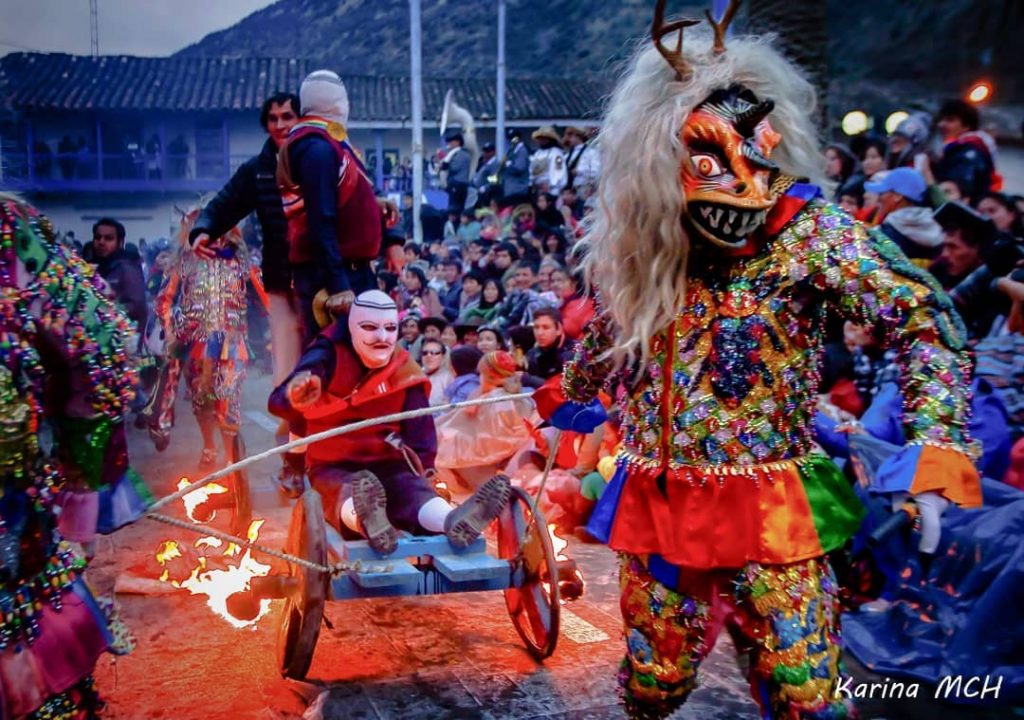
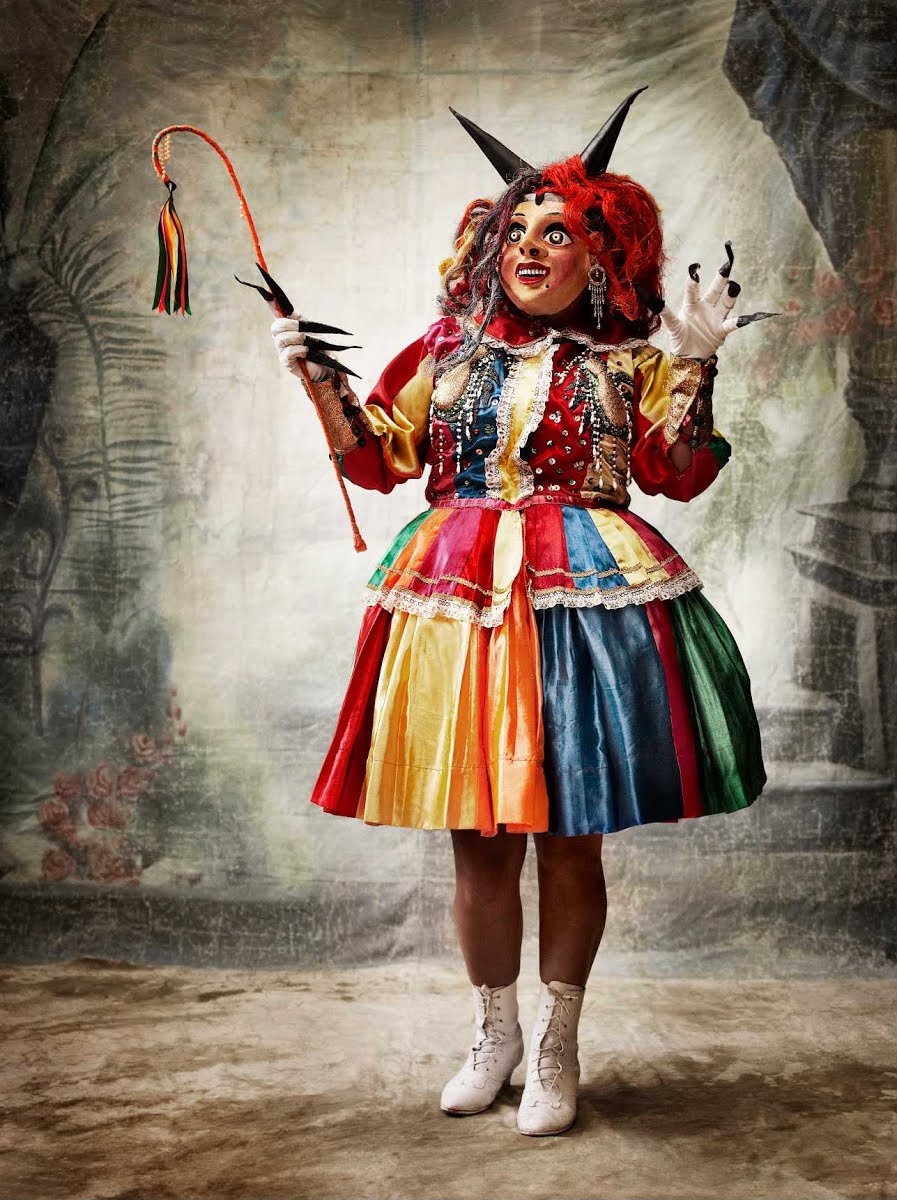
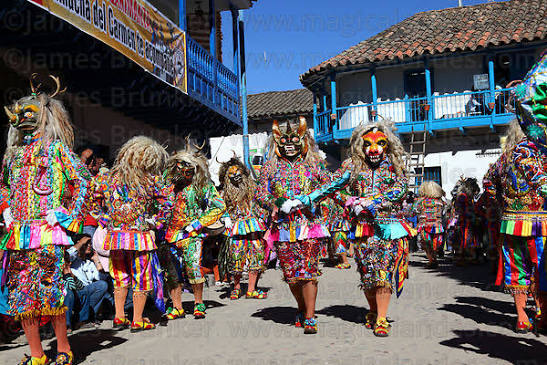
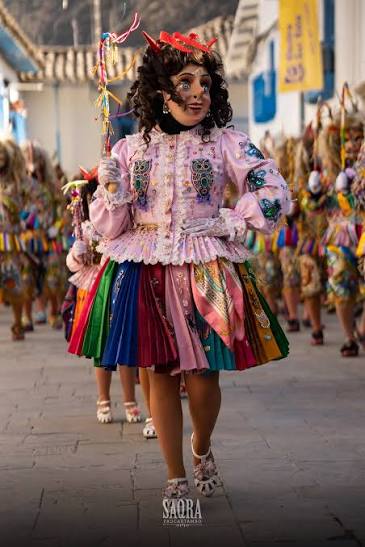
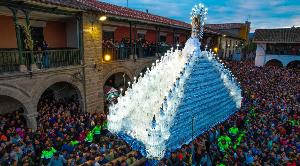
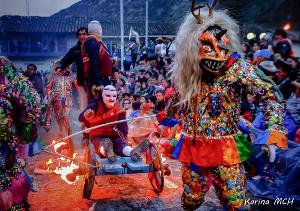
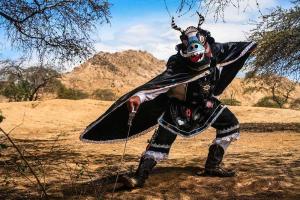
The Saqra Dance is one of the distinctive masked dance traditions performed during the Festival of the Virgin of Carmen in Paucartambo, Cusco. Its dancers appear as mischievous, supernatural beings with animal and human characteristics, moving through the streets, balconies and rooftops of the town while interacting theatrically with the sacred procession.
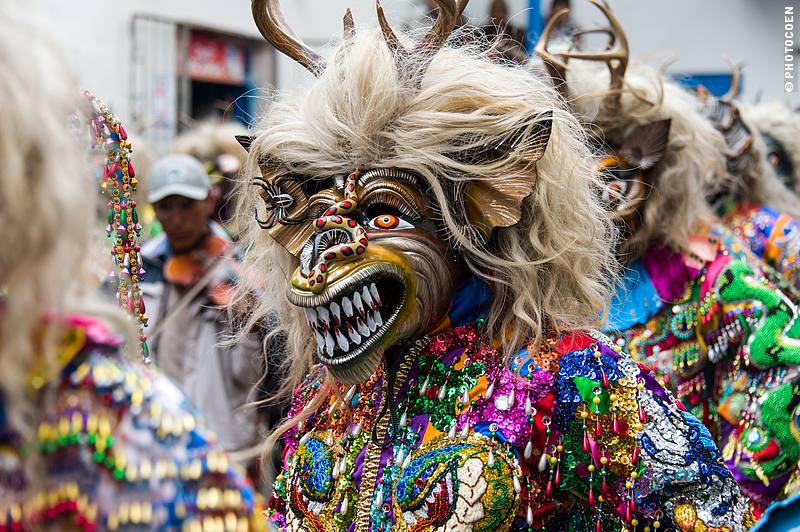
The tradition combines dance, music, mask making, costume knowledge, theatrical character, religious devotion and community organization. The Saqra is not simply a representation of evil. Within the festive world of Paucartambo, the character occupies an ambiguous space between the sacred and the mischievous, the frightening and the humorous, and the human and the supernatural. The masks themselves transform the dancer into another social and symbolic being. The Peruvian Ministry of Foreign Affairs describes the Saqras as playful devils whose anthropomorphic forms combine human and animal characteristics.
The dance is practiced as part of the annual Festival of the Virgin of Carmen, celebrated in Paucartambo in July. The festival itself was declared National Cultural Heritage in 2006, while the municipality of Paucartambo separately recognized the Saqra Dance in 2025 as a living expression of local folklore and a source of cultural identity.
08-14-2026
| Institutional and human capacities | The Saqra Dance is sustained through the internal organization of its dance group, known as a comparsa, together with the broader social and religious structures of the Paucartambo festival. Its organization includes senior dancers, newer members, leadership roles, musicians, costume and mask makers, organizers and families who participate in the preparation of the annual celebration. Research conducted by the National University of San Antonio Abad of Cusco identifies a structured process through which knowledge is transmitted from established members to new participants, locally known as Morocos. The study emphasizes that organization, identity, faith and the relationship between older and newer members are fundamental to the continuity of the comparsa. The tradition therefore depends on a complex body of human knowledge. A dancer must learn not only steps and movements, but also how to inhabit the character, handle the mask and costume, interact with other dancers, respond to the music and participate appropriately in the different moments of the festival. | |
| Transmission and education | Transmission takes place principally through participation in the comparsa. New members learn by observing experienced dancers, practicing alongside them and gradually assuming responsibilities within the group. The 2024 study of the Saqra comparsa specifically identifies the transmission of knowledge from older members to new participants as one of the central mechanisms sustaining the tradition. Learning encompasses choreography, music, character behavior, costume, mask use and the codes governing interactions between dancers. It is therefore a form of embodied education: knowledge is acquired through the body, repetition and collective experience rather than exclusively through written instruction. The tradition also transmits an understanding of Paucartambo's festive world. Younger participants learn how the Saqra relates to the Virgin, the other dance groups, the town's sacred spaces and the wider sequence of the festival. In this sense, joining the dance means entering a preexisting cultural system rather than simply learning a performance. | |
| Inventorying and research | The Saqra Dance has considerable potential for detailed documentation because it exists at the intersection of several domains of intangible cultural heritage. A complete inventory should document choreography and music together with the knowledge surrounding masks, costumes, characters, organization, ritual participation and the spatial behavior of dancers. Anthropologist Gisela Cánepa's ethnographic study of the Festival of the Virgin of Carmen is particularly important for understanding masks, transformation and identity in Paucartambo. Based on fieldwork carried out principally between 1989 and 1991, with later visits, the study examines the festival through observation, interviews and local documentation. It also highlights how tourism, migration and changing economic conditions influence debates about authenticity and changes in festive practices. The 2024 study dedicated specifically to the Saqra comparsa provides another valuable source, documenting its internal organization, traditions and transmission of knowledge. It places the emergence of the contemporary Saqra tradition in Paucartambo around 1924, while emphasizing the particular development of its choreography and music. This date should be understood as a finding of that study rather than as an uncontested beginning of all of the cultural ideas associated with the Saqra character. Future documentation would benefit from recording the complete annual cycle rather than photographing only the public performance. Rehearsals, preparation of masks and costumes, internal meetings, learning processes, songs, personal memories and relationships between generations would reveal dimensions of the heritage that disappear once the festival ends. | |
| Policies as well as legal and administrative measures | The Festival of the Virgin of Carmen of Paucartambo was declared National Cultural Heritage in 2006 under Resolution Directoral No. 543/INC-2006. The declaration recognizes the festival as a major ritual and festive expression of Paucartambo. More specifically, on 19 June 2025, the Provincial Municipality of Paucartambo issued Mayoral Resolution No. 0238-2025-A-MPP/C, formally recognizing the Saqra Dance as a living expression of Paucartambo folklore and as a source of cultural identity that preserves local customs and traditions. The Saqra Dance should therefore be understood within two complementary levels of recognition: the national protection of the wider festival and the more recent local recognition of the dance itself. Safeguarding measures should prioritize the continuity of community transmission, preservation of traditional performance spaces, documentation of masks and costumes, support for younger participants and recognition of the knowledge holders responsible for maintaining the tradition. | |
| Role of intangible cultural heritage and its safeguarding in society | The Saqra occupies an intentionally ambiguous position within the religious universe of Paucartambo. The dancers represent supernatural and mischievous beings, yet their presence does not simply oppose the sacred. Their relationship with the Virgin, the procession and the other characters forms part of the symbolic order through which the community understands and performs its festival. The masks are particularly important because they enable transformation. The Ministry of Foreign Affairs' Cultural Center describes the Saqra masks as representing playful devils whose forms combine human and animal characteristics, including feline and predatory bird features. It also records the belief that Saqras prepare themselves outside the town, near the Qenco Mayu River, before entering Paucartambo. The dance consequently demonstrates how intangible heritage can operate through transformation. A person becomes a Saqra through the combination of mask, costume, movement, music and collective recognition. The character exists only because the community knows how to create, interpret and respond to it. | |
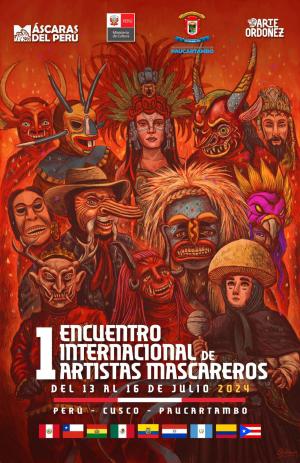
| Awareness raising | The spectacular appearance of the Saqras has made them one of the most visually recognizable elements of the Paucartambo festival. Their masks, elaborate costumes and dramatic movements have attracted photographers, researchers and visitors from Peru and abroad. Yet visual recognition presents a safeguarding challenge. The Saqra should not be reduced to an exotic "devil mask" or an attractive festival costume. The mask is part of a wider system of knowledge involving character, ritual, movement, music, craftsmanship and community identity. Awareness initiatives should therefore explain the cultural logic behind the character and the relationship between the dancer and the mask. They should also distinguish the Saqra from generic representations of devils found in other Andean festivals. The existing work of the Ministry of Foreign Affairs is valuable in this regard because it places the Saqra within Peru's broader masked dance traditions while identifying the distinctive characteristics of the Paucartambo form. | |
| Engagement of communities, groups and individuals as well as other stakeholders | The Saqra Dance is fundamentally community based. The comparsa provides an organized structure through which dancers, musicians, families and other participants collectively maintain the tradition. The participation of established members and new aspirants demonstrates that continuity depends on an active relationship between generations rather than simply on preserving an old choreography. Mask makers are particularly important stakeholders. Although the Saqra Dance is primarily a performing art, its visual identity depends upon specialized knowledge of mask production. This relationship is reinforced by the fact that the Ministry of Culture declared the knowledge and techniques involved in making Paucartambo masks National Cultural Heritage in 2018, recognizing their continuity, social and cultural value and importance to the identity of Paucartambo. This creates an unusually strong safeguarding network between performing arts and craftsmanship. The dancer, mask maker, musician, costume maker, organizer and audience are not independent components: together they create the cultural environment in which the Saqra can exist. | |
| International engagement | The Saqra Dance offers an important case for international research into masked performance, religious festivals and cultural transformation. Its combination of Catholic devotion, Andean symbolism, animal imagery, theatricality and community organization demonstrates how communities can reinterpret inherited religious frameworks through locally meaningful forms. It also provides a valuable comparative case alongside masked traditions elsewhere in the Andes. Comparative research could examine how different communities use masks to represent supernatural beings, social characters, animals, outsiders or moral figures, while avoiding the assumption that all masked "devil" dances share the same meaning. International cooperation could particularly support documentation of the relationship between mask craftsmanship and performance. Paucartambo already possesses nationally recognized knowledge of mask making, making the connection between material and performing heritage an especially strong area for cultural exchange and research. | |
| References |
|
|




.jpeg)

.png)
.jpeg)
.jpg)
.png)
.jpg)


_(31711258567).jpg)