
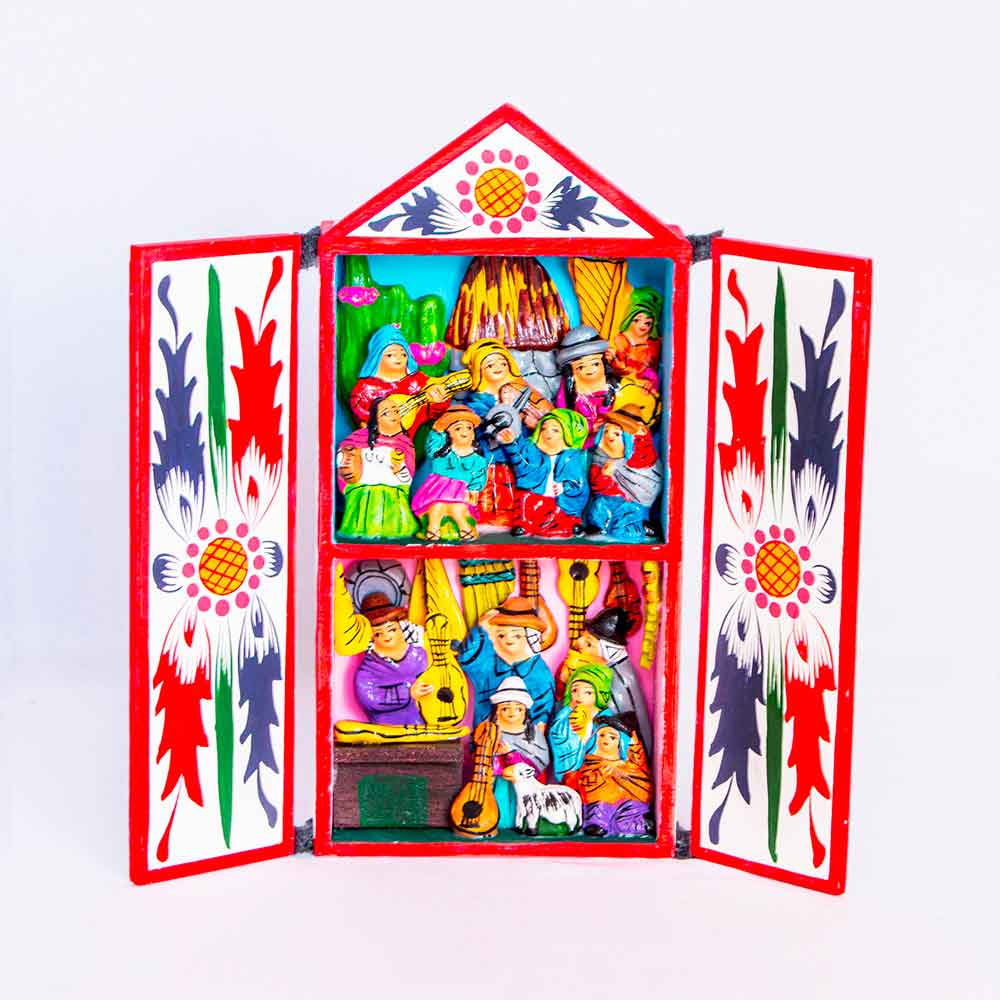
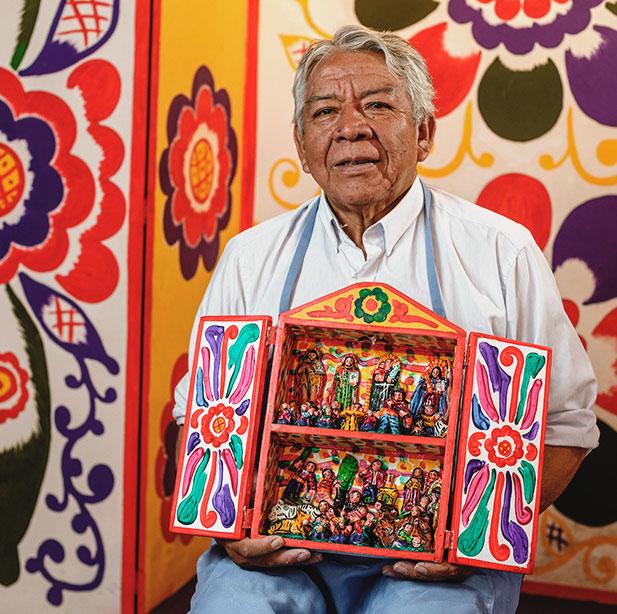
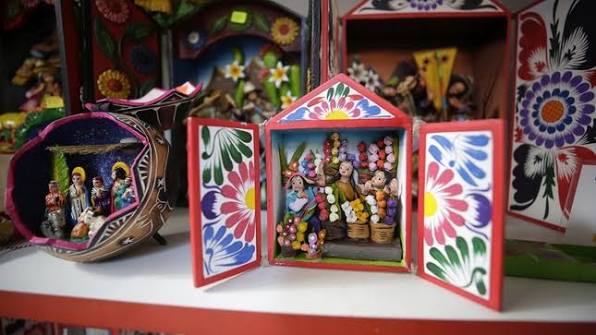
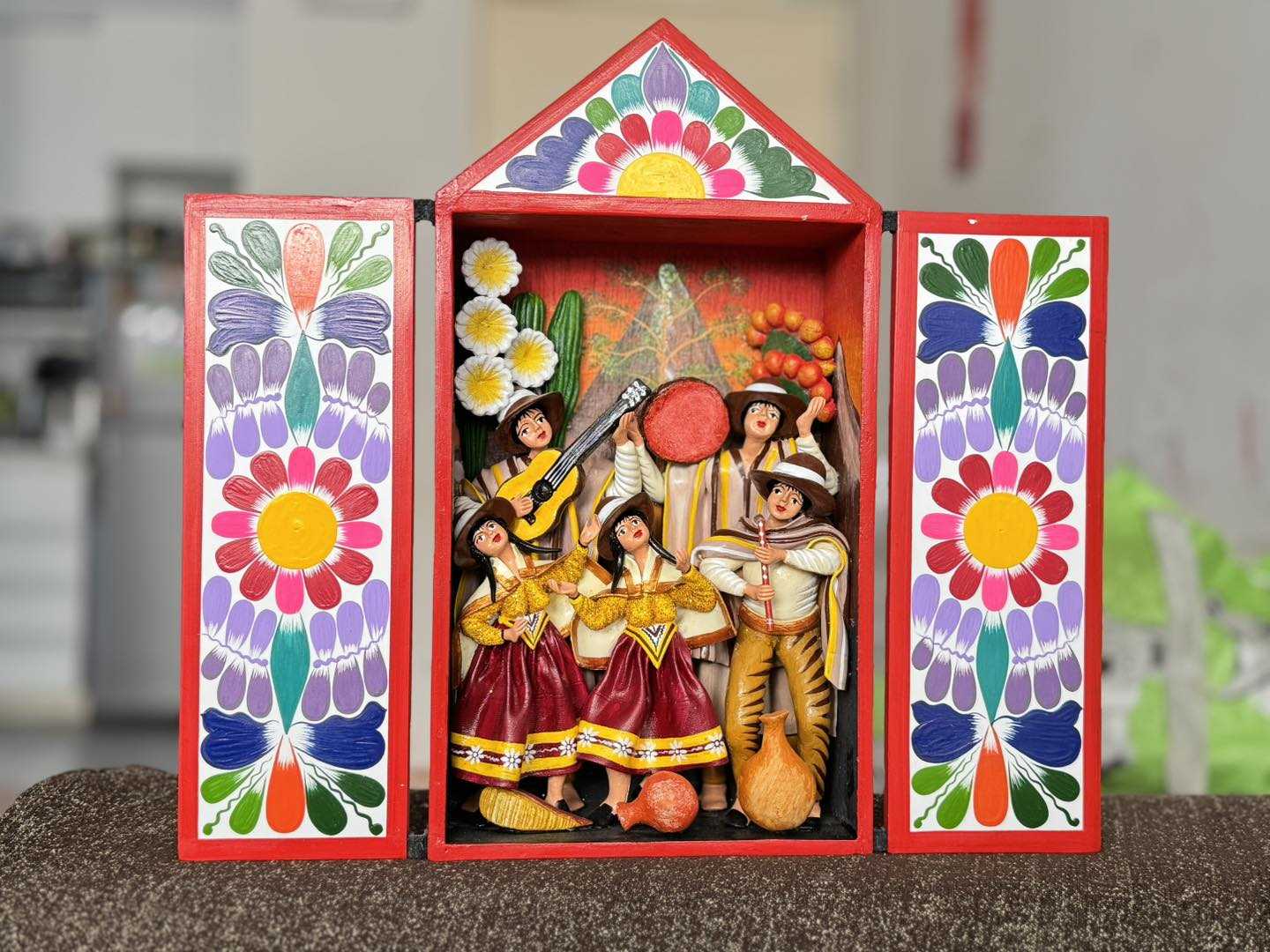
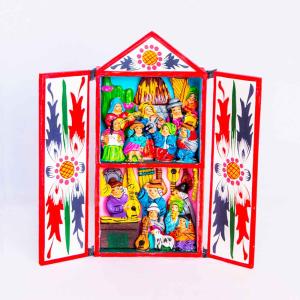
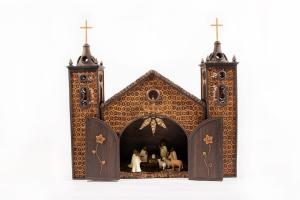
Behind the colorful doors of a retablo ayacuchano lies a miniature world that tells stories of faith, daily life, history, and celebration. These handcrafted wooden boxes, filled with carefully modeled and painted figures, are among the most distinctive artistic traditions of the Ayacucho Region in the central Peruvian Andes. Their origins can be traced to colonial-era portable altars brought by Spanish missionaries, which gradually merged with Indigenous artistic traditions. Over time, local artisans transformed these religious objects into expressive cultural narratives that portray not only sacred themes but also agricultural activities, festivals, family life, markets, and significant historical events.
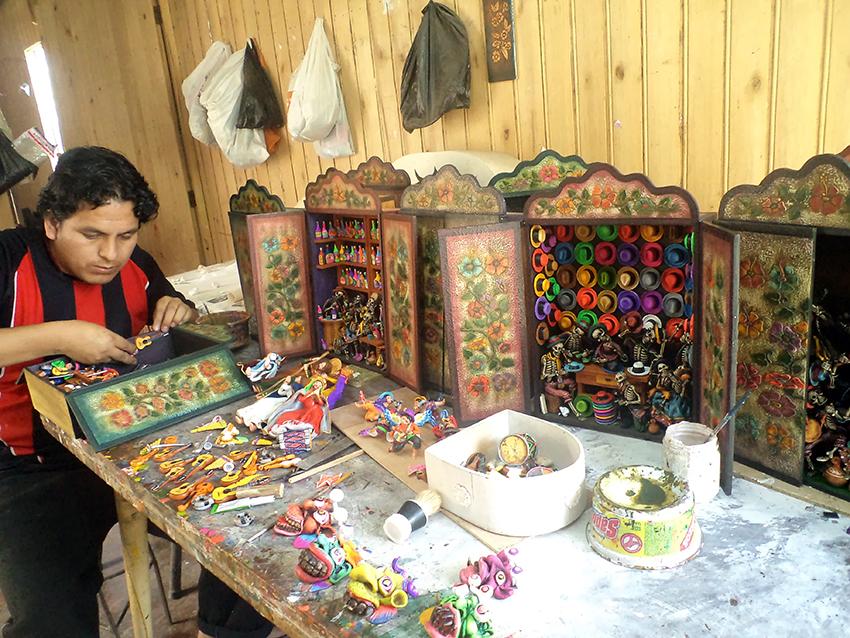
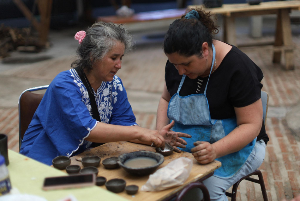
The tradition is maintained by artisan families, craftspeople, apprentices, and local communities, many of whom acquire the necessary skills through years of observation and practical experience. The creation of a retablo involves multiple stages, including woodworking, sculpting miniature figures from a mixture of materials, painting intricate details by hand, and arranging the composition inside the wooden structure. Every element is carefully designed to communicate a story, often incorporating symbolic colors, traditional clothing, local architecture, and regional customs. While some retablos continue to depict Christian scenes associated with religious celebrations, many others document everyday life in the Andes, making each piece a visual record of community traditions and collective memory.
Today, Ayacucho retablo making continues to thrive as both a living artistic tradition and a means of preserving regional identity. Workshops and family studios remain important spaces where craftsmanship, creativity, and cultural knowledge are transmitted across generations. The tradition also contributes to cultural education by providing tangible representations of Andean customs, allowing both local residents and visitors to better understand the diversity of life in the Peruvian highlands. As one of Peru's most recognized forms of traditional craftsmanship, the Ayacucho retablo stands as a testament to the ability of communities to preserve their history and values through artistic expression, ensuring that stories of the past remain visible for future generations.
07-24-2026
| Institutional and human capacities | The safeguarding of the Retablo Ayacuchano Craft Tradition is sustained by artisan families, master retablo makers, apprentices, painters, sculptors, and local cultural communities in the Ayacucho Region. Knowledge is concentrated in family workshops where artistic techniques, narrative composition, and symbolic interpretation are transmitted through continuous collaboration between generations. Cultural institutions, museums, municipalities, and Peru's Ministry of Culture contribute by supporting exhibitions, documentation projects, artisan fairs, and educational initiatives that promote the recognition of the retablo as both a traditional craft and an important expression of Peru's living cultural heritage. | |
| Transmission and education | Learning the retablo tradition is a gradual process that combines artistic training with cultural observation. Apprentices begin by assisting experienced artisans with preparing materials, painting figures, and assembling compositions before progressing to the more demanding tasks of sculpting, designing narratives, and creating complete retablos independently. Education focuses not only on craftsmanship but also on learning how to tell stories visually. Young artisans become familiar with local history, religious celebrations, agricultural life, traditional occupations, and community customs, allowing them to represent these experiences through carefully arranged miniature scenes that preserve collective memory. | |
| Inventorying and research | The Retablo Ayacuchano has been widely studied by anthropologists, art historians, folklorists, and museum specialists because it offers a unique visual record of Andean society. Researchers have documented its historical transformation from colonial devotional altars into complex artistic compositions portraying religious traditions, everyday life, festivals, markets, migration, and important historical events. Recent documentation has also explored how contemporary artisans continue to incorporate new social realities into their work while maintaining traditional techniques and aesthetic principles. This evolving character demonstrates that the retablo remains a living form of cultural expression rather than a static artistic tradition. | |
| Policies as well as legal and administrative measures | Safeguarding measures encourage the preservation of traditional craftsmanship while recognizing the creative freedom that allows artisans to document contemporary community life. Cultural institutions support exhibitions, artisan markets, educational programs, and initiatives that strengthen opportunities for intergenerational learning and public appreciation. Administrative efforts also promote the economic sustainability of artisan workshops by facilitating participation in cultural fairs, museum programs, and heritage promotion activities, helping ensure that traditional craftsmanship continues to provide viable livelihoods for future generations. | |
| Role of intangible cultural heritage and its safeguarding in society | The Retablo Ayacuchano functions as a visual archive of community life. Through miniature scenes, artisans document traditions, ceremonies, occupations, family relationships, and historical events that might otherwise survive only through oral memory. In doing so, each retablo becomes both an artistic creation and a cultural testimony that connects past and present. The tradition also strengthens community identity by transforming everyday experiences into shared cultural narratives. Rather than simply reproducing historical themes, artisans continuously reinterpret their surroundings, allowing the retablo to evolve alongside the communities whose stories it represents while preserving their values, beliefs, and collective memory. | |
| Awareness raising | Exhibitions, museums, artisan fairs, educational workshops, and cultural festivals have significantly expanded public appreciation of the Retablo Ayacuchano. These initiatives encourage audiences to look beyond the intricate craftsmanship and recognize each retablo as a narrative composition that communicates aspects of Andean history, spirituality, and daily life. Digital archives, documentary films, and museum interpretation programs have further contributed to raising awareness by explaining the symbolism of individual figures, the arrangement of scenes, and the historical contexts represented within the retablos, making their cultural significance accessible to wider audiences. | |
| Engagement of communities, groups and individuals as well as other stakeholders | The continuity of the tradition depends on close collaboration among artisan families, apprentices, museums, cultural organizations, educational institutions, collectors, researchers, and local authorities. Family workshops remain the primary spaces for artistic creation, while exhibitions and cultural events provide opportunities for artisans to exchange experiences and present their work to broader audiences. Community participation is also reflected in the subjects represented within the retablos themselves. Festivals, agricultural activities, religious celebrations, and everyday community life continue to inspire new artistic compositions, ensuring that the tradition remains closely connected to the experiences of the people it portrays. | |
| International engagement | The Retablo Ayacuchano has become one of Peru's most recognizable forms of traditional folk art through international museum collections, cultural exhibitions, artisan fairs, and academic research. These exchanges have introduced global audiences to the artistic richness of the Ayacucho Region while highlighting the role of traditional craftsmanship in preserving intangible cultural heritage. Its international presence has also encouraged dialogue among museums, researchers, and heritage professionals regarding the documentation of community memory through visual arts. In this context, the retablo is increasingly appreciated not only as a handcrafted object but also as a sophisticated cultural narrative that communicates the history and identity of Andean communities across generations. | |
| References |
|
|
















.jpeg)



.png)







.jpeg)
.jpg)



.png)
.jpg)


_(31711258567).jpg)