
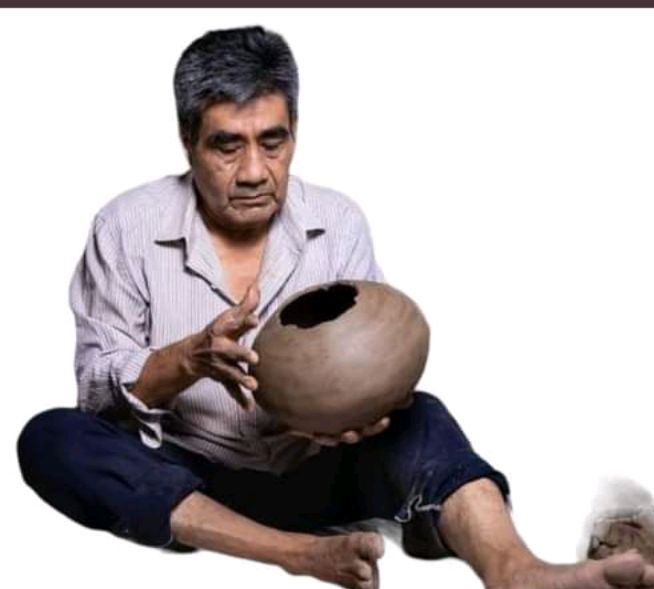

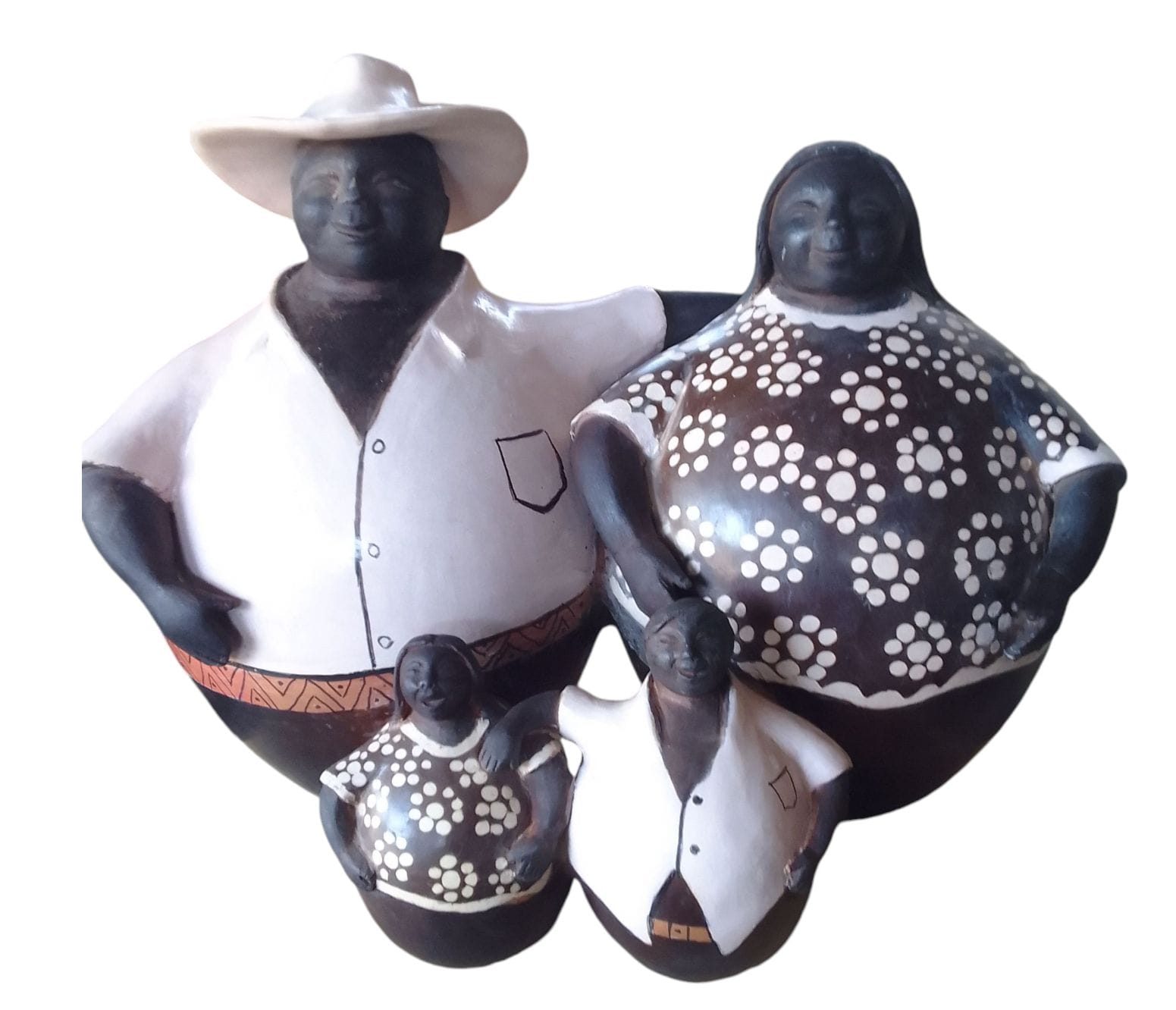
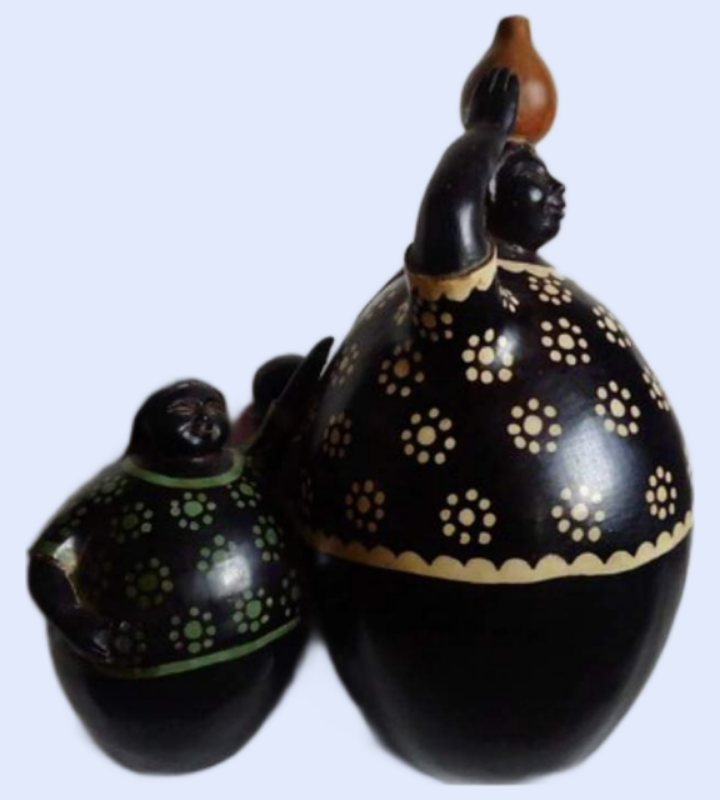
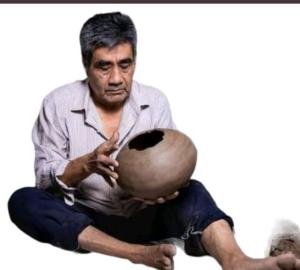
Gerasimo Sosa Alache, master of traditional Peruvian craftsmanship, was born on March 16, 1953, in Chulucanas, Piura, Peru. The son of a potter of Tallán cultural heritage, he learned ceramic techniques from his father, Don Andres Sosa Ruiz, from a very young age, assisting him in the workshop in the production of ceramics for the local community. During his youth, Gerasimo demonstrated artistic talent in drawing and painting through self-taught study, skills that he later applied to ceramic art.
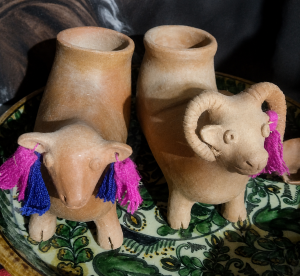
Gerasimo developed a unique ceramic style by shaping pottery into human figures, adding heads and arms to vessels. This sculptural approach was later known as the “Gorditos de Chulucanas,” representing a fundamental reimagining of traditional pottery within a contemporary artistic context.
It is important to note that pottery traditions in northern Peru had entered into decline: people were no longer purchasing clay artifacts, preferring aluminum and iron alternatives; water was no longer stored in large clay containers due to the availability of potable water in households; and, most critically, the potters themselves were aging, losing the physical strength required to continue working, or passing away. As a result, pottery produced using the ancestral techniques of the Tallán people was on the verge of extinction.
Gerasimo transformed this situation, but another challenge remained: the absence of decorative elements, which constitute an essential component of artistic ceramics. It was then that Gloria Joyce, an American nun, introduced him to the concept of negative decoration, as practiced by the ancient Vicús culture, a millenary civilization that flourished in the region. After numerous experiments, Gerasimo successfully rediscovered or recreated the authentic Vicús negative decoration technique used by this culture around 500 BCE.
Today, all artisans in Chulucanas and surrounding areas use the “Vicús Negative Decoration” technique, which has become the defining characteristic of Chulucanas pottery.
05-29-2026
| Institutional and human capacities | Gerasimo Sosa founded the Asociación de Alfareros “Vicus” de Chulucanas (Vicus Potters’ Association of Chulucanas), which later became the Asociación de Cerámica Vicus de Chulucanas (Vicus Ceramics Association of Chulucanas) in 1986 and continues to exist to this day, bringing together numerous ceramic artisans descended from potter families. This association has played a fundamental role in Chulucanas by establishing its official headquarters, now the Centro de Innovación Cerámica de Chulucanas (Ceramic Innovation Center of Chulucanas), and by obtaining the “Denominación de Origen Chulucanas” (Chulucanas Designation of Origin) as well as the designation of “Producto Bandera del Perú” (Flagship Product of Peru). This organizational spirit is also reflected among the artisans themselves: today, there are six (6) artisan associations, two of which are composed exclusively of women. | |
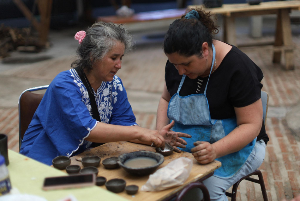
| Transmission and education | Gerasimo Sosa began his work in the workshop located in the house that had belonged to his father. At first, he worked alone, but as his work gained recognition, a neighboring friend joined him as an assistant. Over time, the workshop expanded with the incorporation of more apprentices, giving rise to a new generation of artisans. In addition, he taught ceramics at a private school and trained numerous individuals, not only from Peru, but also from other countries, in mastering the ancestral techniques of Maestro Gerasimo. He has also been contracted to work on ceramic projects at both the national and international levels, including at the Escuela Nacional de Cerámica de Guadalajara (National School of Ceramics of Guadalajara), Mexico. | |
| Inventorying and research | Gerasimo has systematized his knowledge under the name “Los Tres Pasos Básicos del Modelado Escultórico” (“The Three Basic Steps of Sculptural Modeling”). In his practice, he combines this technique with the traditional “paleta y piedra” (“paddle and stone”) method. He has also worked to improve traditional ceramic firing kilns, which were originally built in cavities in the ground and are now considered inadequate for achieving higher-quality ceramic firing. | |
| Policies as well as legal and administrative measures | The Peruvian State enacted the Law on Artisans and the Development of Artisanal Production with the aim of promoting and encouraging the growth of the artisanal sector throughout the country. This was carried out through the National Council for the Promotion of Artisanship (CONAFAR), the Regional Councils for the Promotion of Artisanship (COREFAR), and the Local Councils for the Promotion of Artisanship (COLOFAR). I actively participated in the presentation and defense of the draft law before the Congress of the Republic. The law was approved and remains the current legal framework governing this important sector. In the Provincial Municipality of Morropón-Chulucanas, the current mayor is promoting tourism and giving significant importance to Chulucanas ceramics. In the renovated Plazuela del Km 50, a sculpture of me has even been installed. In addition, the Gerasimo Sosa Medal for Artisanal Excellence has been established, with the purpose of granting it annually to young ceramic artists of the new generations | |
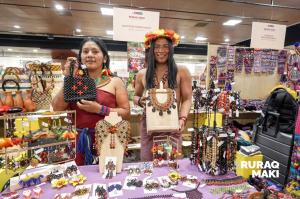
| Role of intangible cultural heritage and its safeguarding in society | In Lima, the Ruraq Maki Fair is held every year, bringing together, through a selection process, the most representative artisans from each region of Peru. Gerásimo Sosa participates in this fair to exhibit and sell his work as an Amauta of Peruvian Artisanship and as a recipient of the Joaquín López Antay Medal. For this reason, the art of Chulucanas ceramics, developed through ancestral Vicús and Tallán techniques, can be considered protected and safeguarded. | |
| Awareness raising | In Chulucanas, until around 1970, only traditional pottery existed. The potters who had come from Simbilá and settled in Chulucanas, including Mr. Andrés Sosa Ruiz, Gerásimo’s father, saw their craft gradually decline. With the arrival of aluminum and iron utensils, as well as access to running water in homes, clay objects slowly began to disappear, and pottery was heading toward extinction. Gerásimo rescued the Vicús decorative technique and adapted pottery to an artistic context. His work became an example of how traditional pottery, as well as lost techniques, could be successfully recovered. At first, Gerásimo worked alone. Later, close relatives, including his sisters and nephews, joined him. Over time, young descendants of potters also became involved. Today, there are ceramic artists who do not come from artisan families but who possess artistic skills and have turned ceramics into an economic activity. | |
| Engagement of communities, groups and individuals as well as other stakeholders | The local population is vividly represented in the ceramics of Chulucanas: the vessels, in figurative form, clearly portray the inhabitants of the region, who are generally characterized by short stature and robust physiques. Even when these pieces depict dances, customs, agricultural activities, or other everyday practices, they subtly convey the community’s deep connection to their homeland. Most importantly, Chulucanas has gained international recognition; today, the town is proudly known as the “Land of Mangoes, Lemons, and Ceramics.” | |
| International engagement | The Municipality of Chulucanas is deeply committed to promoting its ceramic heritage. It not only supports the development of handicrafts by fostering tourism through the creation of spaces dedicated to ceramic art, but, in coordination with CITECERÁMICA and the Ministerio de Comercio Exterior y Turismo (MINCETUR) (Ministry of Foreign Trade and Tourism), it is also promoting these crafts in other remote areas where traditional craftsmanship has long flourished with limited institutional support, thanks primarily to the efforts of local artisans from Chulucanas. In addition, various local associations actively participate in these initiatives. Chulucanas ceramics have already secured a place on the international stage, and their reputation generates pride not only for local and regional communities, but also for artisans throughout the country. For them, these ceramics are not merely a means of livelihood, but also an expression of cultural identity. For this reason, they remain committed to continuing their work and refining their craft in order to preserve the excellence of their ceramic pieces within the global arena. | |
| References | -Feria Ruraq Maki, San Borja-Lima. -Peruvian Craft Heritage 2000, MINCETUR-Lima. -Joaquin López Antay Medal. Congress of the Republic – Lima. -Preemio Esteban Campodónico Figallo, University of Piura-Piura. -"Beloved Son of Chulucanas" – Chulucanas. -"El Barro Unió: The Art and Technology of Chulucanas" – CIPCA-Piura Social Media:
|
|












.jpeg)

.png)





.jpeg)
.jpg)


.png)
.jpg)


_(31711258567).jpg)