

.mp4_thumbnail.png)
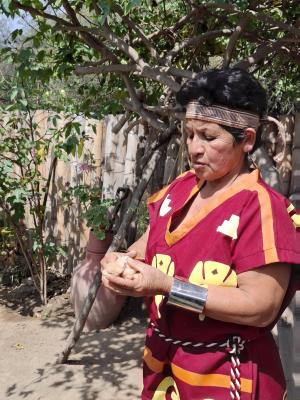
Gerald Valdez, a 49-year-old artisan, was born in the district of Tingo, located in the Amazonas region, an area that hosts one of Peru’s most important cultural heritage landmarks: the Kuélap Fortress. His work is deeply connected to the natural environment, particularly to walnut tree ecosystems, which have shaped both his personal and professional trajectory since an early age. In the productive sphere, he specializes in the transformation of walnut seeds, a resource that was previously undervalued and considered waste. Through an approach grounded in circular economy principles and environmental sustainability, he has successfully revalorized this material, transforming it into artisanal pieces of high aesthetic and cultural value. This process not only contributes to waste reduction but also promotes the responsible use of natural resources. Furthermore, he carries out significant educational and community outreach work by delivering workshops and lectures in rural schools. Through these initiatives, he fosters the transmission of traditional knowledge and the strengthening of skills among younger generations, encouraging sustainable practices and the recognition of the economic and environmental potential of local resources. Additionally, he promotes concrete ecological restoration actions through the cultivation and planting of walnut seedlings. To date, he has achieved the distribution of approximately 1,550 walnut seedlings across various areas of the Amazonas region, thereby contributing to ecosystem recovery, biodiversity conservation, and the mitigation of environmental impacts. Overall, his work integrates environmental conservation, artisanal innovation, and community education, positioning him as a local reference for sustainable development.
05-01-2026
| Institutional and human capacities | education within rural communities of the Amazonas region. His work is centered on the intergenerational transfer of artisanal techniques associated with the use and transformation of walnut-based resources, ensuring the continuity of local cultural practices while adapting them to contemporary sustainability challenges. Through the organization of workshops, practical sessions, and educational talks in rural schools, he creates participatory learning environments that combine theory and hands-on experience. These spaces enable students to acquire technical skills in artisanal production, while also fostering critical awareness regarding environmental conservation, resource management, and the value of local biodiversity. Moreover, his pedagogical approach emphasizes experiential learning and community engagement, encouraging students to recognize the economic, cultural, and ecological potential of their immediate surroundings. By integrating traditional knowledge with principles of sustainable development, he contributes to the formation of environmentally responsible attitudes and the strengthening of local identity among younger generations. In addition, his educational initiatives support the development of entrepreneurial capacities, motivating participants to explore sustainable livelihood opportunities based on locally available resources. This not only enhances individual skills but also contributes to the resilience and socio-economic development of rural communities. Overall, his work in transmission and education constitutes a key pillar in preserving intangible cultural heritage, while simultaneously promoting sustainability, innovation, and community empowerment. resumelo a 2 parrafosGerald Valdez is a key figure in the Amazonas region, dedicated to the intergenerational transmission of traditional artisanal techniques, specifically the sustainable use of walnut. Through participatory workshops and educational sessions in rural schools, he blends theory with hands-on experience to teach technical skills while fostering environmental consciousness and a deep appreciation for local biodiversity among younger generations.His pedagogical approach emphasizes experiential learning to help students recognize the economic and ecological potential of their surroundings, strengthening their local identity. Furthermore, these initiatives promote entrepreneurial capacities and sustainable livelihood opportunities, positioning Valdez's work as a vital pillar for preserving cultural heritage and empowering rural communities through innovation and environmental stewardship. | |
| Transmission and education | education within rural communities of the Amazonas region. His work is centered on the intergenerational transfer of artisanal techniques associated with the use and transformation of walnut-based resources, ensuring the continuity of local cultural practices while adapting them to contemporary sustainability challenges. Through the organization of workshops, practical sessions, and educational talks in rural schools, he creates participatory learning environments that combine theory and hands-on experience. These spaces enable students to acquire technical skills in artisanal production, while also fostering critical awareness regarding environmental conservation, resource management, and the value of local biodiversity. Moreover, his pedagogical approach emphasizes experiential learning and community engagement, encouraging students to recognize the economic, cultural, and ecological potential of their immediate surroundings. By integrating traditional knowledge with principles of sustainable development, he contributes to the formation of environmentally responsible attitudes and the strengthening of local identity among younger generations. In addition, his educational initiatives support the development of entrepreneurial capacities, motivating participants to explore sustainable livelihood opportunities based on locally available resources. This not only enhances individual skills but also contributes to the resilience and socio-economic development of rural communities. Overall, his work in transmission and education constitutes a key pillar in preserving intangible cultural heritage, while simultaneously promoting sustainability, innovation, and community empowerment. resumelo a 2 parrafosGerald Valdez is a key figure in the Amazonas region, dedicated to the intergenerational transmission of traditional artisanal techniques, specifically the sustainable use of walnut. Through participatory workshops and educational sessions in rural schools, he blends theory with hands-on experience to teach technical skills while fostering environmental consciousness and a deep appreciation for local biodiversity among younger generations.His pedagogical approach emphasizes experiential learning to help students recognize the economic and ecological potential of their surroundings, strengthening their local identity. Furthermore, these initiatives promote entrepreneurial capacities and sustainable livelihood opportunities, positioning Valdez's work as a vital pillar for preserving cultural heritage and empowering rural communities through innovation and environmental stewardship. | |
| Inventorying and research | Gerald Valdez has developed a systematic approach to identifying and documenting walnut-based resources in the Amazonas region, creating an inventory that highlights the ecological and cultural value of these ecosystems. Through empirical research and continuous observation, he has transformed previously underutilized seeds into innovative artisanal products. His work not only preserves traditional techniques but also systematizes production processes, ensuring that this local knowledge can be accurately transmitted and replicated.His research integrates environmental criteria by linking technical innovation with sustainable resource management and walnut reforestation initiatives. By engaging with innovation programs and institutional networks, Valdez has incorporated new methodologies that strengthen the connection between biodiversity conservation and local economic development. Ultimately, his efforts safeguard ancestral knowledge while promoting a sustainable economy rooted in respect for the region's natural environment. | |
| Policies as well as legal and administrative measures | Gerald Valdez aligns his work with national and regional policies focused on sustainable development, cultural heritage safeguarding, and the strengthening of Peru's artisanal sector. His initiatives operate within legal frameworks for production, entrepreneurship, and environmental management, ensuring the legitimacy and long-term sustainability of his projects. Through formalization and continuous training, Valdez ensures his activities not only meet commercial standards but also actively support public strategies for ecosystem conservation.Furthermore, his work drives the practical implementation of circular economy policies by repurposing organic materials like walnut seeds and promoting responsible resource management. His reforestation efforts and educational programs in rural communities bring to life state goals regarding intercultural education and biodiversity protection. Overall, his career demonstrates an effective integration between grassroots initiatives and institutional frameworks, making him a key actor in regional development and the preservation of local identity. | |
| Role of intangible cultural heritage and its safeguarding in society | Gerald Valdez stands out as a fundamental figure in safeguarding intangible cultural heritage in the Amazonas region, focusing on the revalorization of traditional knowledge linked to walnut trees. His work innovatively integrates tradition with circular economy principles and sustainable design, ensuring that ancestral techniques remain relevant and functional in the face of contemporary challenges. Additionally, his reforestation efforts secure the continuity of the ecosystems that sustain these practices, strengthening the bond between cultural identity and environmental conservation.As a community educator, Valdez ensures the intergenerational transmission of this knowledge through workshops in rural schools, where he fosters a sense of belonging and pride in local resources among young people. By transforming natural materials into artisanal products with commercial value and cultural significance, he dignifies traditional expertise and creates opportunities for sustainable development. Overall, his leadership not only preserves the region's intangible legacy but also turns it into a dynamic engine for social strengthening and economic resilience. | |
| Awareness raising | Gerald Valdez plays a crucial role in social awareness by promoting the connection between culture, nature, and sustainable development in the Amazonas region. Through workshops and practical demonstrations in rural communities, he educates new generations on the responsible use of walnut seeds, transmitting not only artisanal techniques but also fundamental values of environmental respect and cultural identity. His work successfully transforms social perception regarding local resources, turning previously ignored materials into symbols of economic and ecological value under circular economy principles.This commitment acts as a driver for change that strengthens community participation and motivates society to adopt more conscious production and consumption models. Valdez’s example creates a multiplier effect that transcends the individual, driving collective actions for conservation and cultural preservation. Ultimately, his work not only safeguards intangible heritage but also builds a collective consciousness oriented toward a more inclusive, sustainable future that respects the natural environment. | |
| Engagement of communities, groups and individuals as well as other stakeholders | Gerald Valdez bases his work on a participatory model that actively integrates rural communities, students, and various institutions into the value chain of his artisanal production. By purchasing walnut seeds from local families, he transforms a previously underutilized resource into a complementary source of income, fostering a circular economy based on mutual benefit. This approach is reinforced through workshops and pedagogical activities involving teachers and youth, strengthening a sense of shared responsibility for heritage protection and environmental conservation.On a strategic level, his active participation in institutional networks, fairs, and training programs allows him to connect local initiatives with broader platforms for visibility and collaboration. This collaborative model not only ensures the region's economic sustainability but also positions intangible cultural heritage as a central axis for territorial development. By combining tradition with collective innovation, Valdez ensures that safeguarding culture and caring for the ecosystem become a shared effort among diverse social actors. | |
| International engagement | Gerald Valdez’s work aligns with international frameworks such as the 2003 UNESCO Convention by prioritizing intergenerational transmission and the safeguarding of living heritage. His approach integrates tradition with the Sustainable Development Goals (SDGs), particularly in areas like responsible production, quality education, and ecosystem conservation. By linking ancestral practices with global standards, Valdez demonstrates that local initiatives are essential for protecting cultural diversity and mitigating environmental impact on a broader scale.Through his participation in innovation forums and artisanal promotion networks, he projects his expertise toward national and international spheres, fostering the exchange of best practices. His work proves that the protection of intangible heritage and sustainability are not isolated efforts but interconnected processes that promote universal values. Ultimately, Valdez stands as a model of how local commitment can significantly contribute to global agendas for human development and social responsibility. | |
| References | (2003). Convention for the Safeguarding of the Intangible Cultural Heritage. United Nations (2015). Sustainable Development Goals (SDGs). Ministry of Culture of Peru. Policies, regulations, and technical documents on intangible cultural heritage and the promotion of craftsmanship. Ministry of Environment of Peru. Guidelines on environmental sustainability, biodiversity conservation, and reforestation. Ministry of Foreign Trade and Tourism of Peru. Strategies for the development of the artisanal sector and promotion of local products. United Nations Development Programme. Reports on sustainable development, circular economy, and local capacity building. National platform for the promotion of traditional Peruvian craftsmanship. Center for Technological Innovation in Craftsmanship and Tourism. Programs for training, innovation, and artisanal development. National Institute of Statistics and Informatics. Socioeconomic data on rural communities and productive sectors. Academic repositories and technical documents on cultural heritage, sustainability, and circular economy in rural contexts. Empirical experience, personal trajectory, and fieldwork of Gerald Valdez in communities of the Amazonas region (primary source). Testimonials from beneficiaries, rural educational institutions, and local actors linked to his activities. |
|

















.jpeg)




.png)


.jpeg)

.jpg)


.png)
.jpg)


_(31711258567).jpg)