
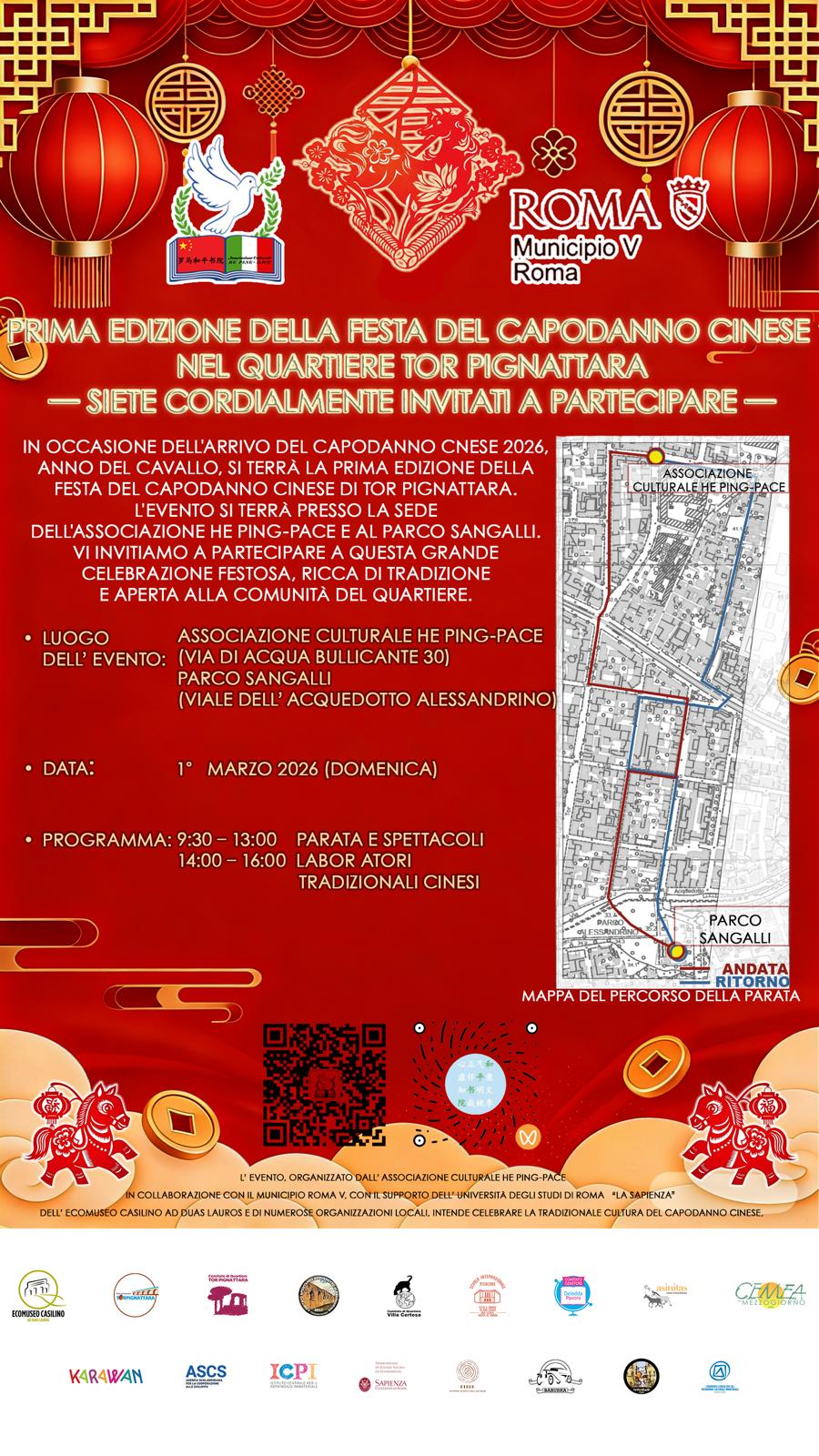
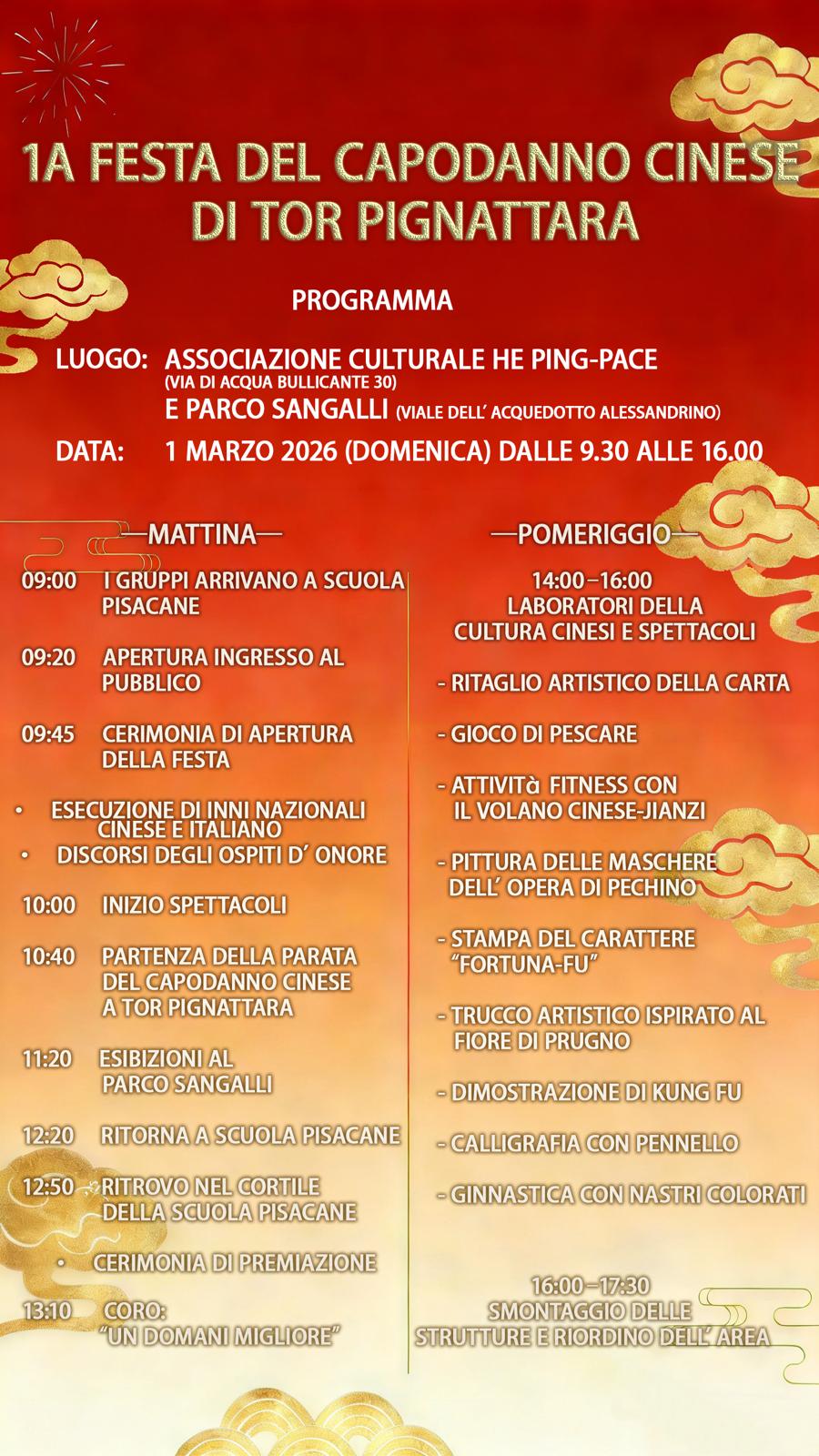
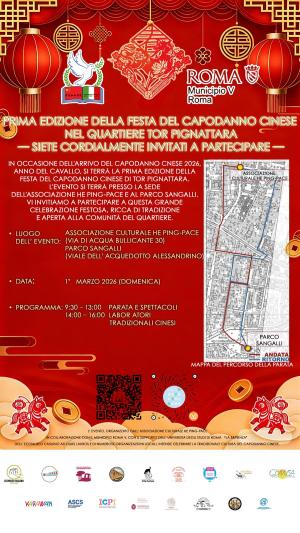
On March 1, 2026, from 9:30 a.m. to 4:00 p.m., the neighborhood of Tor Pignattara in Municipio Roma V (Rome) will host the first edition of the “Chinese New Year of Tor Pignattara”, a community-led intercultural event that reinterprets the Chinese New Year as a shared urban heritage and a tool for social cohesion.
Recognized by UNESCO as Intangible Cultural Heritage of Humanity, the Chinese New Year is here presented not only as a festive celebration, but as a living cultural practice embedded in everyday urban life, capable of fostering dialogue, inclusion, and collective belonging within one of Rome’s most historically multicultural areas.
A community-based intercultural parade
The event takes the form of a participatory parade starting from the historic Carlo Pisacane school complex and moving through the streets of Tor Pignattara. It is conceived and coordinated by Xiaoyan Zhou, Director of the HE PING – PACE Association, with the active involvement of local schools, associations, residents, and cultural actors.
Unlike large-scale spectacular parades, the Chinese New Year of Tor Pignattara is grounded in a grassroots approach, where public space becomes a shared arena for cultural exchange. The neighborhood itself acts as a living framework in which Chinese and Italian cultural expressions intersect, are negotiated, and collectively reimagined.
“This parade is not a performance to be watched, but a shared experience to be lived,” explains Xiaoyan Zhou.
“The street becomes an open space of dialogue, where cultural practices foster mutual recognition and everyday coexistence.”
Plurality as a shared urban condition
In a neighborhood shaped by decades of migration and cultural plurality, the initiative aims to challenge narratives of fear or cultural separation. Instead, it affirms diversity as an ordinary and constitutive element of contemporary urban life.
Through music, dance, colors, and collective participation, the Chinese community presents itself as an integral and active component of Roman civic life, contributing to the social, cultural, and symbolic vitality of the area. The celebration thus becomes a powerful tool for normalizing plurality and strengthening social bonds.
Institutional, academic, and cultural collaboration
The event is supported by Municipio Roma V, with the involvement of the Department of Social and Economic Studies (DISSE) of Sapienza University of Rome and the Central Institute for Intangible Heritage (ICPI). This collaboration highlights the value of integrated approaches that connect institutions, academia, and community-based organizations in addressing urban complexity.
A first outcome of the Intangible Cultural Heritage Advisory Body
The Chinese New Year of Tor Pignattara represents the first concrete outcome of the Intangible Cultural Heritage Advisory Body of Municipio Roma V, recently established to support communities of practice in the promotion and safeguarding of living heritage.
Through the joint action of ICPI, DISSE, Municipio Roma V, and the Ecomuseo Casilino ad Duas Lauros, the advisory body has adopted an enabling approach: leaving communities in charge of curating their cultural practices, while facilitating institutional coordination and overcoming organizational and administrative barriers.
An urban model for living heritage
By integrating intangible cultural heritage into local governance, intercultural dialogue, and community development, the Chinese New Year of Tor Pignattara offers an experimental model for contemporary cities. It demonstrates how living traditions, when shared and collectively curated, can become drivers of inclusion, recognition, and social innovation.
Boilerplate – Institutional Information
Ecomuseo Casilino ad Duas Lauros
The Ecomuseo Casilino ad Duas Lauros is a community-based cultural institution operating in eastern Rome (Municipio Roma V). It promotes the recognition, safeguarding, and enhancement of both tangible and intangible heritage through participatory processes, intercultural dialogue, and territorial networks. The Ecomuseo works at the intersection of heritage, social innovation, education, and community empowerment, fostering shared stewardship of local cultural resources.
Municipio Roma V – City of Rome
Municipio Roma V is one of the administrative districts of the City of Rome, characterized by a rich social and cultural diversity. The Municipality actively supports initiatives that promote social cohesion, cultural participation, and inclusive urban development, with particular attention to community-based heritage practices.
Central Institute for Intangible Heritage (ICPI)
The Central Institute for Intangible Heritage is a national body of the Italian Ministry of Culture dedicated to the study, safeguarding, and promotion of intangible cultural heritage, in line with the UNESCO 2003 Convention.
Department of Social and Economic Studies (DISSE) – Sapienza University of Rome
DISSE conducts research and educational activities on social, economic, and cultural transformations, with a focus on urban studies, migration, and community-based cultural processes.
● Event Summary
| Title | Chinese New Year in Tor Pignattara: An Intercultural Community Celebration Rooted in Living Heritage | ||
|---|---|---|---|
| Place | ITALY | ||
| Start Date | 2026-03-01 | End Date | 2026-03-01 |


-2.jpg)
.png)






 (40 x 60 cm).png)
.jpg)

.jpg)


.PNG)


(2021-12-17.png)













.jpeg)


.png)


.jpg)


.jpg)